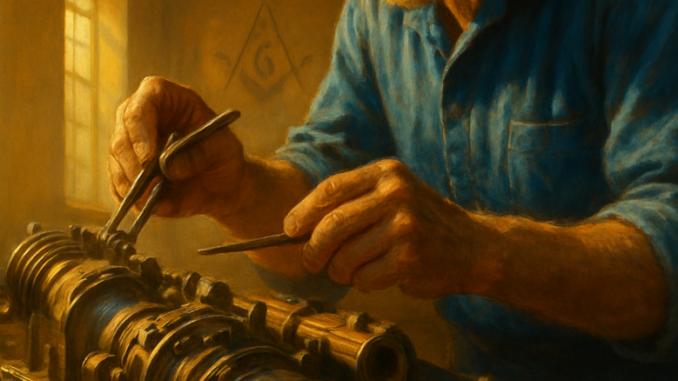
Imagine stepping onto an aircraft, trusting that every bolt, every cable, every engine has been meticulously inspected by someone who has mastered their craft to its very core. That trust is no small thing. The recent news that KLM’s engineering and maintenance division has been placed under heightened regulatory oversight since May touches on something fundamental: the question of who we are when no one is watching — and how our daily work shapes the person we become.
When Oversight Becomes a Mirror
Heightened oversight sounds like a punishment, but there is another way to look at it. It is a moment of confrontation with a simple yet profound question: are we doing what we promised? Are we living up to the standards we set for ourselves? For an aircraft mechanic, this is literally a matter of life and death. For the rest of us, the stakes may be subtler — but they are no less real.
In Freemasonry, we call this working on the rough ashlar. Every Brother enters the lodge as unfinished material, full of rough edges and imperfections. The goal is not to achieve perfection but to work consciously and deliberately on oneself. That work doesn’t happen only during rituals or lodge meetings. It happens precisely when no one is watching — in the quiet, everyday choices we make.
The Mechanic as a Metaphor for Inner Work
You probably recognise the feeling: you do something just a little less carefully because you’re in a hurry, because no one will notice, because it’s “good enough.” An aircraft mechanic who thinks this way puts lives at risk. But in our own lives, that same attitude carries consequences too — even if they’re less visible.
Johann Wolfgang von Goethe, himself a Freemason, wrote about the importance of completing what you begin. Not for the outside world, but for your own soul. Every unfinished task, every half-hearted effort leaves a trace in who you are. The mechanic who treats every fastener with full attention isn’t just shaping the aircraft — he is shaping himself.
Craftsmanship is not merely a technique you learn; it is a character you develop by performing every action with full and deliberate attention.
Responsibility Without an Audience
KLM’s heightened oversight didn’t come out of nowhere. Somewhere along the line there were signals — deviations from the standard, moments when the bar wasn’t met. That is human. The real question is never whether we fail, but how we respond to that failure.
In the lodge, Brethren work with the concept of the level: the idea that all people stand on equal ground and that honesty begins with oneself. When you make a mistake and hide it, you create a distortion in your own foundation. When you acknowledge and correct it, you actually strengthen that foundation.
Marcus Aurelius, the Roman emperor and Stoic philosopher, wrote in his private meditations that the quality of your life is determined by the quality of your thoughts. His deeper point was that integrity is not a performance you put on for others — it is an inner state you cultivate, day by day, thought by thought.
The Toolbox of the Soul
A mechanic has physical tools: wrenches, gauges, technical manuals. A Freemason has symbolic tools: the square for righteousness, the compasses for balance and restraint, the gavel for willpower. Both sets of tools serve the same ultimate purpose — to build something that endures.
The square reminds us that our actions must be upright and just. The compasses teach us to respect boundaries and seek equilibrium. The gavel symbolises the strength to act, not merely to think.
When an organisation is placed under heightened scrutiny, it is really an invitation to open the toolbox and examine which instruments have been neglected. Not as a punishment, but as an opportunity for renewed attention and care.
Trust as a Foundation
What the KLM story ultimately tells us is a story about trust. Passengers trust that mechanics do their work properly. Mechanics trust that their colleagues uphold the same standard. And society trusts that companies honour their commitments.
That trust is fragile. It is built through thousands of small moments of reliability, and it can be shattered in a single moment of negligence. This is why Freemasonry speaks so much about brotherhood — the awareness that your actions don’t affect only yourself, but the entire community of which you are a part.
Your Own Maintenance Check
Perhaps this is the right moment to ask yourself: where in my life is heightened oversight needed? Not from an external authority, but from within. Which corners of your daily conduct deserve more attention? Where have you settled for “good enough” when what you really aspire to is craftsmanship?
This isn’t about perfectionism or self-punishment. It is about recognising that who you are is shaped by what you do — especially when no one is watching. The rough ashlar is not hewn in a single day. But every day that you consciously take up the chisel, the form hidden within the stone comes a little closer to the surface.
The news about KLM’s maintenance division is more than a business headline. It is an invitation to reflect on craftsmanship, responsibility, and the quiet formation of character. Whether you maintain aircraft or tend to your own life, the question remains the same: are you the person you want to be, even when no one is looking? In the honest answer to that question lies the beginning of true growth.
Copyright text & image: devrijmetselaar.nl
Texts are based on the ideas and content of the author of devrijmetselaar.nl, reviewed, corrected, and supplemented with the assistance of OpenAI. Images are created based on the ideas of the author of devrijmetselaar.nl using OpenAI/DALL-E.
Frequently Asked Questions
What does Freemasonry mean by 'working on the rough ashlar'?
In Freemasonry, the rough ashlar represents an unfinished stone that symbolizes each member when they first enter the lodge. Working on the rough ashlar means consciously and deliberately improving oneself through daily choices and actions, not just during lodge meetings. This personal development is a core principle of Freemasonry that shapes one's character over time.
How does the concept of craftsmanship relate to Masonic teachings?
Craftsmanship in Freemasonry extends beyond technical skill—it represents the development of character through deliberate attention and integrity in every action. When a Mason approaches their work with full consciousness and care, they are simultaneously shaping both their external accomplishments and their inner self. This principle teaches that how we do our work when no one is watching reveals and defines who we truly are.
What is the Masonic concept of 'the level' and how does it relate to responsibility?
The level in Freemasonry symbolizes the principle that all people stand on equal ground and that true honesty must begin with oneself. This concept emphasizes personal accountability and the importance of acknowledging mistakes rather than hiding them. When Masons take responsibility for their actions without requiring external oversight, they strengthen their own integrity and the trust within their community.
Why do Freemasons emphasize integrity when 'no one is watching'?
Freemasonry teaches that true character is revealed through actions taken in private, away from judgment or recognition. A Mason's personal integrity when unsupervised directly shapes who they become as a person, far more than their public reputation. This principle reflects the belief that inner development and moral consistency are the foundation of genuine personal growth and respect.
How does Freemasonry view the purpose of oversight and scrutiny?
Rather than viewing oversight as punishment, Freemasonry sees it as an opportunity for self-reflection and recommitment to one's values and standards. Heightened scrutiny invites individuals to honestly examine whether they are living up to the promises they have made to themselves and others. This perspective transforms oversight into a positive catalyst for personal accountability and strengthened character.




Be the first to comment