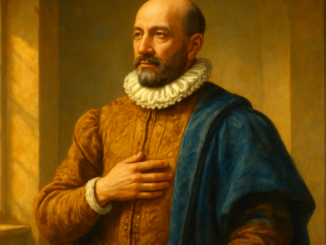
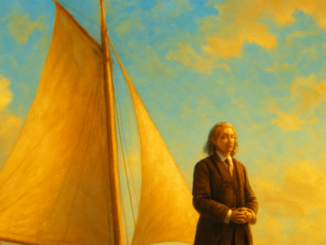
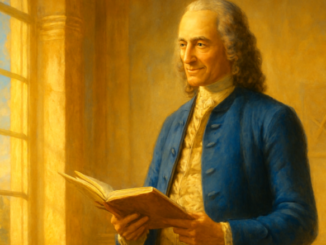
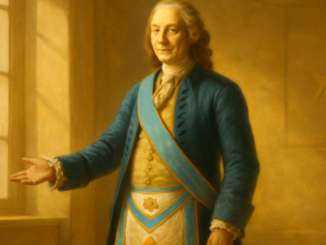
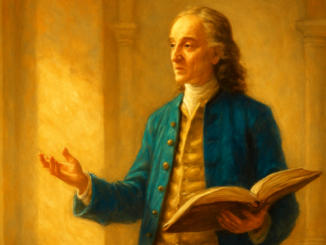
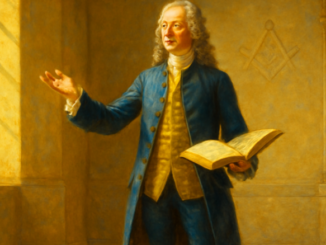
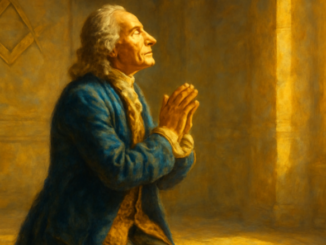
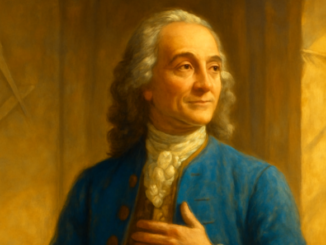
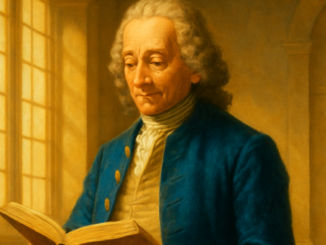
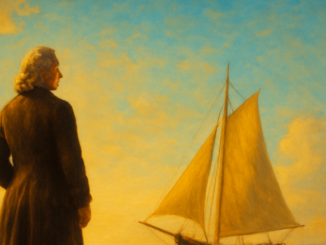
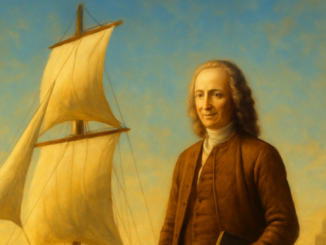
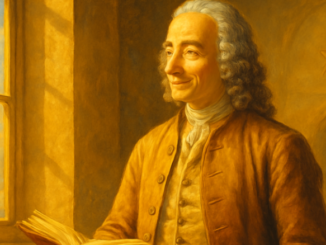
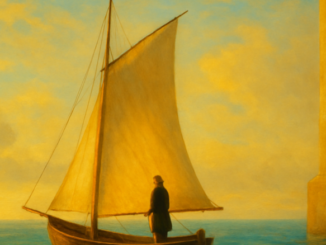
Voltaire writing by candlelight symbolizing Enlightenment tolerance and reason
Symbolism & Rituals

Voltaire and the Calas Affair: Philosophical Roots of Tolerance

In 1762, the Protestant merchant Jean Calas was executed in Toulouse on charges of murdering his own son. The trial was steeped in religious prejudice and judicial arbitrariness. Voltaire, deeply shaken by this judicial scandal, took up his pen and wrote his celebrated Traité sur la tolérance — Treatise on Tolerance. Yet this was no impulsive reaction. It was the culmination of centuries of philosophical thought on tolerance, reason, and human dignity. The intellectual heritage behind this essay reveals deep roots that continue to resonate in the principles of Freemasonry to this day. The Stoic Legacy: Universal Humanity The deepest roots of Voltaire’s thinking on tolerance reach back to the Stoic philosophy of antiquity. Thinkers such as Seneca, Epictetus, and Marcus Aurelius developed the concept of the cosmopolis — a world community in which all human beings share in the same universal reason. For the Stoics, every person, regardless of origin or creed, carried a divine spark within. Seneca wrote in his letters to Lucilius that we are all members of one great body and that nature has brought us forth as kindred. This idea formed a foundation upon which later arguments for tolerance could be built. Voltaire was an […]

Symbolic contrast of light and darkness representing Voltaire and Pascal
Symbolism & Rituals

Voltaire vs Pascal: Two Visions of Human Nature

In his fifth Philosophical Letter, Voltaire took aim at one of the seventeenth century’s most influential thinkers: Blaise Pascal. Where Pascal saw humanity as a wretched creature lost between infinity and nothingness, Voltaire offered a radically different portrait. This was no dry academic dispute — it was a collision between two worlds: Jansenist pessimism and the rising confidence in human reason and progress. For the Freemason, who seeks light in the darkness and the elevation of the human spirit, this confrontation offers surprisingly relevant insights. The Intellectual World of Voltaire To understand Voltaire’s critique of Pascal, we must first understand the intellectual sources that shaped him. Voltaire was a child of the early Enlightenment, deeply influenced by the English empiricists John Locke and Isaac Newton. During his exile in England, he discovered an intellectual climate that was radically different from the dogmatic atmosphere of France. Locke’s idea that the human mind begins as a blank slate stood in direct opposition to Pascal’s notion of humanity stained by original sin. Newton demonstrated that the universe obeyed comprehensible laws rather than impenetrable mysteries. Voltaire also drew from the skeptical tradition of Michel de Montaigne, whose essays he studied closely. Montaigne’s gentle doubt […]

Reeds bending in wind symbolising Voltaire and Pascal philosophical dialogue
Symbolism & Rituals

Voltaire on Pascal: The Fifth Philosophical Letter Explored

A thinking reed. With this single image, Blaise Pascal captured the human condition — insignificant amid the vastness of the universe, yet elevated by the capacity for thought. Voltaire read these words and felt compelled to respond. In his fifth philosophical letter, he enters into dialogue with a thinker who both fascinated and unsettled him. The result is a text that still invites profound reflection: is humanity truly as wretched as Pascal claimed? The Heart of Pascal’s Thought Blaise Pascal wrote his famous Pensées as groundwork for a defence of the Christian faith. At its centre lies his conviction that humanity without God is lost. He describes human nature as broken, torn between greatness and insignificance. We seek distractions so we need not feel the void within. We entertain ourselves to forget death. Pascal’s analysis is saturated with a deep pessimism about humanity’s capacity for happiness outside divine grace. Voltaire acknowledges Pascal’s brilliance as both mathematician and prose stylist. At the same time, he resists Pascal’s bleak vision of human nature. In the fifth letter, he methodically dissects Pascal’s propositions and sets his own perspective against them. This is not destructive criticism — it is a dialogue between two fundamentally […]

Voltaire and Newton symbolizing Enlightenment philosophy and Freemasonry
Symbolism & Rituals

Voltaire on Newton: Philosophical Roots of the Enlightenment

Imagine living in Paris in 1733. The salons are buzzing with new ideas, yet the Church and the State maintain a firm grip on what you are allowed to think and say. Then a book appears that turns everything upside down: Voltaire’s Philosophical Letters. His fourth letter, devoted to Isaac Newton, is far more than a tribute to a scientist. It is a philosophical manifesto that lays the foundation for an entirely new way of thinking about humanity, nature, and the cosmos — a way of thinking that resonates powerfully with the principles of Freemasonry. The Intellectual World Voltaire Wrote In To understand why Voltaire’s letter on Newton was so revolutionary, you need to step into the intellectual landscape of early eighteenth-century France. The Cartesian philosophy of René Descartes still dominated the academies. Descartes had promoted a mechanistic worldview in which nature operated like an enormous clock, driven by swirling particles in a filled universe. For the French elite, this was the officially sanctioned framework of thought. Voltaire returned from his English exile carrying a radically different message. During his stay in London, he had encountered the empirical philosophy of John Locke and the scientific revolution set in motion by […]

Prism splitting white light into a spectrum symbolizing Masonic enlightenment
Symbolism & Rituals

Voltaire on Newton: Light as a Symbol of Insight

When a ray of light passes through a prism and splits into a rainbow of colors, we witness more than a physical phenomenon — we witness a revelation. Voltaire understood this profoundly when he introduced Isaac Newton’s ideas to continental Europe in his fourth Philosophical Letter. What he described was not merely science, but an entirely new way of seeing reality — one that resonates deeply with the symbolic language of Freemasonry. The Context of Voltaire’s Admiration Voltaire wrote his Philosophical Letters after a period of forced exile in England between 1726 and 1729. Those years changed his thinking fundamentally. Back in France, the natural philosophy of René Descartes still held sway, with its vortex theories and mechanistic explanations of the universe. Newton offered a radically different perspective: no speculation about invisible matter, but measurable forces and mathematical laws. Voltaire saw in Newton far more than a scientist — he saw a liberator of the human mind. His fourth letter reads as a tribute, but one that consistently invites the reader to investigate for themselves. What made Voltaire’s approach remarkable was his ability to make Newton’s complex work accessible without oversimplifying it. He described the discovery of gravity, the laws […]

Philosophical books representing Voltaire and Locke's Enlightenment ideas
Symbolism & Rituals

Voltaire on Locke: Philosophical Roots of the Third Letter

What is it about a seventeenth-century philosopher that still echoes through modern conversations about knowledge, freedom, and the limits of human understanding? When Voltaire devoted his third philosophical letter to John Locke, he did far more than introduce an English thinker to a French audience. He opened a door to an entirely new way of philosophizing — a method that would leave its mark on Enlightenment thought and, perhaps less obviously, on the principles embraced within Freemasonry. Why Did Voltaire Choose Locke as His Guide? The question is worth pausing over. In early eighteenth-century France, the ideas of René Descartes still dominated intellectual life. His rationalism — with its emphasis on innate ideas and the certainty of thought — formed the bedrock of philosophical culture. But during his exile in England from 1726 to 1728, Voltaire encountered a radically different approach. John Locke had argued in his Essay Concerning Human Understanding that the human mind at birth is a blank slate, a tabula rasa. All knowledge, Locke maintained, arises from sensory experience and our reflection upon it. This empiricism appealed deeply to Voltaire. It offered an antidote to what he saw as the hollow speculations of scholasticism and the dogmatic […]

Voltaire meeting a Quaker in 18th-century England, symbolizing tolerance
Symbolism & Rituals

Voltaire on the Quakers: Philosophical Roots of Tolerance

Imagine stepping ashore in England in 1726 as a French writer, fresh from exile and the shadow of the Bastille, only to have your very first encounter be with a Quaker who refuses to remove his hat in your presence. No bow, no title — just a plain “thou.” For Voltaire, this moment was far more than a cultural oddity. It marked the beginning of a philosophical quest into the foundations of tolerance, one he would later weave into his celebrated Letters on the English. But what intellectual traditions shaped the lens through which he viewed this remarkable religious community? The Legacy of Skepticism When Voltaire composed his first letter on the Quakers, he was drawing from a deep well of philosophical skepticism. Two centuries earlier, Michel de Montaigne had already posed the essential question: who are we to pass judgment on the customs of others? In his famous essay on cannibals, Montaigne demonstrated how seemingly strange practices reveal their own internal logic upon closer inspection. Voltaire applied precisely this method to the Quakers. Rather than dismissing their refusal to swear oaths, their rejection of ecclesiastical hierarchy, or their austere dress as foolishness, he presented these as elements of a […]

Open copy of Voltaire's Candide with Masonic symbols and garden imagery
Symbolism & Rituals

Voltaire’s Candide: Philosophical Roots of Suffering and Hope

When Voltaire published his satirical masterpiece Candide in 1759, he set off a philosophical earthquake. The work confronts the reader relentlessly with human suffering, yet refuses to abandon hope entirely. How can a thinker who depicts misery with such razor-sharp clarity still leave a path open toward meaning? The answers lie in a rich intellectual heritage stretching from the Stoic philosophers to the Enlightenment salons of Paris — and they connect in surprising ways to the ideals cherished by Freemasonry. Two Perspectives on Evil To understand Voltaire’s treatment of suffering, we need to set two fundamentally different worldviews side by side. On one hand stands the optimism of Gottfried Wilhelm Leibniz, the German philosopher who claimed that we live in the best of all possible worlds. According to Leibniz, God — as a perfect being — necessarily created the most harmonious universe. Every evil serves a higher purpose; every instance of suffering fits neatly into a grand cosmic plan. On the other hand stands Voltaire himself, who dissected this optimism with biting irony. After the devastating Lisbon earthquake of 1755, which killed tens of thousands of people, he could no longer accept the notion that all suffering has divine justification. […]

Open copy of Voltaire's Candide with Masonic square and compasses symbol
Symbolism & Rituals

Voltaire’s Candide: The Struggle for Good in Masonic Light

A candle flickers in the study as a young Freemason opens a yellowed copy of Candide. Voltaire’s razor-sharp wit, first published in 1759, still sparks after nearly three centuries. What drove this towering Enlightenment thinker to tear so relentlessly into the optimism of his era? And what can we — as modern seekers of wisdom — learn from this satirical journey through human suffering and the stubborn struggle for good? The Central Idea: Optimism Under Fire Voltaire wrote Candide as a devastating attack on the philosophical optimism of Gottfried Wilhelm Leibniz. The German philosopher argued that we live in “the best of all possible worlds” — a thesis that absolves God of evil by insisting that every instance of suffering is necessary for some greater good. Voltaire found this reasoning intolerable, particularly after the catastrophic Lisbon earthquake of 1755, which killed tens of thousands of people in a matter of minutes. The title character, Candide, grows up in the castle of Baron Thunder-ten-Tronckh in Westphalia, where his tutor Pangloss instructs him in “metaphysico-theologo-cosmo-nigology.” This absurd academic discipline teaches only one lesson: everything is for the best. When Candide is thrown out of the castle for kissing the baron’s daughter, Cunégonde, […]

Open book showing Voltaire's Candide with garden and Enlightenment imagery
Symbolism & Rituals

Voltaire’s Candide: The Best of All Worlds as a Mirror

Can a world filled with earthquakes, wars, and relentless human suffering truly be the best that God could have created? Voltaire posed this question with biting wit in his masterwork Candide, a satirical novella that has confronted readers since 1759 with the dangerous limits of naive optimism. This analysis explores the core ideas behind the story and why this eighteenth-century work continues to resonate with anyone searching for genuine meaning without self-deception. The Paradox of Optimism Voltaire wrote Candide as a direct attack on the philosophical optimism of Gottfried Wilhelm Leibniz, who argued that our world — despite all its misery — is the best of all possible worlds. On the surface, this sounds comforting. But Voltaire saw something dangerous lurking beneath: a complacency that kills initiative. If everything is already perfectly arranged by divine providence, why would anyone bother striving for improvement? The paradox Voltaire exposes is deeply unsettling: a philosophy designed to offer hope can easily become an excuse for passivity and moral blindness. In the story, the character Pangloss embodies this optimism in its most absurd form. As tutor to the naive young hero Candide, Pangloss insists that every misfortune ultimately serves the greater good — even […]

Ancient stone tools and rough ashlar symbolizing Freemasonry's journey toward justice
Symbolism & Rituals

Violence and Justice: A Historic Look at Human Darkness

In 1762, Cesare Beccaria published his groundbreaking treatise on crime and punishment, arguing for a more just approach to violence and retribution. When we are confronted today with atrocities that defy our imagination, a fundamental question arises: how should society respond to such evil? Freemasonry, with its centuries-old emphasis on moral improvement and justice, offers a historical framework for reflecting on these profound questions. The Enlightenment Ideal of Justice The eighteenth century brought a fundamental shift in how Western civilization thought about crime and punishment. Philosophers like Voltaire and Montesquieu railed against arbitrary and cruel penalties. They believed that civilization was best served by a legal system that pursued rehabilitation rather than revenge. Beccaria’s work became a source of inspiration for reformers across Europe, including many Freemasons who debated the ideal society within the walls of their lodges. During this period, a new awareness emerged: extreme acts of violence were not merely crimes against an individual but offenses against the entire human community. The ritual work of Freemasonry reflected this understanding. The symbolic journey from darkness to light represented the possibility of moral transformation — even in the darkest of circumstances. The Rough Ashlar and the Shadow Side of Humanity […]