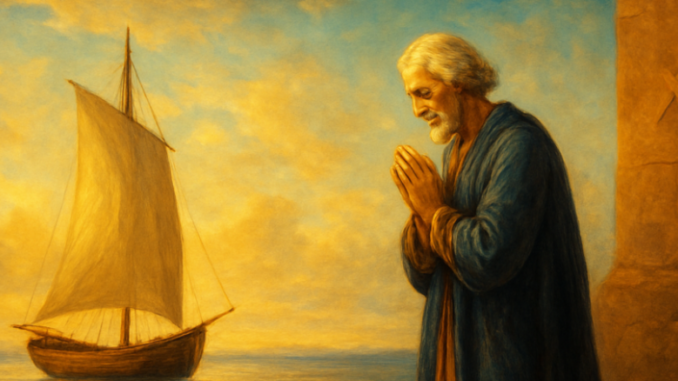
In a world that often seems fractured by misunderstanding and prejudice, it is remarkable that a text written in the eighteenth century can still move us so deeply. Voltaire’s prayer for tolerance, found in his Treatise on Tolerance, expresses a universal longing for mutual understanding that transcends centuries. For Freemasons, this prayer is far more than a historical curiosity — it touches the very heart of what the Craft has pursued for generations: a world where people of every background can meet one another as brothers.
A Philosopher’s Prayer for All Humanity
Voltaire did not address his prayer to the god of any single religion. Instead, he directed it to the Supreme Being who might unite all people. “You did not give us hearts to hate one another,” he wrote, “nor hands to murder one another.” These words grew from his deep revulsion toward religious fanaticism. The Calas affair — in which an innocent Protestant father was wrongfully sentenced to death — had shaken him to the core. His prayer was no theological treatise; it was a cry from the heart for human dignity.
For Voltaire, tolerance was never passive acceptance. It was an active, deliberate choice. He acknowledged that human beings naturally differ in their beliefs, their languages, and their customs. But rather than viewing those differences as obstacles, he saw them as expressions of the same human spirit seeking meaning in its own way. His prayer does not ask for uniformity of thought — it asks for equality of being.
The Masonic Perspective: Ritual and Brotherly Connection
When a Freemason enters the lodge, he leaves behind his social rank, his political convictions, and his particular religious denomination. Inside, men meet as brothers, united by shared values rather than divided by their differences. Freemasonry prescribes no dogma about how the Supreme Being should be understood. It asks only that its members acknowledge something greater than the individual ego.
This openness is not weakness — it is a conscious commitment to connection over division. The rituals of the lodge remind every brother that he is rough material in need of shaping. The symbolism of the rough ashlar being worked into a perfect cube speaks of inner growth that is only possible when one is willing to listen to others. Just as the square and compasses set boundaries and measure proportions, so the Freemason learns to temper his judgments and open his heart.
Where Voltaire and the Craft Converge
Voltaire’s prayer and the practice of Freemasonry spring from the same source: the recognition that humanity is one family, despite all apparent differences. Voltaire composed his prayer from the study of an intellectual who had witnessed the madness of intolerance firsthand. Freemasons experience that same truth within the sacred space of the lodge, where ritual continually reminds them of their shared humanity.
Tolerance is not a concession to weakness — it is the highest expression of strength: the courage to see in the other a mirror of yourself.
Both traditions recognize that genuine tolerance begins with self-reflection. Voltaire understood that those who condemn others for their beliefs have seldom examined their own prejudices. Freemasonry translates this insight into practice: every brother is invited to contemplate his own rough edges in silence before passing judgment on another. The result is not moral relativism, but a more deeply rooted certainty about what truly matters.
Symbolism as a Bridge Between Thought and Action
Voltaire used words to convey his message. Freemasonry uses symbols. Yet both serve the same purpose: making the inexpressible tangible. The light that is kindled in the lodge symbolizes the same enlightenment Voltaire pursued — the banishment of ignorance and prejudice. The chain that brothers form at the close of their labors represents the bond that could unite all people, if only they had the courage to tear down their walls.
The temple in which Freemasons gather is itself a powerful symbol. It refers to the Temple of Solomon, built by craftsmen of diverse backgrounds who collaborated on a single magnificent project. Voltaire would have understood this symbolism immediately. His vision of a tolerant society was likewise an edifice that could only rise through the efforts of people willing to set aside their petty differences for a greater good.
Lessons for Today
The world of 2026 faces challenges that Voltaire could scarcely have imagined. Yet his prayer remains strikingly relevant. Freemasonry offers a space where the principles of that prayer are not merely discussed but actively lived. Where Voltaire wrote about tolerance, the lodge practices it. Where the philosopher hoped for a better world, brothers work daily on their own improvement as the first step toward that world.
Several enduring principles emerge from both Voltaire’s vision and Masonic tradition. Self-reflection must precede any judgment of others. Diversity is a strength, not a threat. Tolerance demands courage, not complacency. And genuine connection arises from shared values, never from imposed uniformity.
Voltaire and Freemasonry speak in different registers, but their melody is the same. Both believe in the possibility of a humanity that transcends its divisions. Both recognize that this work begins in the heart of every individual. And both understand that the road is long, but that every step counts.
Voltaire’s prayer for tolerance and the brotherly practice of Freemasonry complement each other like two voices in a choir. The philosopher provides the words; the lodge provides the deed. Together, they remind us that tolerance is not a luxury reserved for peaceful times — it is a necessity for all times. Whoever has the courage to see a brother in his fellow human being is helping to build a temple that no wall can contain.
Copyright text & image: devrijmetselaar.nl
Texts are based on the ideas and content of the author of devrijmetselaar.nl, reviewed, corrected, and supplemented with the assistance of OpenAI. Images are created based on the ideas of the author of devrijmetselaar.nl using OpenAI/DALL-E.


Be the first to comment