A fourteen-year-old girl was recently arrested after causing an estimated hundred thousand euros in damage to an elementary school. It’s the kind of news story that makes you pause. What drives a young person to such destructive behavior? And perhaps more importantly, what does it reveal about the formation of character — about the long road every human being walks from chaos toward inner order?
The Rough Stone as Starting Point
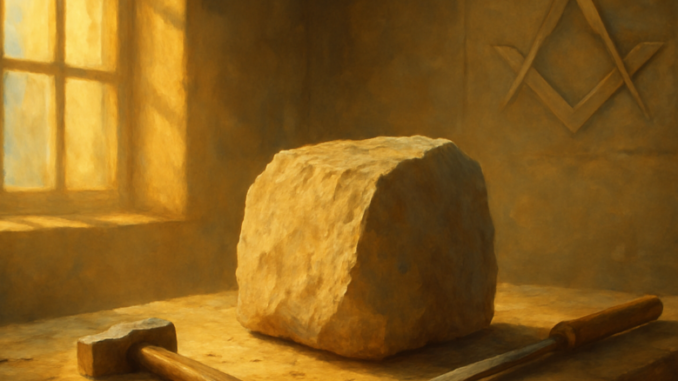
Freemasonry offers a powerful symbol that speaks directly to this situation: the rough ashlar. Every apprentice who enters the lodge is symbolically presented as an unworked stone, full of irregularities and sharp edges. The Mason’s task is to work this stone — to smooth it, shape it, and form it into something that fits within a greater structure. But no one begins as a perfectly polished cube. Everyone carries rough corners and jagged edges.
A teenager who destroys a school shows us that rough stone in its most visible form. This isn’t meant as an excuse for the act, but rather as an invitation to look beyond the surface. What shaped this young girl? What circumstances, what unprocessed emotions, what missed opportunities for guidance led to this moment of destruction? A Freemason doesn’t only look at the damage — a Freemason asks: how could this have gone differently?
Impulsivity and the Absence of Inner Master Builders
Jean-Jacques Rousseau once wrote that human beings are inherently good but become corrupted by society. You don’t have to fully agree with him to acknowledge that young people are extraordinarily sensitive to their environment. Without role models, without people who teach them to channel their impulses, emotions can derail into actions they themselves don’t understand afterward.
Freemasonry speaks in this context of the inner Master Builder. This is not some external authority telling you what to do. It is a voice within that helps you step back and reflect before you act. Developing this inner master is not an innate gift — it is a skill that must be trained, often through the example of others, through rituals that compel contemplation, through the experience of brotherhood in which you see yourself reflected.
Character formation is not a destination but a continuous process — from rough stone to polished cube — in which every misstep is an invitation to further work.
What Aristotle Taught Us About Virtue and Habit
The Greek philosopher Aristotle argued that virtue is not a random impulse but the result of repeated practice. You don’t become courageous by being brave once; you become courageous by choosing courage again and again when fear creeps in. The same applies to self-discipline, to compassion, to integrity. These are habits etched into character through repetition.
When a young person lacks this practice, when there are no structures inviting her to exercise virtue, then character remains formless — vulnerable to the whims of the moment. The destruction at that school is, in a sense, the result of an absent building site. Not as a condemnation of the girl herself, but as an indictment of everything that should have surrounded her and wasn’t there.
The Lodge as a Workshop for Character Formation
Masonic lodges are not perfect communities, and Freemasons are not flawless human beings. But what the lodge does offer is a deliberate space for reflection. Every meeting invites silence, the consideration of one’s own actions, and the opportunity to listen to brothers and sisters who are working on their own rough stones.
Johann Wolfgang von Goethe, himself a Freemason, wrote extensively about the formation of the individual. His concept of Bildung — the continuous development of personality through experience and reflection — resonates deeply with Masonic practice. The lodge, in this sense, is a workshop where adults do what ideally should begin much earlier in life: working on oneself, not in isolation, but in community.
From Destruction to Construction
The news about this girl will quickly fade from the headlines. But somewhere, her life goes on. Perhaps she will receive the guidance she needs. Perhaps she will meet someone who shows her that there are paths other than destruction. Perhaps one day, much later, she will begin to understand what happened inside her that day — and transform it into something constructive.
Freemasonry teaches us that it is never too late to work on yourself. The rough stone can be picked up at any age. But it also teaches us that we all bear a responsibility to be Master Builders for others — especially for young people who are still searching. Not with judgment, but with patience. Not with distance, but with engagement.
An Invitation to Reflect
Ask yourself: who were your Master Builders? Which people, experiences, or communities helped you work on your own rough edges? And perhaps even more importantly: for whom are you a Master Builder now? The temple we build together is not made only of stones. It is made of the characters we help shape, of the hands we extend to those who are on the verge of falling.
Behind every news story about destruction lies the story of a personality in the making. Freemasonry invites us to look beyond the damage, toward the question that precedes it: how do we guide young people toward inner order? The answer lies not in condemnation, but in the willingness to serve as an example ourselves — as a living stone in a structure far greater than any one of us.
Copyright text & image: devrijmetselaar.nl
Texts are based on the ideas and content of the author of devrijmetselaar.nl, reviewed, corrected, and supplemented with the assistance of OpenAI. Images are created based on the ideas of the author of devrijmetselaar.nl using OpenAI/DALL-E.



Be the first to comment