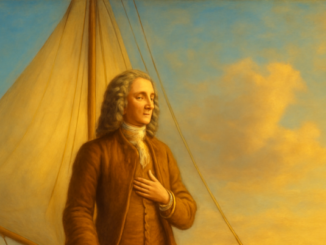
Voltaire portrait beside Masonic symbols representing tolerance and wisdom
Symbolism & Rituals

Voltaire on Tolerance as a Virtue: Wisdom for Freemasons

Tolerance is often treated as a passive attitude today — a matter of letting others do as they please so long as they don’t bother you. Voltaire saw things very differently. For him, tolerance was an active virtue demanding courage, self-reflection, and wisdom. When we place his ideas alongside the Masonic tradition, a remarkably rich conversation emerges about what it truly means to be tolerant. The Outsider Sees Tolerance as Weakness Let’s be honest: for many people in the eighteenth century, tolerance was seen as a sign of indifference or even cowardice. The reasoning went that anyone who took their own convictions seriously could not possibly bear others thinking radically differently. Voltaire knew this criticism all too well. In his time, religious minorities were persecuted, dissenters were banished, and books were burned. The social norm was not tolerance but conformity. From this perspective, tolerance was suspicious. It implied that you didn’t truly believe in anything — that you lacked principles. Intolerance was often dressed up as virtue: one was simply protecting truth against error. Those who showed tolerance, it was claimed, had chosen no side and therefore had nothing meaningful to offer. Voltaire’s Reversal: Tolerance Requires Strength Voltaire turned this […]


Voltaire portrait with Masonic symbols representing tolerance and Enlightenment
Symbolism & Rituals

Voltaire on Tolerance: Virtue as the Foundation of Society

Some ideas from the eighteenth century feel remarkably current — and Voltaire’s reflections on tolerance are a prime example. Writing during a period of religious persecution and deadly conflict, Voltaire articulated a vision of tolerance that went far beyond political convenience. In his second essay on the subject, he presented tolerance not merely as a practical necessity, but as a fundamental human virtue — a perspective that aligns seamlessly with the principles of Freemasonry. The Historical Context of Voltaire’s Plea Voltaire wrote his reflections on tolerance against the backdrop of the Calas affair, in which a Protestant father was wrongfully convicted and executed for the alleged murder of his son. This gross miscarriage of justice, fueled by religious fanaticism, struck Voltaire to his core and became the catalyst for his passionate defense of tolerance as a moral duty. In his second essay on the topic, he moved beyond practical arguments to make a bolder claim: tolerance is not a sign of weakness but a hallmark of civilization and inner strength. Voltaire placed his argument within a sweeping historical framework. He pointed to ancient civilizations such as the Roman Empire, where diverse religions coexisted for long periods. This tolerance did not […]

Portrait of Voltaire symbolizing tolerance and Enlightenment ideals in Freemasonry
Symbolism & Rituals

Voltaire on Tolerance: The Calas Affair and Freemasonry

What happens when a society projects its deepest fears onto an innocent family? Voltaire’s treatise on tolerance opens with one of the most harrowing cases of religious intolerance in eighteenth-century Europe: the Calas affair. This was not merely a judicial error — it was a mirror held up to humanity, revealing how swiftly prejudice can escalate into murder. For Freemasons, who regard brotherhood and tolerance as pillars of their work, Voltaire’s writing resonates as powerfully today as it did over two and a half centuries ago. The Tragic Heart of the Calas Affair In 1761, the Protestant merchant Jean Calas of Toulouse discovered his son Marc-Antoine dead in the family home. The young man had hanged himself. What followed was not a search for truth but a hysterical wave of accusations. The local population, saturated with religious tension between Catholics and Protestants, quickly concluded that the father had murdered his son to prevent him from converting to Catholicism. Without credible evidence, Jean Calas was tortured and publicly executed on the breaking wheel in March 1762. Voltaire first heard about the case through friends and was initially uncertain about Calas’s guilt. But as he gathered more testimonies and studied the facts, […]