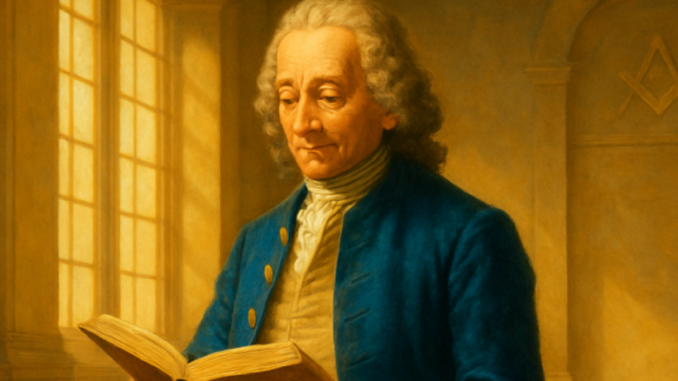
In his fifth Philosophical Letter, Voltaire took aim at one of the seventeenth century’s most influential thinkers: Blaise Pascal. Where Pascal saw humanity as a wretched creature lost between infinity and nothingness, Voltaire offered a radically different portrait. This was no dry academic dispute — it was a collision between two worlds: Jansenist pessimism and the rising confidence in human reason and progress. For the Freemason, who seeks light in the darkness and the elevation of the human spirit, this confrontation offers surprisingly relevant insights.
The Intellectual World of Voltaire
To understand Voltaire’s critique of Pascal, we must first understand the intellectual sources that shaped him. Voltaire was a child of the early Enlightenment, deeply influenced by the English empiricists John Locke and Isaac Newton. During his exile in England, he discovered an intellectual climate that was radically different from the dogmatic atmosphere of France. Locke’s idea that the human mind begins as a blank slate stood in direct opposition to Pascal’s notion of humanity stained by original sin. Newton demonstrated that the universe obeyed comprehensible laws rather than impenetrable mysteries.
Voltaire also drew from the skeptical tradition of Michel de Montaigne, whose essays he studied closely. Montaigne’s gentle doubt and emphasis on human dignity despite our limitations resonated with Voltaire’s own temperament. Ancient wisdom played its part as well: Seneca’s Stoic acceptance of fate and Cicero’s humanistic rhetoric provided a counterweight to the Augustinian pessimism that Pascal embodied.
Pascal’s Dark Mirror
Blaise Pascal wrote his Pensées from a place of deep Jansenist conviction. Jansenism, a movement within Catholicism, emphasized the total depravity of humanity after the Fall and the absolute necessity of God’s grace. Pascal saw human beings as trapped between two infinities — too great for nothingness, too small for the whole. His famous observation that man is but a reed, the weakest thing in nature, but a thinking reed, sounds exalted yet carries a profound melancholy.
For Pascal, distraction was the enemy. Humanity flees into amusement to avoid confronting its miserable condition. Only through complete surrender to the Christian faith can we recover our dignity. This vision was rooted in Augustine, the Church Father who placed original sin at the center of Western Christianity. Where the Renaissance had celebrated the individual, Jansenism pulled humanity back toward humility and dependence on the divine.
Two Perspectives on Human Dignity
Here lies the heart of the conflict. Pascal wrote to humble humanity before God; Voltaire wrote to elevate humanity through reason. Where Pascal emphasized the wretchedness of man without God, Voltaire saw possibilities for happiness, knowledge, and progress within earthly existence. This was not shallow optimism but a philosophically grounded confidence in human capability.
Voltaire did not attack faith itself — he challenged the idea that without divine intervention, humanity is incapable of any good. This distinction matters greatly. He objected not to religion but to a theology that denied the value of human effort and moral striving.
This opposition reflects a broader division in European thought. On one side stands the Augustinian-Jansenist tradition running through Pascal: humanity is fundamentally broken. On the other stands the humanistic tradition of Erasmus, Montaigne, and later the philosophes: humanity can improve its condition through education, reason, and moral endeavor. Voltaire placed himself unequivocally in the second camp.
The Symbolism of Light and Darkness
For the Freemason, this debate is far more than historical curiosity. The symbolism of the Lodge revolves around the transition from darkness to light, from ignorance to knowledge, from roughness to refinement. This symbolic journey assumes that human beings are capable of growth and improvement. In a sense, Freemasonry takes a position in the debate between Pascal and Voltaire.
The rough ashlar shaped into a perfect cube is a powerful symbol of human perfectibility. This aligns with Voltaire’s conviction that through labor on oneself and service to society, we can contribute to a better world. At the same time, the Freemason acknowledges that this labor is never finished — that we are always on the journey, never fully arrived. This element of humility resonates with Pascal’s awareness of human limitation.
The working tools of the Craft — the gavel, the square, the compasses — all imply that transformation is possible but requires discipline and intention. Neither blind optimism nor paralyzing despair serves the brother who genuinely seeks the Light.
What Both Thinkers Share
Despite their opposing conclusions, Pascal and Voltaire shared a deep seriousness about the human condition. Neither was superficial or indifferent. Pascal wanted to shake humanity out of complacency; Voltaire wanted to liberate it from superstition and tyranny. Both believed that reflecting on our existence is essential to living a dignified life.
Pascal held that we find dignity through surrender to the divine. Voltaire maintained that we find dignity through the cultivation of reason. Both agreed that reflection on our existence is a moral duty. These are not mutually exclusive positions, and the thoughtful Freemason recognizes the value in each.
Freemasonry embraces brothers of widely varying convictions. Some are drawn to Pascal’s religious depth; others find their footing in Voltaire’s rational confidence. The Lodge offers space for both perspectives, united in the shared pursuit of self-knowledge and fraternity.
Lessons for the Modern Seeker
Voltaire’s critique of Pascal teaches us that we may critically examine different views of human nature without being disrespectful. The goal is not to win the argument but to think clearly. The Freemason who sharpens the tools of the mind learns to distinguish between fruitful humility and paralyzing pessimism, between well-founded confidence and naive optimism.
In our own time, when both doomsday thinking and blind faith in progress have their adherents, the dialogue between Pascal and Voltaire offers a compass. The Masonic path calls us neither to despair at our imperfections nor to deny them, but to work with them — stone by stone, degree by degree — toward greater light.
The confrontation between Voltaire and Pascal is ultimately not a contest to be decided but a tension to be held. The Freemason who studies both thinkers enriches his inner life and deepens his understanding of the Craft’s symbolic journey. In the space between Pascal’s humility and Voltaire’s confidence, we find a productive balance — the very balance the Lodge invites us to seek. To walk between darkness and light, carrying the tools of reason and the compass of conscience, is perhaps the most Masonic response to this enduring philosophical debate.
Copyright text & image: devrijmetselaar.nl
Texts are based on the ideas and content of the author of devrijmetselaar.nl, reviewed, corrected, and supplemented with the assistance of OpenAI. Images are created based on the ideas of the author of devrijmetselaar.nl using OpenAI/DALL-E.
Frequently Asked Questions
What was the main disagreement between Voltaire and Pascal regarding human nature?
Pascal, influenced by Jansenism, viewed humanity as wretched and trapped between infinity and nothingness, requiring complete surrender to Christian faith for dignity. Voltaire, shaped by Enlightenment thought and empiricists like Locke and Newton, offered a radically different portrait emphasizing human reason, progress, and the mind's capacity to understand the universe through comprehensible laws rather than divine mysteries.
What intellectual influences shaped Voltaire's critique of Pascal?
Voltaire was influenced by English empiricists John Locke and Isaac Newton, whose ideas he encountered during his exile in England. He also drew from Michel de Montaigne's skeptical philosophy, Seneca's Stoic acceptance, and Cicero's humanistic rhetoric. These sources provided a counterweight to the Augustinian pessimism that Pascal embodied.
Why is the Voltaire-Pascal debate relevant to Freemasonry?
For Freemasons, who seek light in darkness and the elevation of the human spirit, this confrontation between Jansenist pessimism and Enlightenment confidence offers surprisingly relevant insights. The debate touches on fundamental questions about human potential, reason, and progress that align with Masonic principles and values.

Be the first to comment