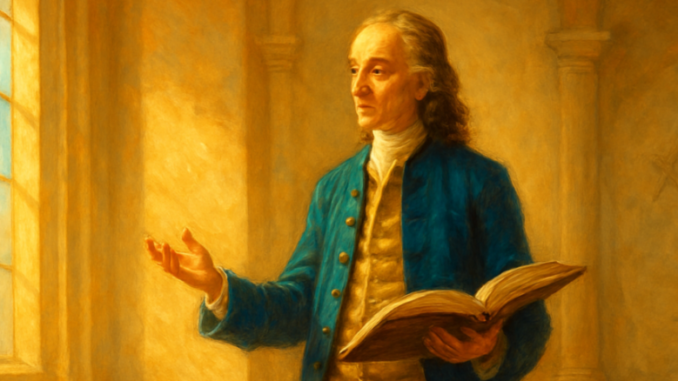
What did Voltaire actually mean when he wrote about equality? And why does his vision, more than two centuries later, still resonate so deeply with anyone who reflects on human dignity and what truly connects us? In his Philosophical Dictionary, the great French Enlightenment philosopher devoted a sharp and sometimes provocative essay to this very concept. His ideas carry a remarkable relevance for those who appreciate both the philosophical tradition and the principles of Freemasonry.
What Does Voltaire Actually Say About Equality?
Voltaire opens his essay with a characteristically sober observation: all human beings are born equal in their fundamental needs and vulnerabilities. Everyone requires food, everyone falls ill, everyone dies. But the moment people begin to live together in society, differences in talent, circumstance, and power inevitably emerge. Voltaire argues that complete social equality is an illusion — an unattainable ideal that can even become dangerous when enforced.
Yet he does not reject equality altogether. He draws a crucial distinction between two kinds: the natural equality of human dignity, and the artificial inequality that arises from social structures. The first is inalienable — it belongs to every person simply by virtue of being human. The second is the result of human action and can therefore be tempered by human effort. This is where Voltaire reveals himself as a thinker who refuses to simply accept the way things are, and instead asks how they ought to be.
Why Does This Matter for Freemasonry?
Freemasonry has a rich tradition of bringing people together regardless of their social standing. Inside the lodge, the hierarchies of the outside world are set aside: the laborer sits beside the scholar, the merchant beside the artist. This principle of brotherly equality is not a coincidental overlap with Voltaire’s thinking — it touches on the same fundamental question: what truly makes us equal?
True equality does not lie in erasing all differences, but in recognizing that every human being possesses the same inner dignity and the same calling toward moral growth.
Voltaire would likely have applauded this Masonic practice. He believed that human dignity depends not on birth or wealth, but on character and virtue. In his essay, he sharply criticizes the aristocratic arrogance that ranks people according to their lineage. Freemasonry does precisely the opposite: it values members for their inner qualities and their willingness to work on themselves.
Is Complete Equality Truly Impossible?
Voltaire would say: yes, in a certain sense it is. People simply differ in their talents, energy, and circumstances. It would be absurd to claim that everyone has identical capabilities. But here lies an important distinction. The goal is not to level all differences — it is to create a space where those differences do not lead to oppression or contempt.
In Freemasonry, this idea finds beautiful expression in the concept of the rough and polished stone. Every person begins as a rough ashlar, with their own imperfections and potential. The work consists of shaping that stone — not to become identical to others, but to become the best version of oneself. Equality, in this context, means equal access to the workshop, equal respect for the effort, and an equal bond of brotherhood.
What Can We Learn From This Connection?
Voltaire’s essay compels us to examine our own assumptions honestly. Do we truly believe in the dignity of every person? Or do we, in practice, make exceptions for those who are different from us? Freemasonry offers an answer that is anything but passive: it calls for active engagement, for ritual practice, for continuous self-reflection.
The pursuit of truth — one of the core values of Freemasonry — fits seamlessly here. Voltaire was a tireless seeker of truth, someone willing to challenge sacred cows whenever reason demanded it. That attitude — questioning critically without becoming cynical — characterizes both the Enlightenment philosopher and the Freemason who walks his path with sincerity.
How Do We Translate This to Our Lives Today?
In a time when social divisions sometimes seem sharper than ever, the combination of Voltaire’s philosophy and Masonic values offers a genuine anchor. Not as a political program, but as an inner compass. Equality begins with recognizing the other person as your equal, regardless of the superficial differences that divide us.
Consider these principles as daily practice:
Self-reflection: Ask yourself where your own prejudices lie.
Brotherhood: Treat others as you would wish to be treated yourself.
Inner growth: Work on your own rough stone before passing judgment on others.
The pursuit of truth: Be willing to revise your opinions when the facts demand it.
Voltaire and Freemasonry share a profound conviction: human dignity is non-negotiable. That conviction does not call for forced uniformity, but for mutual respect and the willingness to build together — to create a world in which every person can flourish. This is not a utopian dream; it is a daily commitment.
Voltaire’s Philosophical Dictionary remains a wellspring of inspiration for anyone who reflects on what connects us as human beings. His essay on equality resonates deeply with the Masonic values of brotherhood, self-reflection, and moral growth. The question is not whether we are all the same — clearly, we are not. The question is whether we are willing to recognize the other as our equal. That conversation, that inner work, continues — inside the lodge and far beyond its walls.
Copyright text & image: devrijmetselaar.nl
Texts are based on the ideas and content of the author of devrijmetselaar.nl, reviewed, corrected, and supplemented with the assistance of OpenAI. Images are created based on the ideas of the author of devrijmetselaar.nl using OpenAI/DALL-E.

Be the first to comment