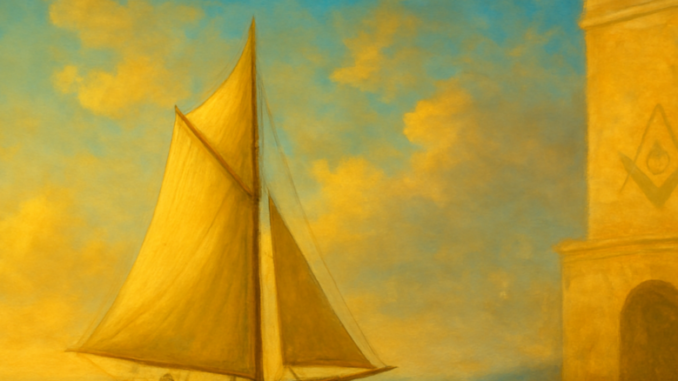
What did Voltaire actually mean when he wrote about equality? And why does his vision still resonate in Masonic lodges around the world? In his Philosophical Dictionary of 1764, François-Marie Arouet — better known as Voltaire — devoted a sharp and ironic essay to the concept of equality. To understand what he was truly arguing, we need to trace the philosophical sources that shaped his thinking.
Which Thinkers Shaped Voltaire’s View of Equality?
Voltaire did not operate in an intellectual vacuum. His thinking on equality was profoundly influenced by both classical and modern philosophers. The Stoics — particularly Seneca and Marcus Aurelius — had introduced the idea that all human beings are naturally equal in their capacity for reason. This cosmopolitan insight, that the slave trader and the emperor share the same rational faculty, flowed as an underground current into Enlightenment thought.
But it was John Locke, above all, who directly shaped Voltaire’s ideas about equality. During his exile in England (1726–1728), Voltaire immersed himself in Locke’s political philosophy. Locke’s argument that human beings are born into a natural state of equality — without any inherent right of one person over another — became a cornerstone of Voltaire’s social criticism. Yet Voltaire charted his own course: where Locke posited a natural-law equality, Voltaire emphasized the tension between natural equality and social inequality.
What Did Stoicism Offer Voltaire?
Stoicism gave Voltaire a philosophical framework for thinking about human dignity without relying on religious dogma. Seneca wrote in his Letters to Lucilius that true slavery lies not in chains but in uncontrolled passions. Marcus Aurelius constantly reminded himself that the emperor’s purple cloak made no difference in the face of death or the cosmic order. These ideas echo throughout Voltaire’s essay: he acknowledges that social inequality is inevitable, yet insists that the fundamental human condition — our mortality, our needs, our suffering — is the same for everyone.
For Voltaire, equality is not a political program but a philosophical recognition of our shared humanity beneath the veneer of rank and status.
Voltaire and Rousseau: A Defining Rivalry
An essential context for understanding Voltaire’s essay is his intellectual rivalry with Jean-Jacques Rousseau. In his Discourse on Inequality (1755), Rousseau advanced a radical thesis: that civilization itself was the source of inequality. Voltaire took a far more nuanced position. He rejected the romantic image of the “noble savage” that Rousseau evoked. For Voltaire, the state of nature was no paradise of equality but rather a condition of primitive insecurity.
This tension explains the ironic tone pervading his essay. Voltaire subtly mocks those who preach absolute equality while living in luxury themselves. His realism is rooted in a skeptical tradition that reached the French Enlightenment through Michel de Montaigne, who had already shown in his Essays how relative our cultural judgments truly are — a lesson Voltaire took deeply to heart.
Why Does This Matter for Freemasonry?
This is where the conversation gets truly compelling. Freemasonry, which was taking its modern form during Voltaire’s lifetime with the publication of James Anderson’s Constitutions in 1723, shared a remarkable amount of common ground with his philosophical outlook. The lodge was a space where distinctions of social rank were symbolically suspended: the count and the tailor met as brothers, equal before the Grand Architect of the Universe.
This is no coincidence. Both Voltaire and the early Freemasons drew from the same philosophical wellsprings. Stoic cosmopolitanism, Locke’s natural equality, and the skeptical humanism of the Renaissance converged in a vision that placed the individual human being at the center, regardless of birth or title. The apron that every Freemason wears symbolically refers to the working craftsman — a reminder that labor is honorable and that human dignity does not depend on inherited privilege.
The Philosophical Threads That Come Together
When we step back and survey the landscape, several distinct philosophical traditions converge in Voltaire’s treatment of equality and its Masonic resonance:
Seneca and Marcus Aurelius provided the Stoic foundations of human equal worth. John Locke supplied the concept of natural equality as a starting point. Montaigne contributed cultural relativism and skeptical humility. Rousseau served as the intellectual rival whose radicalism Voltaire deliberately rejected. And Freemasonry offered the practical space where all these ideas could fuse into lived experience.
Voltaire’s essay on equality only becomes fully comprehensible when we understand the philosophical conversations he was engaged in — with Seneca, Locke, Montaigne, and others. His vision was not naively optimistic but critically informed and deeply considered.
For Freemasons, Voltaire’s thinking offers a mirror. The lodge is not a place where inequality disappears — it is a space where the recognition of fundamental human equal worth is ritually affirmed. Voltaire shared with the Craft not a doctrine of equality, but a practice of searching for truth together, in a setting where the ranks of the outside world are temporarily set aside. That is no small thing — that is civilization in practice.
Copyright text & image: devrijmetselaar.nl
Texts are based on the ideas and content of the author of devrijmetselaar.nl, reviewed, corrected, and supplemented with the assistance of OpenAI. Images are created based on the ideas of the author of devrijmetselaar.nl using OpenAI/DALL-E.

Be the first to comment