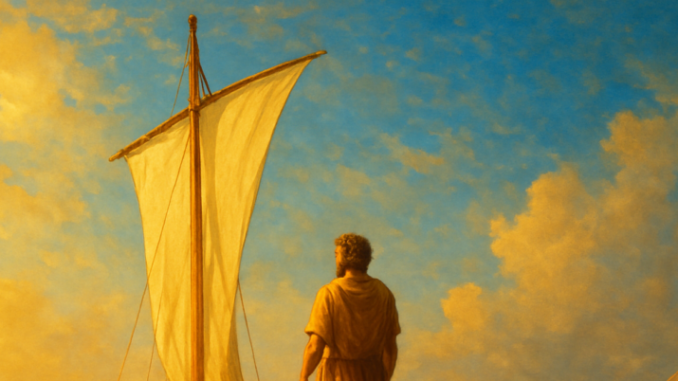
In the year 170 AD, a Roman emperor sat in his tent along the Danube, surrounded by war and death, writing about how a human being should relate to the divine. Marcus Aurelius — the philosopher-emperor whose private notebooks we know as the Meditations — devoted the ninth book of this work to a subject that still resonates deeply today: the nature of prayer and our relationship to a higher order. Written for himself alone and never intended for publication, this text offers a surprisingly modern perspective on spirituality that can inspire Freemasons and seekers of wisdom alike.
The Historical Context of Book IX
When Marcus Aurelius was working on his ninth book, the Roman Empire was enduring one of its most difficult periods. The Marcomannic Wars raged along the northern frontier, plague decimated the legions, and the emperor found himself far removed from the comforts of Rome. In these circumstances of profound uncertainty and ever-present mortality, he turned to the Stoic philosophy he had learned as a young man from masters such as Epictetus and Junius Rusticus.
Book IX bears the unmistakable marks of this context. It is saturated with reflections on impermanence, the proper attitude toward fate, and the question of what it truly means to pray. The Stoics of Marcus Aurelius’ era held a distinctive view of the divine. They believed in a cosmic order — a logos or universal reason that permeates and connects all things. This was not a personal god in the Judeo-Christian sense, but rather a rational principle governing the cosmos. When Marcus Aurelius writes about prayer, he means something fundamentally different from the petitionary prayer that stands at the center of many religious traditions.
The Core Idea: Prayer as Inner Alignment
The central thesis of Book IX is that true spirituality does not consist of asking for external favors but of aligning one’s own will with the cosmic order. Marcus Aurelius writes that the gods need not be bribed or begged. They have already given humanity everything it needs: reason, the capacity for virtue, and a place within the greater whole. All that remains for us is to recognize these gifts and live accordingly.
Prayer in the Stoic sense is not a petition to a higher power, but the quiet work of the soul bringing itself into harmony with the cosmic order.
This idea has direct parallels with the Masonic practice of silent contemplation in the lodge. When Freemasons sit in stillness before a ritual begins, or when they meditate upon the working tools of the Craft, they are doing precisely what Marcus Aurelius describes: attuning their inner world to a higher order. The square and compasses — central symbols in Freemasonry — embody the same idea: the restraining and ordering of one’s passions according to a rational and ethical principle.
Examples and Meditations from the Text
Throughout Book IX, Marcus Aurelius uses concrete examples to make his abstract philosophy tangible. He writes about the brevity of human life, comparing famous figures from history — from Alexander the Great to his own predecessors on the imperial throne — with people who are now nothing more than forgotten dust. This meditation on mortality is not a morbid exercise. It is a tool for releasing attachment to fame, possessions, and status.
Another recurring theme is the unity of all things. Marcus Aurelius reminds himself that every human being is part of the same cosmic substance, that we are all branches on the same tree. This idea of universal brotherhood is precisely what Freemasons express symbolically when they welcome brethren from across the globe into their lodges, regardless of background or belief.
The Higher Principle in Freemasonry
Freemasonry speaks of the Great Architect of the Universe — a term deliberately kept broad to allow room for each individual’s own interpretation of the divine. This approach stands remarkably close to the Stoic logos of Marcus Aurelius. Both point toward an ordering principle that governs the cosmos without filling in that principle dogmatically. Both invite the seeker to discover his own relationship to this higher reality through self-reflection and ethical action.
The parallels between Stoic philosophy and Masonic symbolism are striking when examined closely. The rough ashlar that must be shaped into a perfect stone embodies the Stoic ideal of self-improvement. The blazing star points toward a higher light that the Mason must follow. The plumb line symbolizes the uprightness that Marcus Aurelius writes about so extensively. And the chain of brotherhood reflects the Stoic conviction that all human beings are fundamentally connected.
Lessons for the Modern Seeker
What can we, nearly two thousand years later, learn from these imperial meditations? First and foremost, that spirituality need not depend on specific articles of faith. Marcus Aurelius offers a path to inner peace that is accessible to believers and non-believers, to adherents of every tradition. His prayer is an exercise in acceptance: embracing what is, releasing what lies beyond our control, and focusing on what we can influence — namely, our own thoughts and actions.
Second, Book IX teaches us that contact with the higher does not need to be sought in temples or churches alone, but in the silence of one’s own conscience. The lodge can be a sacred space, just as an emperor’s tent on the Danube was a sacred space, but the true temple exists within. This is perhaps the most timeless message Marcus Aurelius has to offer: that in the midst of life’s chaos, we have access to an inner citadel of calm and wisdom.
For Freemasons especially, the emperor’s reflections serve as a powerful reminder that the rituals and symbols of the Craft are not ends in themselves. They are instruments designed to facilitate the very same inner work that Marcus Aurelius practiced alone in his tent — the patient, daily labor of aligning the self with something greater.
Book IX of the Meditations of Marcus Aurelius remains, after nearly two millennia, a wellspring of inspiration for anyone seeking a meaningful relationship with the higher. The Stoic view of prayer as inner alignment rather than petition resonates powerfully with the symbolic practice of Freemasonry. Both traditions remind us that the most profound spiritual work is not performed outwardly but inwardly — in the quiet, deliberate act of shaping ourselves into better human beings. Whether in a Roman emperor’s campaign tent or in the tiled lodge, the work remains the same: to listen, to reflect, and to align the soul with the greater order of things.
Copyright text & image: devrijmetselaar.nl
Texts are based on the ideas and content of the author of devrijmetselaar.nl, reviewed, corrected, and supplemented with the assistance of OpenAI. Images are created based on the ideas of the author of devrijmetselaar.nl using OpenAI/DALL-E.

Be the first to comment