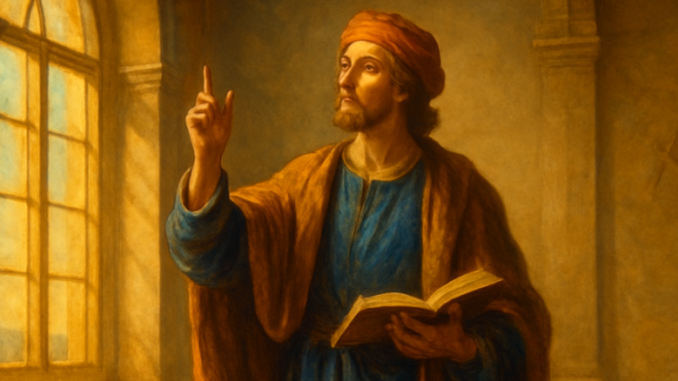
You know the feeling. You do everything right, act with the best intentions, and yet things don’t turn out the way you expected. A promotion slips through your fingers, a relationship falls apart despite your efforts, or circumstances turn against you for no apparent reason. This sense of powerlessness in the face of fate is precisely what Voltaire explores in his philosophical tale of Zadig, the wise Babylonian. But Voltaire offers more than consolation. He gives us practical tools for dealing with life’s unpredictability — tools that resonate remarkably well with the kind of practical wisdom Freemasons have cultivated for centuries.
A Wise Man Who Stumbles: Situations We All Recognize
Zadig is no ivory-tower philosopher. He is a man who uses his reason, acts honestly, and helps others. Yet he is repeatedly punished for those very virtues. He solves a murder mystery through keen observation, only to be accused of theft. He rescues a woman from violence, only to end up in prison himself. Voltaire shows us someone who does everything right and still suffers.
This isn’t pessimism. It’s realism. And the first insight we can draw from it is this: don’t expect virtuous action to be automatically rewarded. Do it anyway.
For Freemasons, this is a foundational idea. The Craft teaches that moral improvement is an end in itself, not a means to success or recognition. You work on yourself because it is right, not because you expect something in return. Zadig embodies this principle on every page of Voltaire’s story.
Practical Steps: What Zadig Teaches Us
Voltaire hides practical wisdom inside what appears to be a lighthearted tale. Let’s distill three concrete lessons you can apply starting today:
1. Observe without judgment. Zadig solves problems by first observing carefully. He notices tracks, patterns, and details that others miss. This requires silence and attention before action.
2. Act despite uncertainty. Zadig never knows whether his good deeds will be rewarded. Yet he acts. This is not naivety — it is courage.
3. Accept that control is an illusion. Fate throws up obstacles you cannot foresee. Zadig learns that resilience matters more than planning.
In Freemasonry, we find these same principles embedded in the ritual work. The search for light is never a straight line. An Entered Apprentice is tested, must grope in darkness, and learns that the journey itself is the destination. Voltaire would have felt right at home in a lodge where these insights are shared.
The Angel Jesrad: Comfort or Challenge?
Near the end of the story, Zadig meets the angel Jesrad, who tells him that everything — including evil — serves a purpose. It’s a controversial moment. Is Voltaire being serious, or is he being ironic? Probably both. He doesn’t offer easy answers. Instead, he poses a question you must answer for yourself: can you find meaning in adversity without justifying that adversity?
True wisdom is not about controlling fate, but about remaining true to yourself while fate tests you.
This is the heart of what both Voltaire and Freemasonry ask of us. You cannot control the world. But you can choose who you are in the midst of chaos. That choice, made anew each day, is what shapes your character.
Brotherhood as a Safety Net
Zadig is often alone in his trials. He lacks what Freemasons have: a community of like-minded individuals. The Brotherhood offers not only moral guidance but also practical support. When fate strikes, you don’t stand alone. There are brothers who listen, who help, who remind you of the values you share.
This may be the most important difference between Zadig’s solitary wisdom and the Masonic experience. Voltaire shows us an individual who struggles. The lodge shows us that the struggle becomes lighter when you carry it together. Both traditions value self-reflection and inner growth, but Freemasonry adds the power of connection.
Start Today: An Invitation
How do you put this into practice? Start small. Take a moment today to observe without immediately judging. Notice what you see, hear, and feel. Then act according to your best understanding, knowing that the outcome is not in your hands. And when things go wrong, ask yourself: who do I want to be in this situation? Not: how do I fix this? But: how do I stay true to my values?
Voltaire wrote Zadig as a mirror. Freemasons use their rituals and symbols for the same purpose. Both invite you to look honestly at who you truly are — and who you could become. The wise man accepts that fate is unpredictable. But he refuses to let those unpredictable winds set his compass. That is not passivity. That is the highest form of freedom.
Voltaire’s Zadig is more than an entertaining eighteenth-century tale. It is a handbook for anyone who struggles with life’s unpredictability. The lessons are concrete: observe carefully, act courageously, accept what you cannot change. Freemasons will recognize these principles as the very building blocks of their own inner work. The difference is that they don’t have to travel alone. In a world that often seems chaotic and unjust, both Voltaire and Freemasonry offer the same consolation: your character is the only thing that is truly yours. Build it with care.
Copyright text & image: devrijmetselaar.nl
Texts are based on the ideas and content of the author of devrijmetselaar.nl, reviewed, corrected, and supplemented with the assistance of OpenAI. Images are created based on the ideas of the author of devrijmetselaar.nl using OpenAI/DALL-E.



Be the first to comment