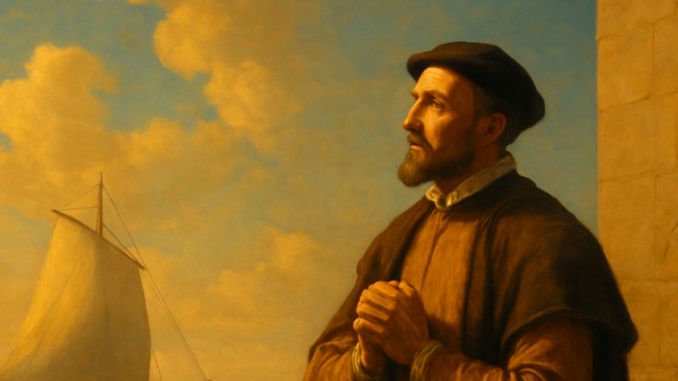
In 1580, Michel de Montaigne published a short but penetrating essay that posed a question destined to echo through the centuries: can a person’s own conscience betray them, even when no judge or accuser ever could? In the fifth essay of his second book, titled “Of Conscience,” Montaigne examines how guilt involuntarily forces its way to the surface. It is a text that remains surprisingly relevant today — not least for those drawn to the Masonic tradition of self-examination and inner honesty.
The Heart of the Essay: Conscience as an Inner Witness
Montaigne opens his essay with a clear premise: the human conscience is a force more powerful than any external compulsion. Where courts of law depend on evidence and witness testimony, the guilty person carries their own accuser within. Montaigne describes how people who have committed a crime betray themselves through their behavior, their facial expressions, their restlessness. Conscience acts as an invisible yet relentless mirror, compelling a person to confront themselves.
The central theme, then, is not so much legal guilt as the inner experience of it. Montaigne draws a sharp distinction between the punishment society can impose and the punishment a person inflicts upon themselves. The latter, he argues, is often far heavier. Conscience knows no escape, no court of appeal, no statute of limitations.
Historical Examples Montaigne Draws Upon
As in many of his essays, Montaigne draws richly from classical antiquity to support his argument. He references stories from the works of Aristotle and Roman historians, among others. One of the most striking examples involves a man who, while felling a tree, suddenly began to tremble — because he was reminded of a murder he had once committed in that very spot. No one had accused him. No judge had summoned him. Yet his body and mind reacted as though he had been caught in the act all over again.
Montaigne also addresses the use of torture as a means of extracting truth, a practice still widespread in his own time. He subtly criticizes this method by pointing out that torture does not reveal the truth — it merely tests the endurance of the body. Conscience, by contrast, brings truth to the surface without any physical coercion whatsoever. This was a remarkably progressive position for the sixteenth century.
Conscience and the Tradition of Self-Examination
What makes this essay particularly relevant to the Masonic tradition is Montaigne’s emphasis on honest self-examination as the highest moral duty. Freemasonry has long practiced the ritual of quiet reflection — the moment when a Brother is invited to look honestly at himself, beyond the masks that daily life demands. This is no coincidental parallel. The roots of both traditions lie in the same humanist conviction: that a person can only be truly free when they know themselves, including their shadow side.
Conscience is the strictest yet most honest judge a person will ever encounter; it passes its verdict in silence, but without respect of persons.
Montaigne also references Stoic philosophy in this context, particularly the idea that the virtuous person has nothing to fear from their own inner life. Marcus Aurelius, the Roman emperor-philosopher, wrote in his Meditations that the conscience of a good person is like a calm sea. Montaigne shares this conviction but adds a characteristically nuanced caveat: even the most virtuous person must remain vigilant, for conscience can never be entirely silenced.
The Power of the Involuntary
One of the most fascinating insights in this essay is Montaigne’s observation that conscience cannot be controlled by the will. A person may choose to remain silent about their deeds, may put on a mask for the outside world, but the body and mind betray them regardless. Blushing, stammering, nightmares, sudden fear in seemingly innocent situations — these are all expressions of a conscience that refuses to be quiet. Montaigne sees this as proof that there exists within every person a natural moral order that runs deeper than rational deliberation.
This insight was revolutionary in the sixteenth century and would be confirmed centuries later by the emergence of psychology. But Montaigne needed no scientific framework to reach this conclusion. His method was the honest, open-minded observation of himself and the people around him — precisely the method that also serves as the foundation for personal growth within Freemasonry.
What This Essay Still Has to Say Today
In an age when transparency and authenticity are increasingly celebrated as core values — yet social media makes it easier than ever to present a curated self-image — Montaigne’s essay on conscience feels more urgent than ever. The question he poses is timeless: who are you really when no one is watching? The answer, Montaigne suggests, is not determined by what you say or show, but by what your conscience whispers to you in the silence.
For anyone reading Montaigne’s essays for the first time, “Of Conscience” is an excellent introduction to his way of thinking. The essay is short, clear, and rich in concrete examples. At the same time, it touches on one of the deepest questions of human existence: the relationship between doing and being, between the exterior and the interior, between the judge and the accused who reside within each of us.
Summary of Key Points
Conscience is an invisible yet inescapable inner judge that requires no burden of proof. Guilt betrays itself involuntarily through the body and through behavior, regardless of a person’s will. Montaigne distinguishes sharply between external punishment and internal punishment — the latter being far more severe. Historical and classical examples illustrate how even long-buried guilt resurfaces unbidden. The essay’s emphasis on honest self-examination aligns closely with the Masonic tradition of inner reflection. Montaigne’s observations about the involuntary nature of guilt anticipated modern psychology by centuries. In a world of curated identities, the question “who are you when no one is watching?” remains as vital as ever.
Montaigne’s “Of Conscience” is far more than a historical curiosity. It is a timeless invitation to do what every Freemason is called to do in the silence of the lodge and the silence of the heart: to face oneself without pretense. The conscience, as Montaigne understood so well, does not need evidence or witnesses. It knows. And sooner or later, it speaks — whether we wish it to or not. For anyone committed to genuine self-knowledge, that uncomfortable truth is not a threat but a gift.
Copyright text & image: devrijmetselaar.nl
Texts are based on the ideas and content of the author of devrijmetselaar.nl, reviewed, corrected, and supplemented with the assistance of OpenAI. Images are created based on the ideas of the author of devrijmetselaar.nl using OpenAI/DALL-E.


Be the first to comment