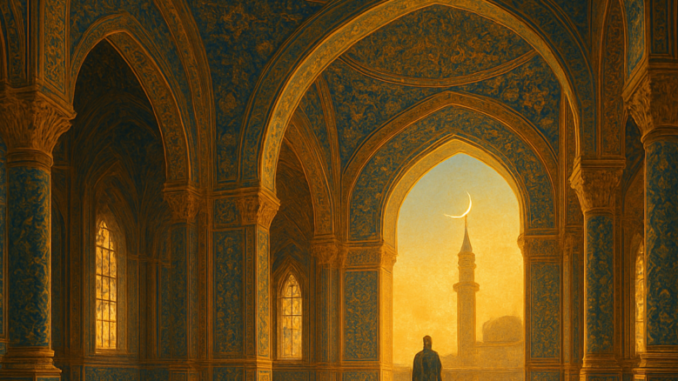
There is a moment, just before sunrise, when the world seems to hold its breath. Night has not yet retreated, but the first light is already glowing on the horizon. It is precisely this in-between space that the eighty-ninth chapter of the Quran takes as its subject: Al-Fajr — The Dawn. A text that opens with a solemn oath sworn upon the breaking of day, then plunges deep into the human tendencies toward arrogance, impermanence, and the ultimate longing for inner peace. Read through the lens of Freemasonry, the resonance is striking: in the lodge, too, every ritual begins with the passage from darkness into light.
An Oath Upon the Breaking of Day
The Dawn opens with a series of powerful oaths: by the dawn, by the ten nights, by the even and the odd, by the night as it passes. This opening is no mere poetic flourish. In the classical Arabic tradition, swearing an oath by natural phenomena is a way of commanding attention, of insisting the listener awaken to something of genuine importance. The dawn functions here as a threshold. What follows is a confrontation with humanity itself — its grandeur, its pitfalls, and its ultimate destination.
It is telling that the surah does not begin at full daylight, but at its earliest stirring. The dawn is not an endpoint but a promise. It represents potential that has not yet been fully realized. In this sense, the image bears a remarkable parallel with a core idea in Freemasonry: the human being is a rough ashlar that still needs to be shaped. The light is already there, but it must be revealed through conscious work on one’s own character.
Fallen Civilizations as a Mirror
After the opening, the surah presents a series of references to mighty peoples of antiquity: the inhabitants of Iram with their towering pillars, the people of Thamud who carved their dwellings from solid rock, and the Pharaoh with his great stakes. These civilizations are not invoked as historical anecdotes. They serve as mirrors. Each of these peoples reached a pinnacle of material power and technical mastery, yet ultimately fell through moral decay. The surah poses an uncomfortable question: what is building worth when the foundation of justice is absent?
For anyone familiar with the building metaphor in Freemasonry, this is deeply recognizable territory. The legend of the Temple of Solomon, in which Master Builder Hiram Abiff plays a central role, is not really about the physical temple — it is about the spiritual edifice that each person must erect within themselves. Aristotle wrote that virtue does not arise by chance but through practice and habit. The civilizations described in The Dawn were technically brilliant builders who neglected their inner construction. The parallel with Freemasonry is clear: a lodge without a moral compass is nothing more than an empty building.
The Trial of Wealth and Poverty
One of the most striking passages in this surah concerns the human reaction to prosperity and adversity. When God tests a person with honor and blessings, they say: “My Lord has honored me.” But when the test comes in the form of restriction, they complain: “My Lord has humiliated me.” The surah sharply corrects this attitude: it is not the quantity of what one receives that determines whether a person is truly honored, but the manner in which they deal with whatever comes their way. The orphan, the needy, the inheritance greedily consumed — these are all touchstones of character.
This resonates with what the Stoic philosopher Marcus Aurelius expressed in his Meditations: it is not events themselves but our judgment of them that determines our well-being. In Freemasonry, this insight returns in the principle of equality. Within the lodge, all brethren are equal regardless of their social standing. This equality is not a social experiment but a spiritual principle. Only when outward distinctions fall away does it become visible who someone truly is. The surah makes the same point in different words, from a different tradition, but with a remarkably similar intent.
The dawn, in both the Quran and in Freemasonry, is not an astronomical phenomenon but a spiritual call: wake up, begin again, and build toward who you can truly become.
The Soul at Rest and the Completed Work
The surah concludes with one of the most frequently cited passages in the entire Quran: the address to the “soul at rest” — nafs al-mutma’innah — which is invited to return to its Lord, well-pleased and well-pleasing. The Arabic term used here describes a soul that has come to peace not through the absence of struggle, but precisely through having lived through it. It is the rest after labor, the light after the night.
Johann Wolfgang von Goethe, himself deeply interested in both Islam and Freemasonry, repeatedly described in his work the ideal of a person who, through experience and reflection, arrives at a higher self-awareness. His concept of Bildung — lifelong formation — bears a kinship with the path that The Dawn outlines. The soul at rest is not one that has never struggled, but one that has endured the trial and been transformed by it. In Freemasonry, this returns in the progression from Entered Apprentice to Fellow Craft to Master Mason: each degree marks not a promotion but a deeper insight that can only be gained through personal experience.
Where the Dawn Begins
What The Dawn ultimately offers is not a theological treatise but a meditative mirror. The surah does not ask the reader to accept a specific dogma; it asks them to look honestly at themselves. Are you a builder who works only on the exterior, or do you also attend to the foundation of justice, compassion, and humility? Freemasonry poses this same question in its own way, in its own ritual language, but the essence is identical.
It is perhaps no coincidence that both traditions place light at the center of their imagery. Light, in both the Quranic tradition and in the Masonic lodge, is never simply given — it must be sought, earned, and internalized. The rough ashlar does not become smooth by accident. The soul does not find rest without first passing through the night. And the dawn, by its very nature, only comes to those who have kept watch through the darkness.
Surah 89 and the rituals of Freemasonry arise from vastly different historical and cultural contexts, yet they converge on a timeless truth: genuine transformation begins in the liminal space between darkness and light. The dawn is not merely a time of day — it is an invitation. It calls upon us to examine our foundations, to resist the seduction of material grandeur divorced from moral substance, and to undertake the slow, patient work of shaping the self. Whether one finds this call in the pages of the Quran or in the symbolic language of the lodge, the message endures: the light is already there, waiting to be uncovered by those willing to do the work.
Copyright text & image: devrijmetselaar.nl
Texts are based on the ideas and content of the author of devrijmetselaar.nl, reviewed, corrected, and supplemented with the assistance of OpenAI. Images are created based on the ideas of the author of devrijmetselaar.nl using OpenAI/DALL-E.


Be the first to comment