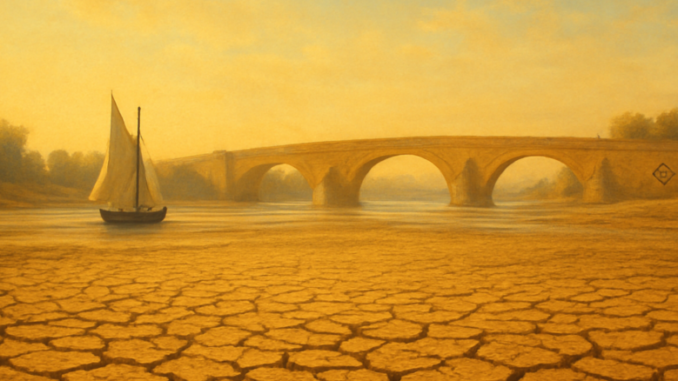
When a nuclear power plant in Hungary has to shut down because the Danube has dropped to historically low levels, most people see a technical problem. But what if this drought tells us something deeper — about the nature of civilizations, the fragility of everything we build, and the ancient wisdom that Freemasons have cherished for centuries? The river that once watched empire after empire rise and fall still whispers the same message.
A River as Witness to Time
The Danube has seen it all. Roman legions marched along her banks. Medieval cathedrals rose in her cities. Emperors and kings laid claim to her waters. Now, in August 2026, this same river has fallen so low that it can no longer provide the cooling water a modern nuclear power plant requires. It is a paradox worth sitting with: our most advanced technology, brought to a standstill by the simple absence of water.
For Freemasons, this image raises a fundamental question. We build temples — not of stone alone, but of ideals, of brotherhood, of moral development. But how enduring are these structures when the current of time suddenly shifts direction? The history of the Danube offers an unexpected mirror.
Heraclitus on the Riverbank
The Greek philosopher Heraclitus once wrote that no man can step into the same river twice. The water flows on; the river is perpetually changing. This insight, more than two thousand years old, takes on an uncomfortable relevance when the river threatens to dry up altogether. What happens to our metaphors when reality overtakes them?
The wisdom of the Master Builder lies not in denying impermanence, but in building with full awareness of it.
Marcus Aurelius — the Stoic emperor who himself fought along the Danube against invading tribes — meditated in his personal journals on the fleeting nature of fame and empire. He wrote about how the names of great conquerors are forgotten, how cities crumble to dust. His Stoic philosophy, which left deep traces in Masonic thought, invites a remarkable peace of mind: not the despair of one who watches everything vanish, but the serenity of one who has accepted the temporary nature of all things.
The River in the Masonic Tradition
Water plays a distinctive role in the ritual tradition of Freemasonry. The symbolism of purification, of transition, of the flowing element that simultaneously renews and washes away — it recurs across different degrees. The river as a boundary between worlds, as a path of transformation, as a source of life and a force of destruction: these are themes that every Brother recognizes who has lived through the rituals with attention and intention.
The operative masons of old — the medieval master builders who raised cathedrals along Europe’s great rivers — understood water’s dual nature intimately. The Danube brought trade and prosperity, but also floods capable of sweeping away entire city quarters. To build beside a river was to build with uncertainty. It required not only craftsmanship but a certain philosophical disposition: the acceptance that every structure is ultimately at the mercy of the elements.
Civilizations as Sandcastles
The historian Edward Gibbon described in his monumental work on the fall of the Roman Empire how even the mightiest civilization can slowly crumble — not through a single catastrophe, but through an accumulation of small cracks in the foundation. The limes along the Danube, once the impenetrable shield of Rome, eventually became a porous border that could not forestall collapse.
When we read today that a nuclear plant has been shut down because the river is too low, we may be witnessing the beginning of such a crack. Or perhaps not. The point is that we don’t know. The future remains inscrutable, even to the best planners and engineers. This is not cause for pessimism, but it is certainly a call for humility.
What Remains?
If everything is impermanent, what is the purpose of building? It is a question every Freemason asks at some point, consciously or not. The answer the tradition offers is not reassuring in a superficial sense, but it is profoundly satisfying: we do not build for the eternity of the result, but for the value inherent in the act of building itself.
The cathedral crumbles, but the wisdom of its master builder can be passed on. The empire falls, but the philosophy it gave birth to remains teachable. The river dries up, but the memory of its course lives on in maps and stories.
Goethe — himself a Freemason who knew the Danube from his travels — wrote about the striving toward something higher as the very essence of human life. Not reaching a final destination, but the continuous act of being on the way. The river is a fitting image here: it flows, sometimes full and sometimes dry, but its bed remains a path that invites us to follow.
The Paradox of Vulnerability and Strength
A nuclear power plant shut down by low water levels is an image of vulnerability. But it is also an image of wisdom. The engineers chose to stop, to take no unnecessary risks, to respect the boundaries of what is possible. In that choice lies an ancient insight: knowing when to build, but also when to wait.
Freemasonry teaches that strength does not lie in denying weakness, but in honestly acknowledging it. The Master is not the one who never fails, but the one who knows his failures and grows wiser through them. The Danube, now too low to cool a power plant, will rise again. And fall again. And rise again. That is the way of rivers. That is the way of civilizations. That is the way of us all.
What remains when the river runs dry? Not the stones of its banks, not the ships that once sailed its waters, not the power plants that drew their energy from its flow. What remains is the question itself — the eternal wonder at the nature of things, the impulse to build in full knowledge of impermanence, and the quiet conviction that the act of building, of striving, of seeking meaning, is itself the answer. That is the lesson the Danube whispers to every Brother willing to listen.
Copyright text & image: devrijmetselaar.nl
Texts are based on the ideas and content of the author of devrijmetselaar.nl, reviewed, corrected, and supplemented with the assistance of OpenAI. Images are created based on the ideas of the author of devrijmetselaar.nl using OpenAI/DALL-E.
Frequently Asked Questions
What is the connection between rivers and Freemasonry?
In Freemasonry, water and rivers hold deep symbolic meaning, representing purification, transformation, and transition between different states of being. The river serves as a boundary between worlds and a path of spiritual renewal, themes that are central to Masonic ritual and philosophy. Medieval operative masons who built cathedrals along Europe's rivers understood both water's life-giving and destructive power, which teaches us to build with awareness and intention.
How does Freemasonry teach us to deal with impermanence?
Freemasonry embraces the ancient wisdom of philosophers like Heraclitus and Marcus Aurelius, who understood that all things are temporary and constantly changing. Rather than despair at impermanence, Masonic philosophy teaches us to build our ideals, brotherhood, and moral development with full awareness of life's fleeting nature, finding peace and serenity in acceptance of this universal truth.
What does the Danube drought teach us about civilization?
The Danube's historically low water levels remind us that even our most advanced civilizations and technologies depend on natural forces beyond our control, and that empires and structures inevitably change throughout time. Freemasonry teaches that true strength lies not in denying this reality, but in building with wisdom, craftsmanship, and awareness of our connection to something greater than ourselves.
Why do Freemasons study Stoic philosophy?
Stoic philosophy, particularly the teachings of Marcus Aurelius, has deeply influenced Masonic thought because it offers a path to inner peace and moral development in the face of life's uncertainties. The Stoic acceptance of impermanence and focus on virtue and brotherhood align perfectly with Freemasonry's core principles of personal growth and dedication to the greater good.

Be the first to comment