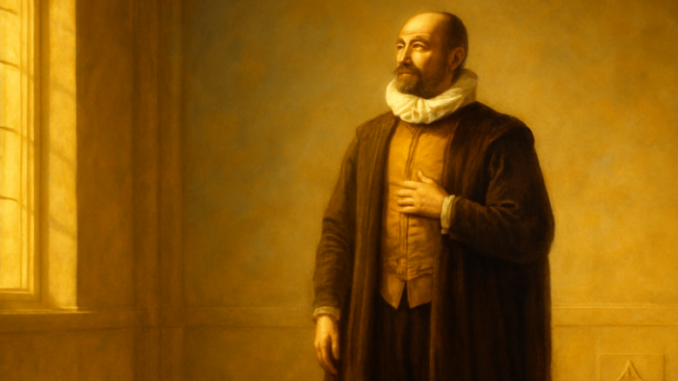
An old man sits in silence beside the bed of his dying friend. No words remain — only the warmth of a hand resting upon a hand. And yet he feels something within himself reaching beyond this moment, beyond this room, beyond his own boundaries. It is precisely this mystery that the sixteenth-century philosopher Michel de Montaigne sought to understand: how our emotions can transcend our bodies and our time, and what that reveals about the nature of human connection.
The Question Montaigne Asked
In his essay Whether Our Emotions Carry Themselves Beyond Us, Montaigne examines a riddle that every thoughtful person has encountered at some point. Why do we worry about what will happen after we die? Why do we feel sorrow now for future losses, or joy for events we will never live to witness? It seems irrational, yet it is profoundly human.
Montaigne suggests that the soul is not imprisoned within the boundaries of the body or a single lifespan. It extends outward — toward others, toward the future, toward ideals larger than ourselves. This insight touches a fundamental truth about human existence: we are not isolated islands. Our emotions, our worries, and our dreams weave themselves through the lives of others. A father who saves for grandchildren he may never meet. An artist who labors over a masterpiece that will only be recognized after his death. Again and again, we see the human spirit refusing to confine itself to the here and now.
Brotherhood as an Expression of Far-Reaching Feeling
Within Freemasonry, brotherhood is not regarded as a casual gathering of like-minded individuals. It is a consciously cultivated bond that reaches far beyond personal interest. When Freemasons recognize one another as brothers, the recognition does not apply only to those present in the lodge at that particular moment. It encompasses a chain stretching back through generations before us and forward to those who will come after. This sense of continuity resonates beautifully with Montaigne’s observation that our feelings transcend the boundaries of time and space.
We plant trees whose shade we will never enjoy, and yet the planting itself gives us satisfaction.
This old saying, found across many traditions, captures what both Montaigne and Freemasonry recognize. The act of giving without direct return, of building without seeing the structure completed — these are expressions of a soul that reaches beyond its own existence. In Freemasonry, this is translated into the work upon the rough ashlar: not for personal gain, but as a contribution to a greater edifice.
Self-Reflection as a Bridge to Others
Montaigne was a master of self-reflection. His essays are ongoing dialogues with himself — attempts to understand his own character and motivations. But this introspection was never narcissism. On the contrary: by knowing himself, he hoped to understand the human condition. And by understanding the human condition, he could connect with others across the boundaries of time and culture.
Freemasonry follows a remarkably similar path. The work on the rough ashlar — the symbolic pursuit of self-improvement — begins with an honest look inward. But the goal is not to become a polished stone that shines only for itself. The polished stone fits into a greater whole, a temple of humanity. Self-reflection is therefore not an endpoint but a starting point for connection.
The Search for Truth as a Shared Journey
Another theme that Montaigne and Freemasonry share is the search for truth. Montaigne was deeply skeptical of absolute certainties. He believed that truth cannot be captured in dogma but can only be approached through continuous inquiry and dialogue. This is a humble stance — one that acknowledges we cannot know everything, while affirming that the search itself holds value.
In Freemasonry, light is often used as a symbol for knowledge and truth. But it is telling that this light is never considered fully attained. The Freemason continues to seek, continues to ask questions, continues to work. This is not a sign of weakness but of wisdom. The recognition that truth is a horizon that recedes as we approach it connects us with every seeker who came before and every one who will follow.
Emotions That Span Generations
What Montaigne describes as emotions that reach beyond ourselves can also be understood as a form of moral responsibility. We feel accountable for the world we leave behind — not because this is logical from a perspective of narrow self-interest, but because we intuitively sense that our lives are part of a larger story. This sense of responsibility is one of the pillars of Freemasonry. The pursuit of moral perfection is not for ourselves alone; it is for the community and for the future.
Consider these interconnected themes that emerge from both Montaigne’s philosophy and Masonic tradition:
Brotherhood: the recognition that we are connected across all boundaries. Self-reflection: the inward journey as a route toward others. The search for truth: a shared voyage without a final destination. Moral responsibility: working for those who will come after us.
These themes form a web of connection recognizable in both Montaigne’s philosophy and in Freemasonry. They invite us to look beyond the immediate, the tangible, and the merely personal.
When we read Montaigne through the eyes of a Freemason, we discover a thinker who understood what it means to be part of something greater. His essay on emotions that carry themselves beyond us is not an abstract philosophical exercise — it is an invitation to connection. It reminds us that our actions, our concerns, and our love do not stop at the boundaries of our bodies or our time. They weave themselves through the fabric of humanity, touching others we will never meet, contributing to an edifice we will never see completed. And perhaps that is the deepest form of brotherhood there is.
Copyright text & image: devrijmetselaar.nl
Texts are based on the ideas and content of the author of devrijmetselaar.nl, reviewed, corrected, and supplemented with the assistance of OpenAI. Images are created based on the ideas of the author of devrijmetselaar.nl using OpenAI/DALL-E.
Frequently Asked Questions
What does Montaigne mean by emotions transcending our bodies and time?
Montaigne suggests that our emotions and concerns extend beyond our individual lifespans and physical boundaries—we can feel joy for future generations we'll never meet or sorrow for events after our death. This reveals that the human soul is inherently connected to others and to ideals larger than ourselves, refusing to be confined to the present moment.
How does Freemasonry relate to Montaigne's philosophy of connection?
Freemasonry embodies Montaigne's insight by cultivating brotherhood that transcends time and space, creating bonds that stretch across generations past and future. When Freemasons work together on the rough ashlar, they contribute to a greater edifice without expecting personal gain, demonstrating the human spirit's capacity to reach beyond its own existence.
What does 'planting trees whose shade we will never enjoy' mean in a Masonic context?
This saying reflects the Masonic principle of contributing to something greater than oneself, building and improving for future generations rather than immediate personal benefit. It symbolizes the selfless work Masons undertake, understanding that true fulfillment comes from participating in a legacy that extends beyond their lifetime.
How can self-reflection help us connect with others, according to this article?
By deeply understanding ourselves through reflection, we gain insight into the universal human condition, which allows us to genuinely connect with others across time, culture, and circumstance. This practice, valued both by Montaigne and in Freemasonry, transforms introspection into a bridge for authentic human connection and brotherhood.


Be the first to comment