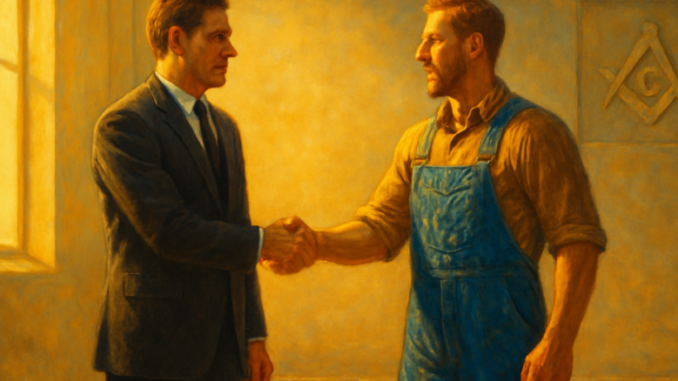
In conversations about Freemasonry, the word “brotherhood” comes up time and again. Some people equate it with close friendships or social networking, and while there is certainly overlap between the two concepts, brotherhood in the Masonic sense is something fundamentally different. Understanding this distinction sheds light on what makes Freemasonry such a unique and enduring institution.
What Is Friendship?
Friendship is a personal bond between people who appreciate and support one another. It grows from shared interests, mutual respect, and genuine affection. Friends choose each other, spend time together, and share personal experiences that deepen their connection over time.
Friendship is intimate yet voluntary — and often shaped by circumstance. Friends may come and go as careers shift, families grow, or life takes unexpected turns. This doesn’t diminish the value of friendship, but it does reveal its nature: it is personal, selective, and sometimes transient.
What Is Masonic Brotherhood?
Brotherhood within Freemasonry runs deeper than friendship. It is not a relationship that forms through shared hobbies or chance encounters — it is forged through a shared dedication to a set of ideals.
Freemasons are bound to one another as brothers regardless of differences in background, social status, or personal beliefs. The relationship is rooted in core values such as mutual respect, equality, and the pursuit of personal growth.
In Masonic brotherhood, the focus shifts away from personal preferences and toward a common purpose: building a better world by first working to improve oneself. This shared mission creates a bond that transcends the individual.
Key Differences Between Brotherhood and Friendship
While brotherhood and friendship overlap in meaningful ways, several important distinctions set them apart:
Purpose: Friendship revolves around personal affection and shared experiences. Brotherhood, on the other hand, centers on mutual support in the pursuit of higher ideals and moral development.
Commitment: Friendship tends to be informal, shaped by personal preferences and convenience. Brotherhood is formal — grounded in a shared commitment to the values and obligations of the Masonic craft.
Inclusivity: Friendships often form between people who are similar in background or outlook. Brotherhood transcends those differences, uniting men from vastly different walks of life under a common set of principles.
Permanence: Friendships can fade or change as circumstances evolve. Brotherhood is a lasting bond within the Order, continuously strengthened through ritual, shared symbolism, and collective experience.
Why Does Brotherhood Matter?
Brotherhood provides a foundation of trust and support that goes beyond personal ties. Freemasons know they can rely on their brothers even when they don’t know each other well on a personal level. This universal connection is one of the things that makes Freemasonry truly distinctive.
Beyond mutual support, brotherhood offers a safe space for introspection and self-development. In a world where differences so often breed division, the Masonic lodge provides a place of unity and understanding — a setting where men can reflect honestly on themselves and grow alongside others doing the same.
Can Brotherhood and Friendship Coexist?
Absolutely. Brotherhood doesn’t exclude friendship — in fact, deep and lasting friendships frequently blossom within the lodge. Many Masons count their brothers among their closest friends.
The crucial difference, however, is that brotherhood endures even in the absence of personal friendship. Two Masons who have never met socially still share a bond of obligation and mutual care. This is what makes Freemasonry so remarkable: the strength of the connection transcends individual relationships.
Brotherhood and friendship are both profoundly valuable, but they differ in essence. Where friendship is built on personal connection, Masonic brotherhood is rooted in shared ideals and a deeper sense of purposeful unity. Within Freemasonry, brotherhood serves as a cornerstone of the Order — a bond stronger than circumstance and the foundation for both personal and collective growth. As the old saying goes: “A brother is always a friend, but a friend is not always a brother.” If you’re curious about what this unique bond feels like in practice, consider reaching out to a local lodge and discovering what Masonic brotherhood could mean for you.
Copyright text & image: devrijmetselaar.nl
Texts are based on the ideas and content of the author of devrijmetselaar.nl, reviewed, corrected, and supplemented with the assistance of OpenAI. Images are created based on the ideas of the author of devrijmetselaar.nl using OpenAI/DALL-E.
Frequently Asked Questions
What is the main difference between Masonic brotherhood and regular friendship?
While friendship is based on personal affection and shared interests, Masonic brotherhood is forged through a shared dedication to core ideals like mutual respect, equality, and personal growth. Brotherhood transcends individual preferences and circumstances, creating a lasting bond that unites men from different backgrounds under common Masonic principles.
Can Freemasons be friends with each other?
Absolutely! Freemasons can and do develop genuine friendships with one another. However, Masonic brotherhood encompasses something deeper—a formal commitment to support each other in pursuing higher ideals and moral development, regardless of whether a personal friendship exists.
Is Masonic brotherhood permanent?
Yes, Masonic brotherhood is designed to be a lasting bond within the Order. Unlike friendships that may fade as circumstances change, brotherhood is continuously strengthened through shared ritual, symbolism, and collective experience, creating an enduring connection between members.
How does Freemasonry bring together men from different backgrounds?
Masonic brotherhood is fundamentally inclusive, uniting men from vastly different social statuses, professions, and personal beliefs under a shared commitment to core values. This creates a unique environment where equality and mutual respect form the foundation of all relationships within the Order.
What makes Masonic brotherhood unique compared to other organizations?
Masonic brotherhood combines formal commitment to higher ideals with universal inclusivity and permanence. The bond goes beyond social networking or shared hobbies—it is rooted in ritual, symbolism, and a collective mission to build a better world through personal and moral development.



Be the first to comment