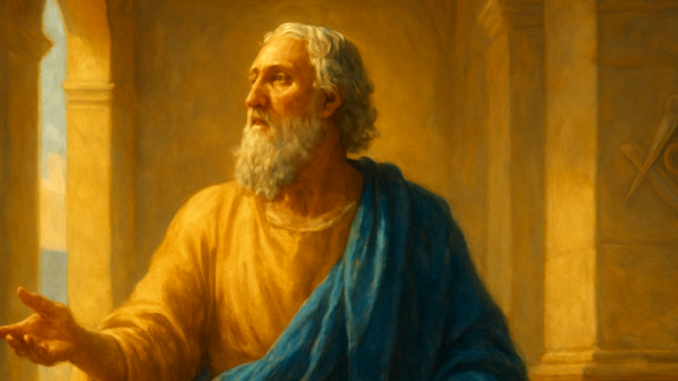
Picture yourself sitting across from a wise teacher. You ask him whether becoming a good person is something you can learn, or whether it’s something you must be born with. He looks at you and says: that depends on what you mean by learning. This is precisely the question Plato posed over two thousand years ago in his dialogue Protagoras. And it is the same question Freemasons ask themselves every time they enter the lodge.
What Did Plato Actually Mean by Teachability?
In the Protagoras, Plato stages a conversation between his teacher Socrates and the renowned Sophist Protagoras. The central question seems straightforward enough: can virtue be taught? Protagoras insists it can. After all, he makes his living selling wisdom, teaching young Athenians how to become better citizens. Socrates isn’t so sure. If virtue can truly be taught, why do so many excellent fathers fail to pass their virtue on to their sons?
But here’s the crucial nuance: Socrates does not deny that people can grow in virtue. What he challenges is the method. Can you transmit virtue the way you teach someone arithmetic? Or does moral growth demand something different — something deeper? This distinction matters enormously for anyone who takes personal development seriously.
Why Do These Questions Resonate So Deeply with Freemasonry?
Freemasonry explicitly does not present itself as a school that hands out ready-made answers. And yet the entire structure of the fraternity is designed to help its members grow in virtue. How do you reconcile that? The answer lies in the kind of learning Freemasonry champions. The lodge is not a lecture hall. No one sits an exam on right and wrong. Instead, the fraternity provides an environment in which self-reflection takes center stage.
Virtue is not something you receive — it is something you develop through continual practice in connection with others.
This is the surprising point where Plato and the Masonic tradition converge. Both recognize that moral growth does not work through passive transfer of knowledge. It demands active engagement — ritual, community, and the willingness to question yourself honestly.
Is Community the Key?
In the dialogue, Protagoras tells a myth about Prometheus and Epimetheus. The gods, he explains, gave humanity two essential gifts to make civilization possible: a sense of shame and a sense of justice. Without these social virtues, no city could survive. It’s a striking detail: virtue is presented here not as an individual achievement but as something that emerges in relationship with others.
Freemasons recognize this immediately. The fraternity is not a random collection of individuals who happen to share a room. It is a network of meaningful connections in which members mirror, support, and challenge one another. The rituals emphasize again and again that no one travels alone. You develop in and through the community.
How Does This Work in Practice?
Consider what Freemasonry does on a practical level. A new member progresses through degrees. Each degree introduces new symbols, new questions, and new responsibilities. This is not an arbitrary structure. It reflects a profound insight: moral growth happens in stages. You cannot become perfect overnight. You build, layer by layer, a stronger inner foundation.
Self-reflection is stimulated through ritual questions and symbols. Brotherhood provides a safe space to practice virtue. Degrees mark growth and call members to new levels of responsibility. The ritual itself is a form of practice, not a lesson from a textbook.
Aristotle, Plato’s student, would later write that virtue is a matter of habit — you become just by performing just acts. Freemasonry applies this principle directly. The ritual is not theater; it is exercise. Every meeting is an opportunity to practice what you aspire to become.
What Does This Mean for the Search for Light?
In Masonic tradition, knowledge is often described as light. The search for light is the search for insight, for truth, for a deeper understanding of yourself and the world around you. But this light is not something you simply receive by reading a book or attending a lecture. It grows within you as you practice, reflect, and seek connection with others.
Plato would recognize this immediately. In his later works, he describes the philosopher as someone climbing out of a cave, slowly adjusting to the brightness. This is not a passive process. It takes courage, perseverance, and the willingness to release old certainties. The parallel with the Masonic journey is striking: both traditions view growth as an active, ongoing effort that never truly ends.
What Can We Take Away from All This?
The dialogue between Socrates and Protagoras ends without a definitive conclusion. Both thinkers, remarkably, find themselves drifting toward each other’s positions. Perhaps that is the deepest lesson of all: the question of whether virtue can be taught matters less than the willingness to keep searching. The conversation itself — the ongoing inquiry — is the path.
Freemasonry offers no final answers. What it does offer is a structure for that continuous search. A brotherhood that invites you to question yourself, to grow, and to do all of this in the company of others who are on the same journey. In that sense, the lodge is a modern echo of the Athenian dialogue: a place where the question of how to live a good life never falls silent.
The question Plato raised still resonates today. Can virtue be taught? The answer suggested by both the Protagoras and the Masonic tradition is nuanced: not through instruction alone, but through practice, community, and relentless self-reflection. Those who are willing to walk that path discover that moral growth is not a destination but a journey — one best undertaken not alone, but in the company of fellow travelers.
Copyright text & image: devrijmetselaar.nl
Texts are based on the ideas and content of the author of devrijmetselaar.nl, reviewed, corrected, and supplemented with the assistance of OpenAI. Images are created based on the ideas of the author of devrijmetselaar.nl using OpenAI/DALL-E.
Frequently Asked Questions
What is the main question Plato explores in his dialogue Protagoras?
Plato explores whether virtue can be taught or if it is something one must be born with. Through a conversation between Socrates and the Sophist Protagoras, he examines not just whether virtue can be taught, but how it is actually learned—distinguishing between passive transfer of knowledge and deeper moral growth that requires active engagement.
How does Freemasonry approach teaching virtue differently from traditional education?
Freemasonry does not present itself as a school that hands out ready-made answers. Instead, it provides an environment centered on self-reflection where virtue is developed through continual practice in connection with others. The lodge functions through ritual and community engagement rather than lectures or exams, aligning with Plato's view that moral growth demands something deeper than passive knowledge transfer.
What role does community play in moral development according to the article?
According to the article, community is essential to moral development. Both Plato's dialogue and Masonic tradition recognize that virtue is not an individual achievement but something that develops through social interaction. Protagoras illustrates this through a myth about divine gifts of shame and justice—social virtues necessary for civilization—suggesting that moral growth is inherently connected to our relationships with others.



Be the first to comment