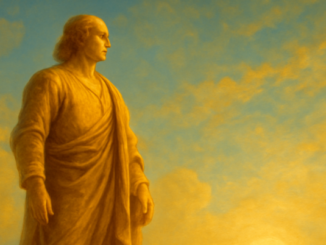
Voltaire's Micromégas gazing down at Earth symbolizing Masonic humility
Symbolism & Rituals

Voltaire’s Micromégas and the Masonic Lesson of Humility

In 1752, Voltaire published a remarkably short story that continues to captivate philosophers and readers to this day. Micromégas tells the tale of an enormous being who descends from the stars to visit Earth and encounters humanity. What Voltaire achieved with this seemingly lighthearted adventure was nothing less than a radical reassessment of our human self-image — a philosophical fairy tale that forced his contemporaries to reconsider their assumed greatness. For Freemasons, the story holds a particular resonance: humility and self-knowledge stand at the very heart of the Masonic tradition. A Giant from Sirius Visits Earth The story opens with the introduction of Micromégas, an inhabitant of a planet orbiting the star Sirius. This being stands an astonishing 120,000 feet tall — a height utterly beyond our comprehension. Voltaire describes how Micromégas travels the universe driven by scientific curiosity and philosophical inquiry. Along the way, he meets a resident of Saturn who, at 6,000 feet, is considerably smaller but still gigantic by earthly standards. Together, these two beings journey to our planet. When they reach Earth, they initially see nothing remarkable. The oceans appear as tiny puddles, the mountains as insignificant hillocks. Only after a lengthy search, using a magnifying […]

Rough ashlar stone with gavel and chisel symbolizing Masonic self-reflection
Michel de Montaigne – Freemasonry & Connection

Montaigne on Preaching Virtue: When Good Intentions Fail

You probably recognize this scenario: someone with the best of intentions lectures others about how they should live, while quietly struggling with those very same shortcomings. Or perhaps you’ve caught yourself offering unsolicited advice when your own house was far from being in order. In the sixteenth century, Michel de Montaigne wrote a remarkably short but incisive essay on this very phenomenon — that preaching virtue can itself become a kind of vice. His observation touches on something that also lies at the heart of Freemasonry: true wisdom begins with self-reflection, not with correcting others. The Paradox of Moral Admonition Montaigne observed that some people are so busy proclaiming virtue that they forget to practice it themselves. Preaching becomes a form of self-deception — a way of masking personal failings behind a façade of moral superiority. The philosopher from Bordeaux had little patience for this kind of posturing. He saw clearly how rhetorical display so often substitutes for genuine character development. This is not a cynical observation but a call for honesty. Montaigne genuinely believed in virtue, yet he understood that true virtue is quiet work. It is the daily discipline of self-examination, the willingness to face your own shadow […]

Masonic symbols representing the agnostic search for truth and meaning
Philosophy & Ethics

Agnosticism and Freemasonry: The Art of Not Knowing

What if the answer to life’s greatest questions isn’t a definitive yes or no, but an honest “I don’t know”? Agnosticism makes room for exactly that kind of intellectual humility. Far from being a position of weakness, it takes genuine courage to acknowledge that some truths may lie beyond our reach. In Freemasonry, we find a remarkable kinship with this philosophical stance — not as doctrine, but as a living practice of seeking without the pretense of final answers. What Does Agnosticism Actually Mean? The word “agnostic” has its roots in Greek: “a” means without, and “gnosis” means knowledge. An agnostic is, quite literally, someone who acknowledges that certain knowledge — particularly about the existence of a higher power or the ultimate purpose of the universe — may be fundamentally unattainable. This is not intellectual laziness. It is a deeply considered epistemological position. The agnostic doesn’t claim that truth doesn’t exist, but rather that we as human beings may lack the tools to fully grasp it. The term was first coined in the nineteenth century by the British biologist Thomas Henry Huxley, who grappled with the question of how we can truly know what we think we know. Since then, […]