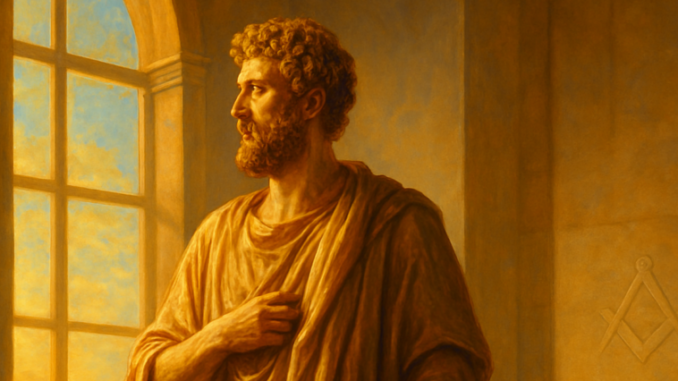
Death is the great mystery that every person must eventually face. In the ninth book of his Meditations, Marcus Aurelius writes about mortality with remarkable calm, reflecting on what remains after this life ends. His words, penned in the second century AD, prove surprisingly close to insights that Freemasons have cherished for centuries. How do these two perspectives relate to each other? And what can we, in our own search for meaning, learn from both?
The Stoic View of Mortality
For Marcus Aurelius, death was not an enemy to be feared but a natural transition to be accepted. In Book IX of the Meditations, he reflects on the impermanence of all things — fame, possessions, even the memory of who we once were. The philosopher-emperor saw death as a return to the elements from which we came. There is no drama in his words, only the sober recognition that everything alive is subject to change.
This vision was rooted in the Stoic worldview, which sees the cosmos as a single living whole, permeated by a divine reason or logos. The individual soul is a spark of this greater whole. At death, that spark returns to its source. For Marcus Aurelius, this meant that immortality does not lie in the survival of the personal self, but in the ongoing cycle of creation and dissolution of which we are all a part.
Freemasonry and the Mystery of Death
Within Freemasonry, the confrontation with mortality also plays a central role — though in a different way. During the rituals, the candidate is symbolically confronted with the finite nature of existence. The symbolism of death, often represented by the skull or the black cloth, is not meant to instill fear but to awaken awareness. The Freemason is invited to reflect on what is truly lasting in a human life.
Unlike the Stoic, who emphasizes a cosmic return, the Freemason focuses on moral immortality. The question is not so much what physically remains after death, but what trace we leave in the hearts of others. Virtuous action, brotherhood, and the ongoing labor on the rough ashlar form the legacy a person can leave behind. In this sense, immortality is not a metaphysical given — it is a moral calling.
Where Both Perspectives Converge
Despite their different starting points, Stoic philosophy and Freemasonry share a fundamental conviction: death gives life its meaning. Without finitude, every action would become arbitrary. It is precisely the knowledge that our time is limited that compels us to choose consciously how we spend it.
Immortality lies not in escaping death, but in leaving behind a life that deserves to be remembered.
Both Marcus Aurelius and the Masonic tradition point to the necessity of self-reflection. The emperor asked himself daily whether he had lived according to his principles. The Freemason, at the close of lodge, symbolically lays down his working tools and reflects on the quality of his labor. Neither seeks external validation — both seek inner truth.
The Meaning of Connection
A notable difference lies in the role of community. Marcus Aurelius wrote his Meditations for himself, as personal exercises in wisdom. While he acknowledged the importance of compassion toward others, his practice was essentially solitary. Freemasonry, on the other hand, is by definition a brotherhood. The work on oneself takes place within a circle of like-minded individuals who support and correct one another.
This emphasis on connection gives a different color to the theme of immortality. Where the Stoic finds consolation in dissolving into the cosmic whole, the Freemason finds comfort in the chain of brethren who came before and who will follow after. Symbols, rituals, and values are passed down from generation to generation. In that transmission, something endures that is greater than any individual.
What We Can Learn From Both Traditions
Comparing Marcus Aurelius with the Masonic tradition teaches us that there are multiple paths to making peace with our mortality. The Stoic path emphasizes acceptance and the letting go of attachment to the temporary. The Masonic path emphasizes action and the conscious shaping of a legacy that inspires others.
The Stoic asks: Did I live today in accordance with reason?
The Freemason asks: Did I contribute today to the edifice of humanity?
Both ask: What will remain when I am gone?
Neither perspective claims to hold the ultimate truth — nor does it need to. The power lies in the willingness to ask the great questions without demanding definitive answers. Just as Marcus Aurelius wrote that we are all merely a moment in the infinite stream of time, so the Freemason reminds himself that the temple is never finished — but that every stone matters.
The words of Marcus Aurelius on death and immortality still ring clear, nearly two millennia after they were written. His Stoic serenity finds an echo in the Masonic rituals that invite us to accept our own finitude and transform it into virtuous action. Both traditions offer no escape from mortality, but a way to meet it with dignity. The question they pose is not whether we can avoid death, but whether we can lead a life truly worthy of the name.
Copyright text & image: devrijmetselaar.nl
Texts are based on the ideas and content of the author of devrijmetselaar.nl, reviewed, corrected, and supplemented with the assistance of OpenAI. Images are created based on the ideas of the author of devrijmetselaar.nl using OpenAI/DALL-E.

Be the first to comment