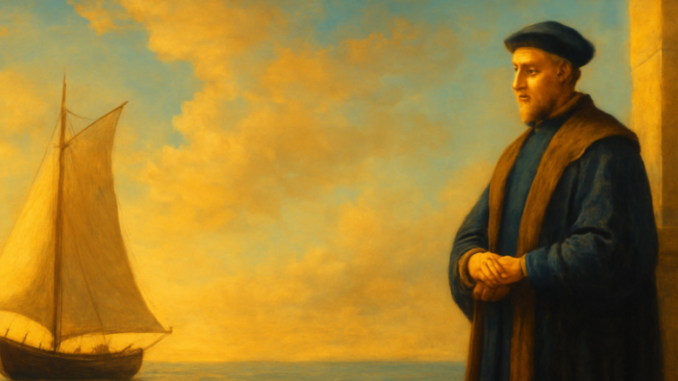
When you stand in front of your wardrobe each morning, you probably don’t consider the centuries-old philosophical traditions shaping your clothing choices. Yet that is precisely what Michel de Montaigne did when he wrote his essay ‘On the Custom of Wearing Clothes’ in the sixteenth century. This short but remarkably layered essay draws on a rich intellectual heritage stretching back to the Stoics, the Skeptics, and classical antiquity. For Freemasons, it holds up a surprising mirror: what do we conceal with our outward appearance, and what do we reveal when we strip that layer away?
The Stoic Foundation: Nature as the Standard
Montaigne’s thinking about clothing is deeply rooted in Stoic philosophy. Seneca and Epictetus — two thinkers Montaigne studied intensively — both emphasized that nature provides us with everything we truly need. In this tradition, clothing arose not from natural necessity but from human vanity and cultural convention. In his letters to Lucilius, Seneca wrote that true wealth lies in limiting our needs, not in multiplying our possessions. Montaigne takes this insight quite literally: if some peoples can live without clothing, why have we become so utterly dependent on textiles and fashion?
Marcus Aurelius added that anything nature does not directly provide eventually becomes a chain that binds us. This idea resurfaces when Montaigne describes how clothing has weakened our bodies. Where our ancestors waded barefoot through freezing rivers, we can barely endure a gust of wind without shivering. The Stoics would recognize this as a loss of autarkeia — self-sufficiency and independence from external circumstances. It is a powerful reminder that comfort, left unchecked, can erode the very resilience it was meant to protect.
Skeptical Doubt: Is Clothing Truly Necessary?
Alongside Stoicism, Pyrrhonist Skepticism fundamentally shaped Montaigne’s approach. Sextus Empiricus, whose works Montaigne knew well, taught that we must constantly question our assumptions. Why do we believe clothing is essential? Because our parents told us so? Because everyone around us gets dressed each day? The Skeptics pointed out that cultural habits do not constitute proof of universal truths.
Montaigne applies this method by citing examples of peoples who wear little or no clothing and yet thrive. He openly wonders whether our Western clothing habits are a cultural construction rather than a biological necessity. This radical doubt is characteristic of his thought: nothing is self-evident, and everything deserves examination. To a modern reader this may sound almost postmodern, but Montaigne was drawing directly on skeptical sources two thousand years old.
Renaissance Humanism: The Individual as Measure
Renaissance humanism provided the immediate intellectual context in which Montaigne wrote. Erasmus, Pico della Mirandola, and other humanists rediscovered classical texts and applied them to their own era. Central to their vision was the conviction that human beings can shape themselves — that we are not pinned down by birth or culture. Montaigne shared this optimism but tempered it with his characteristic humility.
Clothing is the first symbol we adopt to present ourselves to the world, yet the last thing we set aside when we truly wish to know ourselves.
Plutarch, one of Montaigne’s favorite authors, wrote extensively about virtue and outward display. He warned that we cannot judge a person’s character by their garments. A magnificent robe can conceal an empty soul, while simple clothing sometimes covers the greatest wisdom. Montaigne cites Plutarch regularly and builds on his insight that true virtue comes from within, never from without.
Inside the Lodge: Where Appearance Is Set Aside
For Freemasons, these philosophical threads resonate with particular force. In the Lodge, every Brother wears the same ritual clothing regardless of social status or income. This practice reflects exactly what Montaigne and his philosophical predecessors argued: when we equalize the external, the internal comes to the fore. The Masonic apron is not an ornament — it is a reminder of craftsmanship, simplicity, and honest labor.
The Stoic lesson asks us to consider which external trappings we genuinely need and which ones create unnecessary dependency. The Skeptic lesson encourages us to question cultural assumptions we have never examined. And the humanist tradition reminds us that we can choose how we present ourselves to the world. Within the ritual space of the Lodge, these ideas are not abstract philosophy — they are lived experience every time a Brother ties on his apron and leaves his worldly distinctions at the door.
From Theory to Practice: A Daily Exercise
How can you apply these insights in your own life? Start with a simple exercise. Tomorrow morning, look at your clothing choice with full awareness and ask yourself: am I choosing this to protect myself from the elements, or to make a particular impression on others? Both answers are legitimate, but becoming conscious of your motivation transforms your relationship with what you wear.
Consider these practical steps:
- Identify garments you wear out of habit rather than conviction.
- Ask yourself what impression you want to create — and why.
- Experiment with simpler clothing and observe how people respond.
- Reflect on moments when a uniform or ritual dress freed you from the pressure of status.
Montaigne’s essay invites what the Stoics called prosoche — attentiveness to our daily actions. Clothing may seem trivial, but upon closer inspection it reveals our deepest assumptions about nature, culture, and identity. The philosophical traditions that influenced Montaigne offer no definitive answers, but they do provide the right questions.
Montaigne’s essay on clothing is far more than a historical curiosity. It weaves together Stoic practical wisdom, Skeptical inquiry, and Humanist idealism into a coherent argument about appearance and essence. For Freemasons, the theme is deeply familiar: the ongoing search for what lies behind the outward show. Every time we set aside the markers of rank and wealth and meet as equals in the Lodge, we enact what Montaigne spent a lifetime trying to articulate — that who we truly are is never found in what we wear, but in what remains when all coverings have been removed.
Copyright text & image: devrijmetselaar.nl
Texts are based on the ideas and content of the author of devrijmetselaar.nl, reviewed, corrected, and supplemented with the assistance of OpenAI. Images are created based on the ideas of the author of devrijmetselaar.nl using OpenAI/DALL-E.


Be the first to comment