In October 2026, news broke that Arsenal Football Club had laid off dozens of staff members — shortly after head coach Mikel Arteta received a substantial pay rise. The stark contrast between one individual’s reward and the loss of livelihood for many others raises an ancient question that thinkers have grappled with for millennia: what is justice? It is a question that sits at the very heart of Freemasonry, where the pursuit of balance, equity, and moral integrity forms the core of its philosophical heritage.
Aristotle and Distributive Justice
To make sense of what happened at Arsenal, it helps to turn to the Greek philosopher Aristotle, whose Nicomachean Ethics remains foundational to our understanding of justice. Aristotle distinguished between several forms of justice, and the one most relevant here is distributive justice — the question of how scarce resources should be divided fairly among members of a community.
According to Aristotle, distribution should be proportional to merit. But he also recognized that different societies define merit in different ways. In a democracy, equality carries great weight; in an aristocracy, lineage; in an oligarchy, wealth. The tension we see at Arsenal today — between the reward of a single individual and the welfare of a collective — is therefore not a modern phenomenon. It is a dilemma that civilizations have wrestled with for two and a half thousand years.
The Square: A Symbol of Fairness
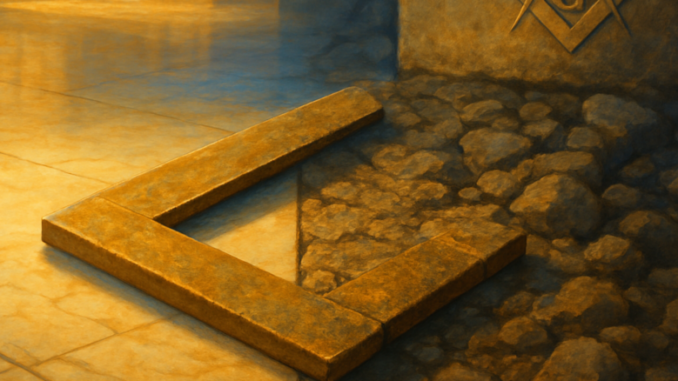
In Freemasonry, the square occupies a central role as both a working tool and a symbol. Originally used by stonemasons to verify right angles, the square represents rectitude and fairness in one’s conduct within the Masonic tradition. Every Freemason is encouraged to test his actions against this symbolic square: are my deeds upright and just?
It would be easy to condemn Arsenal’s leadership outright as unjust. But Masonic philosophy invites us to reflect more deeply. The square asks us to consider not only the outcome of a decision, but also the intention behind it and the circumstances surrounding it. Were there genuine economic pressures? What alternatives existed? The symbolism of the square compels us to look beyond first impressions and examine the full picture before passing judgment.
Adam Smith on Sympathy and Self-Interest
The Scottish philosopher and Freemason Adam Smith is often reduced to his famous remarks about the invisible hand and the pursuit of self-interest. But in his Theory of Moral Sentiments, published in 1759, Smith wrote extensively about sympathy as the foundation of moral conduct. Smith, who was a member of a Scottish lodge, emphasized that human beings are naturally inclined to empathize with the fate of others.
True justice, Smith argued, does not arise from rules alone — it emerges from our capacity to place ourselves in the shoes of those affected by our decisions.
Smith would likely have analyzed the Arsenal situation from this very perspective of sympathy. Did the decision-makers put themselves in the position of the laid-off workers? Did they weigh the consequences for families, for life plans, for human dignity? Masonic philosophy, steeped in the Enlightenment values that Smith championed, demands precisely this kind of moral imagination.
The Building Metaphor and the Value of Every Stone
One of the most powerful metaphors in Freemasonry is that of construction. Every Brother is seen as a rough ashlar — an unpolished stone that, through self-improvement, is refined into a block worthy of its place in a greater edifice. This image underscores a vital truth: no single stone is expendable. A cathedral, however grand, depends on the integrity of each individual stone.
Applied to a modern organization like a football club, this means that the greatness of the whole depends on the value placed on every part. The head coach may be the visible face of the team, but without the people who maintain the pitch, run the administration, develop young players, and welcome supporters, there is no club. The building metaphor reminds us that hierarchy is not the same as worth.
A Lesson for Our Times
What can we learn from this philosophical richness when confronted with news of glaring inequality? First, that moral outrage — however understandable — is not enough. Masonic philosophy calls us to self-reflection: how do we ourselves act in situations where we hold power over the well-being of others? Second, that justice is not an abstract concept but a daily practice that begins with acknowledging the dignity of every human being.
The situation at Arsenal is ultimately a mirror. Not just for the club’s leadership, but for anyone who finds themselves in a position to make decisions that affect others. The square — the Freemason’s enduring symbol — asks us again and again: is my conduct upright? Is it fair? Can I justify it, not only before the law or the market, but before my own conscience and before the community of which I am a part?
The painful round of layoffs at Arsenal reminds us that questions of justice never disappear — they merely change their form. From Aristotle in ancient Athens to Adam Smith in Enlightenment Scotland, and to the symbols that Freemasons continue to use today, the pursuit of fairness is a constant thread in human history. It is a pursuit that does not end with moral indignation but begins with the willingness to examine ourselves. Just as every rough ashlar must be shaped and refined, so too must our understanding of justice be continually sharpened through reflection, dialogue, and the courage to ask uncomfortable questions.
Copyright text & image: devrijmetselaar.nl
Texts are based on the ideas and content of the author of devrijmetselaar.nl, reviewed, corrected, and supplemented with the assistance of OpenAI. Images are created based on the ideas of the author of devrijmetselaar.nl using OpenAI/DALL-E.



Be the first to comment