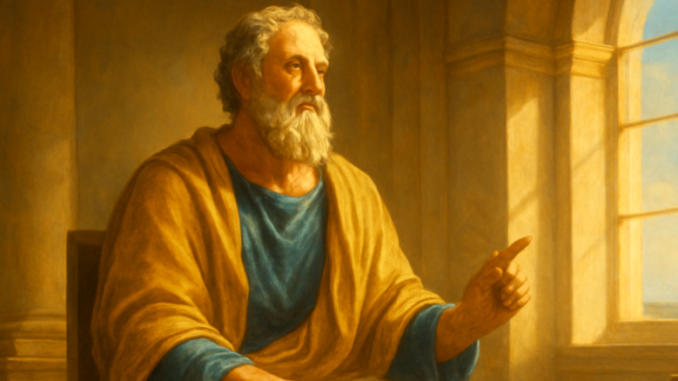
A sword gleaming in the sunlight. A soldier holding his ground as the enemy advances. For centuries, this image served as the ultimate expression of courage. But when Plato wrote his dialogue Laches, his teacher Socrates posed a deeply unsettling question: is physical bravery on the battlefield truly the same as real courage? That question, first asked in fifth-century Athens, touches a nerve that still resonates with anyone who reflects seriously on virtue and character — including those who walk the path of Freemasonry.
The Athens of Socrates: A Turbulent Crucible
To understand the Laches, we need to step into the world of late fifth-century Athens. The city was engulfed in near-permanent conflict: the Peloponnesian War against Sparta had scarred an entire generation. Courage was not some abstract philosophical concept — it was a daily necessity. Generals like Laches and Nicias, the two main interlocutors in the dialogue, had both led real battles and watched real soldiers die. When Socrates asks them what courage actually is, he is not asking for theory. He is asking about the essence of something they have experienced in their very bones.
Plato likely wrote this dialogue around 380 BCE, several decades after Socrates’ death. He was looking back on a time when traditional Athenian values were under siege — not just by enemy armies, but by the Sophists, who had undermined the old certainties by arguing that virtue was nothing more than social convention. Socrates was searching for a deeper answer: if courage is more than whatever a society happens to call bravery, then what is it really?
The Socratic Method as a Scalpel
The way Socrates operates in the Laches reveals a revolutionary approach to philosophical inquiry. Rather than offering a definition himself, he questions the experts in the room. Laches, the seasoned general, opens with a straightforward, practical answer: courage is holding your position in the ranks and not fleeing from the enemy. But Socrates quickly points out that a cavalry unit retreating strategically can sometimes act more courageously than infantry blindly holding the line. The concrete image of the steadfast soldier dissolves into paradox.
Courage without insight is recklessness; only when knowledge of good and evil guides the will does true bravery emerge.
Nicias then tries a more intellectual definition: courage is the knowledge of what is truly to be feared and what is not. This sounds more refined, but it raises new problems. If courage is merely knowledge, how does it differ from wisdom in general? The dialogue ends in aporia — intellectual uncertainty — without a conclusive answer. But this very state of not-knowing is the heart of Socrates’ method. By discovering what courage is not, we draw closer to understanding what it might truly be.
Roots in Pre-Socratic Thought
Plato’s thinking about courage did not arise in a vacuum. The pre-Socratic philosophers had already grappled with the relationship between body and soul, between impulse and reason. Heraclitus of Ephesus wrote about conflict as the father of all things, but also about the logos as an ordering principle. Empedocles spoke of love and strife as cosmic forces. In this context, courage becomes more than a personal trait — it touches the fundamental question of how human beings relate to the chaotic world around them.
The Pythagoreans also played a role in the intellectual climate in which Plato grew up. Their emphasis on harmony and the balance between opposing forces echoes through Plato’s later dialogues, where he divides the soul into three parts: the appetitive, the spirited, and the rational. Courage — the thymos, or spirited element — serves as the bridge between instinct and intellect. For those familiar with Masonic symbolism, this idea of an inner architecture, where different parts of the self must be brought into proper alignment, will feel remarkably familiar.
Echoes Through the Centuries
The questions Plato raised in the Laches reverberated through the philosophical tradition for millennia. Aristotle, in his Nicomachean Ethics, developed the concept of courage as a virtue of the mean — positioned between recklessness and cowardice. For Aristotle, the courageous person is not someone free from fear, but someone capable of acting rightly despite fear. This nuance builds directly on the Socratic insights from the Laches.
The Stoics — from Zeno of Citium to Marcus Aurelius — elevated courage to one of the four cardinal virtues. For them, true courage was inseparable from wisdom: only those who understand the distinction between what lies within their power and what does not can be truly brave. Seneca wrote extensively in his letters about the art of overcoming fear through rational insight. Epictetus taught his students that external circumstances, even death itself, hold no real power over those who remain inwardly free.
This Stoic inheritance runs deep in Masonic tradition. The emphasis on self-mastery, on equanimity in the face of life’s trials, and on the cultivation of virtue as an inner discipline — these are threads that connect the ancient philosophers directly to the principles taught within the Lodge.
The Shield as a Mirror of the Soul
When we picture the shield of a Greek hoplite, it is tempting to see nothing more than a weapon — a practical instrument of protection on the battlefield. But for the ancient Greeks, the shield carried a far deeper significance. It was the one piece of equipment discarded during a retreat, making it the ultimate symbol of the choice between standing firm and running away. The Spartan mother who sent her son to war with the words “with your shield or on it” was not talking about tactics — she was talking about character.
In this symbolic layer, we find what Plato was ultimately searching for. The shield as an object is nothing; the willingness to carry it, knowing full well what it represents, that is true courage. Seen in this light, every action becomes a choice that reveals something about the soul’s posture toward the unknown, the threatening, the uncontrollable. Courage is not something you possess — it is something you become in the moment of decision.
This understanding resonates powerfully with the Masonic journey. The working tools, the symbols, the rituals — none of them have value as mere objects or procedures. Their meaning lies in what they ask of the individual who engages with them: the willingness to face oneself honestly, to stand firm in the pursuit of truth, and to act with integrity even when the easier path beckons.
The Dialogue as a Living Question
What the Laches ultimately offers is not a handbook for bravery, but an invitation to self-examination. Socrates does not ask only Laches and Nicias what courage is — he asks every reader, across the centuries. The aporia with which the dialogue ends is not a failure but a gift: it prevents us from settling for a comfortable, pre-packaged answer and forces us to keep searching.
This is remarkably close to the spirit of Freemasonry, where the journey matters more than the destination and where the questions a Brother carries with him through life are often more valuable than any definitive answer. The rough ashlar is not perfected by being told its final shape — it is shaped by the ongoing, patient work of the craftsman who refuses to stop refining.
Plato’s Laches reminds us that courage is not a single act but a way of being. It is the sustained willingness to look honestly at ourselves, to question what we think we know, and to stand firm — not because we feel no fear, but because we have aligned our understanding with something greater than fear. In a world that often rewards bluster and bravado, this ancient dialogue quietly insists that the deepest form of courage begins in the soul.
Plato’s Laches does not give us a neat definition of courage — and that is precisely its power. By dismantling easy answers, Socrates invites us into a lifelong dialogue with ourselves about what it truly means to be brave. For Freemasons and philosophical seekers alike, this ancient text offers a timeless mirror: courage is not the absence of fear, nor the blind refusal to retreat. It is the disciplined alignment of knowledge, will, and character — the inner architecture that allows us to face the unknown with integrity. The question Socrates posed in Athens twenty-four centuries ago remains as urgent as ever: not whether we can stand firm, but whether we truly understand why we should.
Copyright text & image: devrijmetselaar.nl
Texts are based on the ideas and content of the author of devrijmetselaar.nl, reviewed, corrected, and supplemented with the assistance of OpenAI. Images are created based on the ideas of the author of devrijmetselaar.nl using OpenAI/DALL-E.
Frequently Asked Questions
What is the main question Socrates asks in Plato's Laches dialogue?
Socrates asks whether physical bravery on the battlefield is truly the same as real courage. He challenges the traditional understanding of courage as mere military steadfastness, suggesting that true courage involves deeper philosophical and moral dimensions that extend beyond physical acts of valor.
Why did Plato write the Laches dialogue, and what historical context inspired it?
Plato wrote the Laches around 380 BCE, several decades after Socrates' death, looking back on fifth-century Athens during the Peloponnesian War. He sought to address how traditional Athenian values were being undermined by the Sophists, who argued that virtue was merely social convention. Socrates was searching for a deeper, more essential definition of courage beyond what society simply called bravery.
How does Socrates use the Socratic Method to challenge the generals' understanding of courage?
Rather than offering his own definition, Socrates questions the experts by pointing out flaws in their answers. When Laches defines courage as holding your ground in battle, Socrates notes that a strategic cavalry retreat can sometimes be more courageous. When Nicias proposes courage is knowledge of what to fear, Socrates reveals this definition also has limitations, demonstrating that true courage requires both knowledge and moral insight.


Be the first to comment