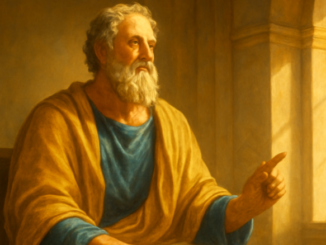
Plato’s Laches: The Philosophical Roots of True Courage
A sword gleaming in the sunlight. A soldier holding his ground as the enemy advances. For centuries, this image served as the ultimate expression of courage. But when Plato wrote his dialogue Laches, his teacher Socrates posed a deeply unsettling question: is physical bravery on the battlefield truly the same as real courage? That question, first asked in fifth-century Athens, touches a nerve that still resonates with anyone who reflects seriously on virtue and character — including those who walk the path of Freemasonry. The Athens of Socrates: A Turbulent Crucible To understand the Laches, we need to step into the world of late fifth-century Athens. The city was engulfed in near-permanent conflict: the Peloponnesian War against Sparta had scarred an entire generation. Courage was not some abstract philosophical concept — it was a daily necessity. Generals like Laches and Nicias, the two main interlocutors in the dialogue, had both led real battles and watched real soldiers die. When Socrates asks them what courage actually is, he is not asking for theory. He is asking about the essence of something they have experienced in their very bones. Plato likely wrote this dialogue around 380 BCE, several decades after Socrates’ death. […]