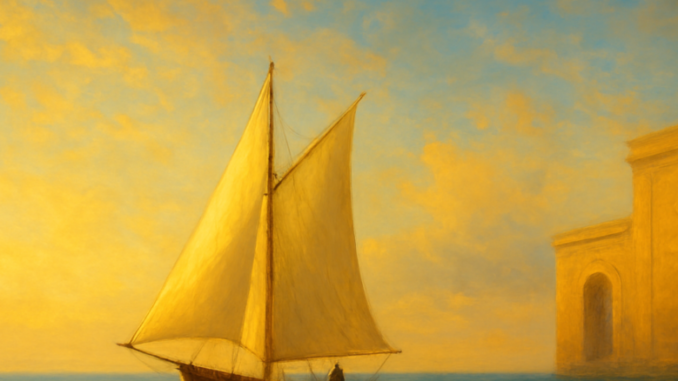
There comes a moment in every life when the question of completion makes itself felt — not as an abstract philosophical puzzle, but as a living reality pressing through the noise of daily existence. Marcus Aurelius knew this moment well. In the twelfth and final book of his Meditations, the Roman emperor reflects on what it means to bring a meaningful life to its close. For Freemasons, this theme strikes a chord of deep recognition: the lodge, too, places the questions of meaning, fulfillment, and our connection to something greater than ourselves at the very center of its work.
The Stone That Must Be Polished
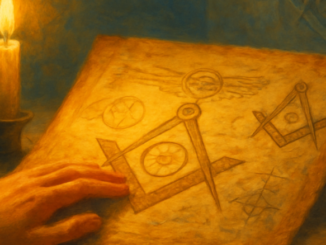
In Freemasonry, the rough ashlar symbolizes the individual as he first enters the lodge: unworked, with sharp edges and hidden potential. The lifelong task is to polish this stone — to chip away at imperfections and reveal the form that was always waiting within. In Book XII, Marcus Aurelius describes a strikingly parallel process. He does not speak of stones, but of the soul that must shape itself, of the daily discipline required to live a life that can withstand the test of eternity.
The emperor asks himself what truly matters when the end draws near. His answer is remarkably simple: not fame, not wealth, not the admiration of others. What remains is the question of whether you lived in accordance with your true nature, whether you fulfilled your duty to the community. This resonates profoundly with the Masonic principle of brotherhood — the recognition that we are all bound together in a greater whole.
Connection as the Foundation of Meaning
Where Marcus Aurelius writes of duty toward the human community, Freemasons will recognize the principles of charity and mutual support. The Stoic philosopher on the throne did not see himself as an isolated individual but as part of a cosmic order in which every person has a role to play. This idea echoes through the lodge, where brothers meet as equals regardless of their social standing.
The completion of a life is not measured by what we accumulated, but by the bonds we forged and the virtue we cultivated.
In Book XII, Marcus Aurelius explains how death need not be feared when one has lived according to reason and virtue. This is not escapism or a denial of human finitude. It is the acknowledgment that a life filled with meaningful relationships and moral integrity carries its own justification. The Freemason who works daily on his inner temple knows this truth well: the edifice we raise is built not of stone, but of character.
The Light That Comes From Within
One of the most powerful symbols in Freemasonry is that of light. The search for light represents the pursuit of knowledge, truth, and enlightenment. Marcus Aurelius employs similar imagery when he writes about the inner spark that every person carries — a spark connected to the cosmic reason that both distinguishes us and binds us to all living things.
In the context of life’s completion, this image takes on special significance. The point is not to gather light from external sources, but to cultivate the inner flame. Marcus Aurelius repeatedly warns against chasing outward display. True wisdom lies in self-reflection, in honestly confronting one’s own shortcomings, and in the tireless work of self-improvement. This is precisely what the Freemason does when he carries out his labor in silence and humility.
The Chain That Links Generations
Marcus Aurelius deliberately places his own life within a larger continuum. He reflects on his predecessors — the emperors who came before him and are now forgotten. He contemplates the generations that will follow. This awareness of impermanence does not lead him to nihilism but to a deeper appreciation for what truly endures: the wisdom that is passed down, the virtue that is lived as an example for others.
Freemasonry embodies this principle in the invisible chain that links brothers across the centuries. From the master builders of the great cathedrals to the thinkers of the Enlightenment, from figures like Voltaire and Goethe to the brothers who enter the lodge today — all are part of an unbroken tradition. The completion of an individual life means passing the torch, contributing to something that transcends our own time on earth.
The Art of Letting Go
One of the most challenging lessons in Book XII concerns the art of letting go. Marcus Aurelius invites his readers to release their attachment to outcomes, to possessions, even to their own continued existence. This is not a call to passivity — it is a call to liberation. When we are no longer chained to the fear of loss, we can truly live.
This means letting go of the need for external recognition. It means accepting our own mortality as a teacher rather than an enemy. It means focusing on the here and now instead of an uncertain future, and trusting in the inner compass of virtue and reason to guide our steps.
For the Freemason, this is immediately recognizable as the practice of working in silence — doing good without expectation of reward. The true master does not labor for applause, but because the work itself is meaningful. In that attitude lies the key to a completed life.
Brotherhood as the Answer to Finitude
Ultimately, Marcus Aurelius offers no magic formula for dealing with the finite nature of human existence. What he does offer is a perspective in which connection stands at the center. We are not alone in our struggle with life’s great questions. Others, in the present and in the past, have asked the same questions and found their own answers. By connecting ourselves to this tradition of seekers, our own lives grow richer and more complete.
Freemasonry institutionalizes this connection. In the lodge, brothers come together to search, to reflect, and to grow — not because they expect to find final answers, but because the shared journey itself gives meaning to each individual path. The work on the self is never done in isolation; it unfolds within a community of fellow travelers who hold each other accountable and lift each other up.
Marcus Aurelius’ twelfth book is more than a philosophical farewell. It is a blueprint for how to approach the completion of a life with dignity, purpose, and peace. For Freemasons, his words serve as a powerful reminder that the true measure of our work is not found in external achievements but in the quality of our character, the depth of our connections, and the light we leave behind for those who follow. In the end, the rough stone does not need to be perfect — it simply needs to have been worked on with sincerity, devotion, and love for the craft.
Copyright text & image: devrijmetselaar.nl
Texts are based on the ideas and content of the author of devrijmetselaar.nl, reviewed, corrected, and supplemented with the assistance of OpenAI. Images are created based on the ideas of the author of devrijmetselaar.nl using OpenAI/DALL-E.

Be the first to comment