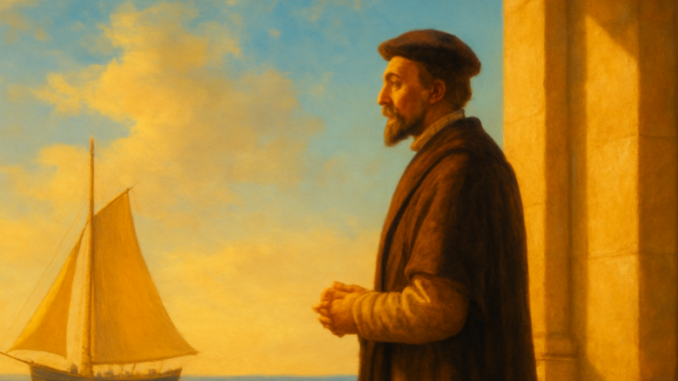
When Michel de Montaigne writes in his thirty-third essay that fortune often acts in the service of reason, he touches on a question that has occupied philosophers for centuries. Is chance truly blind, or does some hidden logic lurk beneath the apparent randomness of existence? To fully grasp Montaigne’s thinking on this matter, we must descend to the sources from which he drew: Stoic wisdom, Skepticism, and the Renaissance humanism that shaped his world.
The Stoic Legacy: Seneca and Fortune
Montaigne’s thinking on fortuna cannot be understood without acknowledging the profound influence of Seneca, the Roman philosopher whose letters and treatises were constant companions on Montaigne’s desk. For Seneca, fortune was not an enemy to be feared but a teacher who compels us toward inner growth. In his Letters to Lucilius, he argues that adversity tests virtue and thereby strengthens it. Fortune thus works, paradoxically, in service of wisdom.
This idea resonates powerfully throughout Essay 33. Montaigne adopts the Stoic notion that seemingly random events often lead to outcomes that reason itself might have devised. Where the Stoics spoke of the logos — a cosmic rationality permeating all things — Montaigne translates this into a more human register. He observes how life itself seems to possess a kind of hidden intelligence, a quiet order beneath the noise of circumstance.
Plutarch: The Moralist as Guide
Alongside Seneca, Plutarch served as an indispensable source for Montaigne. The Greek biographer and philosopher offered in his Moralia a treasure trove of anecdotes and insights that Montaigne eagerly absorbed. Plutarch had a particular interest in the interplay between character and circumstance. In his biographical works, he showed how great figures of antiquity navigated the whims of Fortune.
For Plutarch, fortune was never purely external. The way a person responded to adversity or prosperity revealed their true nature. Montaigne embraced this perspective and pushed it further: perhaps what we call chance is often nothing more than our own inability to perceive a deeper coherence. Reason can always discover a pattern in hindsight — a thread of logic in what first appeared chaotic.
Skepticism: Doubt as Method
Montaigne’s famous motto — “Que sais-je?” (What do I know?) — reveals his deep kinship with Pyrrhonist Skepticism. This philosophical tradition, named after the Greek philosopher Pyrrho of Elis, taught that certainty is an illusion. We cannot know the true nature of things, only the appearances that present themselves to us.
This skeptical stance permeates Essay 33. When Montaigne suggests that fortune acts in the service of reason, he is not making a metaphysical claim about a divine plan. He is observing, rather, that our distinction between chance and intention is far more fragile than we typically assume. The skeptic in him refuses a final verdict. Perhaps fortune is rational. Perhaps we merely project reason onto fortune after the fact.
As Montaigne seems to suggest: fortune and reason are not opposites but dance partners in a choreography we only recognize in retrospect.
Renaissance Humanism: Man as the Measure
Montaigne wrote during an era when humanism was reshaping the intellectual world. Thinkers such as Erasmus and Pico della Mirandola had rediscovered classical sources and placed human dignity at the center of philosophical inquiry. The Renaissance humanist read Cicero, Seneca, and Plutarch not as dusty relics but as living conversation partners.
This explains Montaigne’s characteristic method: he quotes the ancients not to claim authority but to enter into dialogue with them. In Essay 33, he weaves classical examples together with personal observations. The result is a text that is neither purely philosophical nor purely autobiographical, but a hybrid form that Montaigne himself invented — the personal essay as a mode of philosophical exploration.
Two Perspectives: The Philosopher and the Builder
How might a Freemason read this essay? The Craft has a long tradition of reflecting on the interplay between chance and design. The building metaphor at the heart of Masonic symbolism suggests that nothing happens by accident: every stone has its place, every gesture its meaning. Yet every working builder knows that the construction process is full of unforeseen turns. The wood warps, the stone cracks, the wind shifts.
The philosopher looks at fortune and asks: is this chaos or order? The builder encounters the same question in practice. Montaigne would recognize both perspectives. His essay suggests that the opposition between the two is false. Fortune carries out what reason could not have planned but can nonetheless acknowledge. The unexpected turn proves, in hindsight, to have been exactly what was needed.
For the Masonic reader, this resonates with the experience of the lodge itself — where ritual, reflection, and the unpredictable dynamics of brotherhood come together in ways that no one could have entirely foreseen, yet which often feel profoundly right.
The Intellectual Context of the Sixteenth Century
Montaigne composed his Essays during the French Wars of Religion, a period of extreme uncertainty. The old certainties of the Catholic worldview were crumbling, while Protestantism offered new answers that were equally dogmatic. In this context, Montaigne’s investigation of fortune and reason takes on added urgency.
When kings could be assassinated and cities set ablaze, could one still believe in a rational order? Montaigne answers this question not with dogmatic certainty but with observation and nuance. Yes, fortune sometimes appears to act rationally. No, we cannot know this for sure. This duality is precisely what makes his thinking so modern and so enduring.
The philosophical traditions converging in Essay 33 can be summarized as follows:
- Stoicism: The logos as cosmic reason flowing through all things
- Plutarch: Character and fortune as inseparably bound
- Skepticism: Doubt regarding any definitive judgment about chance
- Renaissance Humanism: Dialogue with the ancients as a living method of inquiry
Essay 33 does not stand alone. It forms a nexus where Stoic wisdom, Plutarch’s moral observations, skeptical doubt, and humanist method converge. To read this essay with an awareness of these sources is to discover a richness that remains hidden on a surface reading. Fortune and reason, Montaigne teaches us, may not be the opposites we assume them to be. They are collaborators in the unfolding of a life — and perhaps, for those who walk the Masonic path, collaborators in the slow and deliberate shaping of the self.
Copyright text & image: devrijmetselaar.nl
Texts are based on the ideas and content of the author of devrijmetselaar.nl, reviewed, corrected, and supplemented with the assistance of OpenAI. Images are created based on the ideas of the author of devrijmetselaar.nl using OpenAI/DALL-E.


Be the first to comment