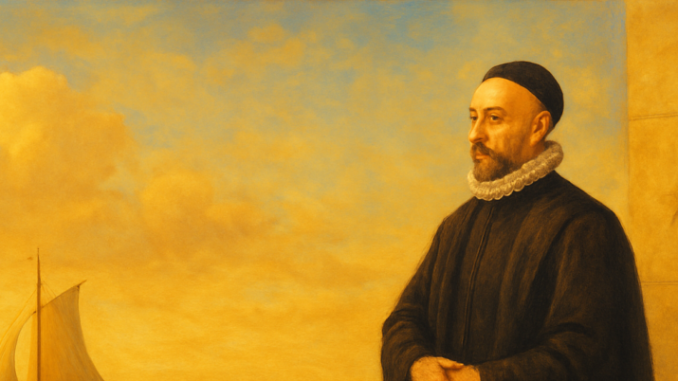
When Michel de Montaigne picked up his pen in the sixteenth century to write about moderation, he drew on a rich tradition of thinkers who came before him. His essay on the subject is no isolated meditation — it is a tapestry woven from Stoic wisdom, Skeptic restraint, and Humanist insight. For anyone searching for balance today, this essay offers not only historical context but also a mirror in which we can recognize our own pursuit of temperance.
The Philosopher’s World: Montaigne’s Intellectual Landscape
Michel de Montaigne lived in an era of violent religious conflict, political upheaval, and intellectual rebirth. The French Wars of Religion raged across his homeland, while the Renaissance made possible a rediscovery of classical texts. In his tower study, surrounded by the works of Greek and Roman thinkers, Montaigne found the stillness to reflect on life’s fundamental questions. His library contained works by Plutarch, Seneca, Cicero, and the Skeptic philosopher Sextus Empiricus. These thinkers formed the foundation upon which he built his famous Essays.
His essay on moderation emerged precisely from this tension between extremes. While Catholics and Huguenots were locked in deadly conflict, Montaigne sought a middle path — not out of cowardice or indecision, but from the conviction that truth is seldom found on only one side. This search for balance connects him to the Stoic tradition, but also to the ancient Greek ideal of the golden mean.
Stoic Influences: Seneca as Teacher
Seneca, the Roman philosopher and statesman, was one of Montaigne’s most beloved authors. In his Letters to Lucilius, Seneca repeatedly addresses the theme of moderation as the key to a virtuous life. Stoic teaching holds that passions can overwhelm us when left unchecked, but also that the complete suppression of emotion is both unnatural and undesirable. Montaigne adopted this nuance and took it even further: where Seneca sometimes leaned toward severity, Montaigne showed greater gentleness toward human weakness.
The Stoic notion of apatheia — freedom from disturbing passions — was transformed by Montaigne into something softer. He did not believe in the perfected sage who masters every emotion, but rather in the ordinary person who strives for equilibrium. This approach made his philosophy more accessible and more human than that of his Stoic predecessors. For those drawn to self-improvement through philosophical reflection, Montaigne offers a remarkably forgiving model.
The Skepticism of Pyrrho and the Art of Suspending Judgment
Alongside the Stoics, Montaigne was deeply influenced by Pyrrhonian Skepticism. Pyrrho of Elis, the Greek philosopher, taught that on most matters we cannot reach a definitive judgment. This attitude of epoché — the suspension of judgment — fits seamlessly with the theme of moderation. Those who acknowledge that absolute certainty is unattainable are far less likely to fall into extremes.
Moderation is not the absence of conviction, but the awareness that every conviction has its limits.
Montaigne’s famous motto, “Que sais-je?” — “What do I know?” — reflects this Skeptical foundation. It is not cynicism but intellectual humility. By admitting that we do not know everything, we create room for nuance, for the voices of others, for growth and change. In a world that often rewards certainty, this posture remains quietly radical.
Plutarch and the Power of Practical Wisdom
Plutarch, the Greek biographer and moralist, offered Montaigne a treasury of stories and examples. In his Moralia, Plutarch addresses topics such as self-control, friendship, and the proper handling of emotions. Where the Stoics sometimes remained abstract, Plutarch brought philosophy to life through concrete anecdotes. Montaigne adopted this method wholeheartedly: his essays overflow with examples drawn from history, personal experience, and observations of everyday life.
Plutarch’s practical bent suited Montaigne’s conviction that philosophy was not meant for the study alone. Moderation had to be lived — at the dinner table, in conversation, in political decisions. This emphasis on the art of living over abstract theorizing is precisely what makes Montaigne’s work timelessly relevant. It reminds us that wisdom must be practiced, not merely professed.
Renaissance Humanism: The Human Being as Measure
The Humanism of the Renaissance placed the individual at the center of the universe. Thinkers such as Erasmus and Petrarch had paved the way for a philosophy that celebrated human dignity, freedom, and potential. Montaigne stood in this tradition but added his characteristic self-criticism. Humanity may be the measure of all things, but that measure is unsteady, full of contradictions and uncertainties.
Aristotle, whose work the Humanists rediscovered, had presented the golden mean as an ethical ideal. Virtue lies between two extremes: courage between cowardice and recklessness, generosity between miserliness and extravagance. Montaigne adopted this framework but also qualified it. The golden mean is not a fixed formula that applies to everyone at all times. It must be found anew in every situation, by every individual. This idea resonates powerfully with anyone who has struggled to apply universal principles to the messy particulars of daily life.
From Philosophy to Living Practice
What sets Montaigne’s approach to moderation apart from those who preceded him? It is the personal voice, the willingness to admit his own failures, the refusal to become dogmatic. Where Seneca prescribes and Aristotle systematizes, Montaigne explores. He invites the reader to think alongside him, not to follow blindly.
From the Stoics, he learned emotional regulation without rigidity. From the Skeptics, he absorbed intellectual humility. From Plutarch, he adopted the art of the concrete example. From the Humanists, he inherited a trust in human potential. This synthesis makes Montaigne’s essay on moderation far more than a historical document — it is an invitation to seek balance for ourselves, to use the wisdom of the past without becoming enslaved to it.
In a world that too often gravitates toward extremes, this approach offers an alternative path. For those who walk a philosophical journey — whether through the study of great thinkers, through fraternal bonds, or through quiet personal reflection — Montaigne’s voice remains a steady companion, urging us toward measure, self-awareness, and the courage to embrace uncertainty.
Montaigne’s essay on moderation endures because it refuses to offer easy answers. Instead, it weaves together the best of Stoic discipline, Skeptic humility, classical example, and Humanist faith in the individual. The result is a philosophy that does not demand perfection but celebrates the honest, ongoing effort to find balance. In every age, that effort remains one of the most worthy pursuits a thoughtful person can undertake.
Copyright text & image: devrijmetselaar.nl
Texts are based on the ideas and content of the author of devrijmetselaar.nl, reviewed, corrected, and supplemented with the assistance of OpenAI. Images are created based on the ideas of the author of devrijmetselaar.nl using OpenAI/DALL-E.

Be the first to comment