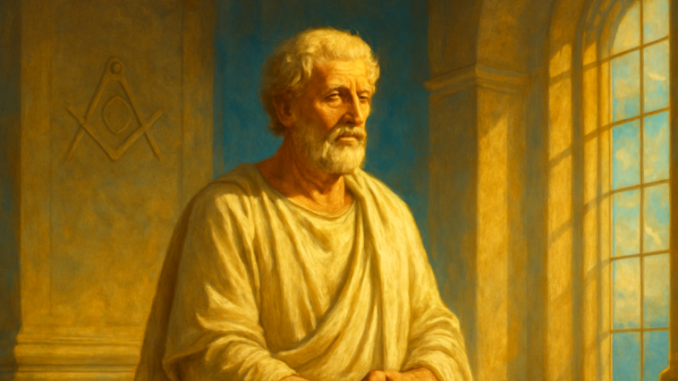
There is an invisible chain between human beings. Not forged from iron or gold, but woven from actions, words, and the silent acknowledgment that we need one another. In his forty-eighth letter to Lucilius, Lucius Annaeus Seneca touches on a theme that, two thousand years later, still strikes at the very heart of what it means to live among others: the mutual duties that arise when we truly see each other. For Freemasons, this message carries a familiar resonance — an echo of the chain of brotherhood made visible in the lodge, yet living on beyond its walls in every handshake, every gesture of support.
The Hand That Gives, the Hand That Receives
Seneca opens his letter with a deceptively simple observation: when someone does us a service, a bond is created. Not because we are obligated to return the favor, but because the act itself fundamentally changes the relationship between two people. The giver and the receiver become part of a shared story. This is not a marketplace transaction, not a barter of favors. It is something more organic — something that grows the way a tree takes root in the earth.
In Freemasonry, we know this principle by many names. The chain of union, the grip, the shared ritual. But behind all these forms lies the same truth: we are connected to one another in ways that reach far beyond the visible. When one brother extends his hand to another, a moment of mutual recognition is born. I see you. You see me. We are part of the same fabric.
The Philosophy Behind the Duty
In his letter, Seneca warns against reducing human relationships to logical puzzles. He has little patience for the sophists of his era who endlessly debate who owes what to whom. For the Stoic philosopher, that is entirely beside the point. Duty does not arise from calculation — it springs from the natural inclination of human beings to be part of something greater than themselves. Just as the hand serves the body without asking what the body does for the hand, so does a person serve their fellow human being.
Mutual duty is not a burden we carry, but the visible expression of the invisible bond that makes us fully human.
This resonates deeply with the Masonic understanding that brotherhood is not a contract but a living reality. The obligation a Freemason takes at his initiation is not a legal agreement. It is an acknowledgment of something that already existed before the words were spoken: the fundamental connectedness of people who seek truth and light together.
The Chain as Symbol
Consider for a moment a concrete image: the chain. In historical depictions of Freemasonry, we often see a chain linking the brethren, link by link. Each link is in itself a closed ring — complete and whole. But only when the links interlock does a chain emerge that is strong enough to bear real weight.
Seneca would have understood this image instinctively. His philosophy of mutual duties is not about surrendering individuality. Each link remains what it is. But in the connection with others, something new emerges — something stronger than the sum of its parts. The chain can carry what the individual link could never lift alone.
Beyond Words: The Call to Action
What makes Seneca’s letter particularly powerful is his insistence on action over words. It is not enough to philosophize about friendship and duty. The true test lies in daily life — in the small acts we perform without expecting anything in return. A hand on a shoulder. A moment of genuine attention. The willingness to listen when someone speaks.
Freemasonry embraces this principle through what it calls working tools. The square and compasses are not abstract symbols to be admired and set aside. They are instruments for the daily work of shaping ourselves and the world around us. The rough ashlar must be hewn, day after day, with patience and perseverance. In the same way, our relationships with others must be tended daily — not through grand gestures, but through the quiet, steady labor of presence and care.
The Circle Closes
There is something beautifully circular in Seneca’s thinking about mutual duties. The one who gives, receives. The one who receives, gives. Not in a simple exchange, but in a continuous movement that encompasses us all. The philosopher Marcus Aurelius, writing later in the same Stoic tradition, called this the cosmopolis — the world-community to which all human beings belong.
For Freemasons, this circle is immediately recognizable in ritual practice. The circle formed around the tracing board, the hand passed from brother to brother, the words spoken in the awareness that they reach far beyond the walls of the lodge. We do not stand apart from one another. We never have.
What Remains
Seneca wrote his letters to Lucilius as lessons for living, not as theoretical exercises. His words on mutual duties are not abstract principles but guidelines for everyday existence. Do not ask what you owe — ask what you can give. See in every encounter the possibility of connection. Recognize that the hand you extend to another is the same hand that holds you up when you stumble.
This is the lesson the Stoic sage shares with the Freemason: the duty of connection is not a restriction of our freedom but its fulfillment. Only in relation to others do we become fully human. Only in acknowledging mutual dependence do we find true independence. The chain binds us, yes. But it binds us to something greater than ourselves.
Two thousand years after Seneca penned his letter to Lucilius, the message still rings clear. The mutual duties that connect us have not grown obsolete, nor have they been rendered irrelevant by individualistic thinking or digital distance. They remain the quiet thread running through every human community — from the ancient Stoics to the modern lodge, from philosopher to craftsman, from one outstretched hand to another. The chain endures, and so does the truth it carries: we are strongest not when we stand alone, but when we stand together.
Copyright text & image: devrijmetselaar.nl
Texts are based on the ideas and content of the author of devrijmetselaar.nl, reviewed, corrected, and supplemented with the assistance of OpenAI. Images are created based on the ideas of the author of devrijmetselaar.nl using OpenAI/DALL-E.

Be the first to comment