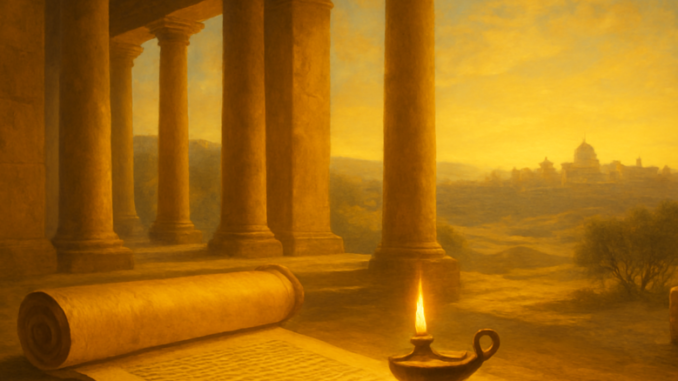
Imagine that after years of preparation, you finally receive the responsibility you’ve been working toward. A new leadership role, your own business, or perhaps parenthood. The question that arises isn’t just how you’ll fill that role — it’s who you want to be within it. Second Samuel, the tenth book of the Old Testament, tells exactly this kind of story. It chronicles the establishment of a kingdom, but its symbolism reaches far beyond political power. Read through the lens of Freemasonry, and it unfolds as a guide for building an inner kingdom — stone by stone.
The Heart of Second Samuel: From Warrior to Builder
Second Samuel covers the reign of King David, from his anointing to the later years of his rule. Where the first book centered on the struggle for recognition, this sequel explores what happens after that recognition has been won. David conquers the city that would become his capital. He brings the Ark of the Covenant to its resting place and receives a promise that will endure across generations. But the book also reveals his deeply human weaknesses: moral failings, family conflicts, and the anguish of loss.
For the Freemason, this narrative follows a familiar pattern. The journey from Fellow Craft to Master Mason isn’t merely about acquiring knowledge or status. It’s about what you do with the responsibility that comes with it. David no longer needed to fight for his position — he had to learn to govern. That is a fundamentally different skill, one that demands inner discipline and genuine self-knowledge.
The Temple That Was Never Built: A Lesson in Humility
One of the most striking moments in Second Samuel is the prohibition David receives against building the Temple. Here is a man who has achieved so much, yet he is told that this one great project is not his to complete. The construction would be left to a future generation. For someone with David’s ambition, this must have been a bitter lesson to accept.
And yet, a powerful truth lies within it. In Freemasonry, we speak of building the temple of humanity, but we also revere the unfinished temple as a symbol. Not everything we aspire to can be completed in our own lifetime. Sometimes our task is to lay a foundation upon which others will continue to build. This requires a particular kind of humility: accepting that your contribution is part of a greater whole, even though you may never see the finished result.
The true builder understands that his work extends far beyond his own years.
Practical Application: Recognizing Your Own Boundaries
How does this translate into daily life? Start by asking yourself an honest question: which projects or ambitions are you holding onto that may not be meant for you? This might relate to your career, but it could just as easily apply to relationships or personal goals. Sometimes we pour energy into something that would be better handed off to someone else — or that simply doesn’t fit our current stage of life.
A practical exercise is to make a list of your current responsibilities and ambitions. For each item, ask yourself: am I contributing from a place of genuine strength, or am I holding on out of habit or ego? Freemasons are familiar with the concept of the rough ashlar that must be shaped and refined. Sometimes that refinement means letting go of forms that don’t align with your true nature.
The Shadow Side: Confronting Your Own Shortcomings
Second Samuel doesn’t shy away from David’s darker moments. His moral transgression involving Bathsheba and its devastating consequences are described at length. This is not hero worship — it is honest storytelling. The message is clear: even those who achieve greatness can fall deeply. And it is precisely within that fall that the possibility of real growth exists.
In the symbolic language of Freemasonry, the cable tow reminds us of our bonds of connection, but also of the moments when those bonds come under strain. Acknowledging your own mistakes is not weakness — it is a prerequisite for genuine improvement. David did not flee from the confrontation with his own actions. He endured the consequences and, despite everything, continued striving to become a more just ruler.
Concrete Steps Toward Inner Leadership
How can you put these insights into practice? Here are some actionable steps drawn from David’s story and Masonic tradition:
Reflect weekly on your actions. Set aside ten minutes to look back on moments when you acted from strength and moments when you fell short. Honest self-assessment is the working tool of the inner builder.
Find a trusted confidant. Seek out someone with whom you can speak openly about your doubts. Brotherhood means daring to show vulnerability — not just presenting a polished exterior.
Accept that you are laying foundations for others. Ask yourself what knowledge, experience, or wisdom you can pass on to those who come after you. Your legacy is not measured by what you complete alone, but by what you make possible for others.
Practice admitting mistakes without self-condemnation. Recognition of error is the first stone of restoration. You cannot rebuild what you refuse to see as broken.
The Covenant as an Enduring Promise
One of the central themes in Second Samuel is the covenant that is established. This is no business transaction — it is a promise that transcends generations. For Freemasons, this resonates deeply with the concept of the chain of union, the invisible bond that connects lodges across the world and through the centuries.
In your own life, consider the covenants you have entered into. What promises have you made — explicitly or implicitly — to your partner, your children, your colleagues, or to yourself? Honoring those promises, especially when it becomes difficult, is an act of inner kingship. Not because someone forces you, but because you have chosen a particular way of living and being in the world.
Second Samuel is far more than an ancient chronicle of kings and battles. It is a mirror that confronts us with the question of how we govern our own inner kingdom. The symbolism of building, of recognizing boundaries, and of reckoning with our own shadow speaks directly to the Masonic tradition. Begin today by laying your foundation — stone by stone — trusting that what you build with integrity will endure far beyond your own lifetime. The temple may remain unfinished in your years, but every well-placed stone matters.
Copyright text & image: devrijmetselaar.nl
Texts are based on the ideas and content of the author of devrijmetselaar.nl, reviewed, corrected, and supplemented with the assistance of OpenAI. Images are created based on the ideas of the author of devrijmetselaar.nl using OpenAI/DALL-E.
Frequently Asked Questions
What is the connection between Second Samuel and Freemasonry?
Second Samuel's narrative of King David's reign serves as a powerful allegory for the Masonic journey, particularly the progression from Fellow Craft to Master Mason. The book illustrates how true advancement isn't just about acquiring knowledge or status, but about developing the inner discipline and self-knowledge needed to govern oneself and serve others responsibly.
What does the unfinished Temple teach Freemasons?
The prohibition against David building the Temple teaches a vital Masonic lesson about humility and accepting that our contributions are part of a greater whole that extends beyond our lifetime. This symbolizes that true builders understand their work serves future generations, and that sometimes our role is to lay foundations rather than complete the structure ourselves.
How can I apply the lessons of Second Samuel to my own life?
You can begin by honestly assessing which projects or ambitions you're holding onto that may not align with your current stage of life or true calling. By recognizing your own boundaries and understanding that some goals are meant for others to complete, you develop the self-knowledge and humility that are central to Masonic growth and spiritual development.
Why is the transition from 'warrior to builder' important in Freemasonry?
The shift from fighting for position to governing wisely represents a fundamental transformation in the Masonic journey. It reflects the difference between external achievement and internal development—moving beyond the struggle for recognition toward cultivating the genuine wisdom, discipline, and character needed to lead and build meaningfully within your sphere of influence.


Be the first to comment