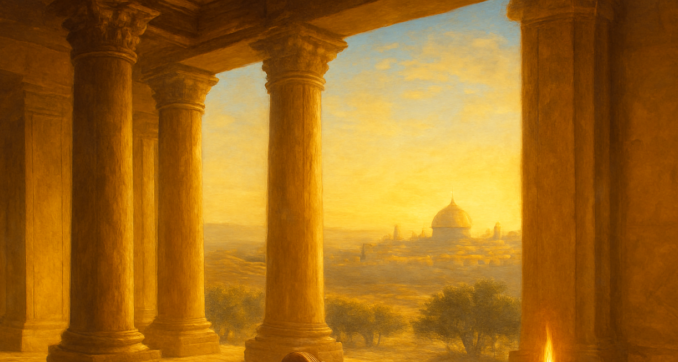
A hammer rests on the workbench. It is motionless, yet it carries within it the potential for both creation and destruction. In much the same way, the Book of Judges lies before us — a collection of stories about leaders who rise and vanish, about a people who fail and recover, fail and recover again. What does this ancient text tell us about the human soul? And how does the symbolism of this seventh book of the Old Testament mirror the path that every Freemason walks?
The Cycle as an Archetypal Pattern
The Book of Judges does not describe a linear history — it traces a spiral. The people turn away from their path, fall into oppression, cry out for help, and a leader emerges to deliver them. After a period of peace, the cycle begins anew. This pattern repeats itself twelve times, like a mantra carved into the very fabric of the text.
For the Freemason, this cycle is deeply familiar. The rough ashlar is not shaped into a perfect cube in a single stroke. It is a process of failure and correction, of straying and returning to center. The cycle in Judges is not a sign of weakness — it is a reflection of the human condition itself. We fall, we rise, and we grow through repetition.
The Judge as a Symbol of the Inner Voice
The English word “judge” conjures images of courtrooms and verdicts. But the Hebrew term shofet carries a far broader meaning: one who sets right what has grown crooked, who restores order where chaos reigns. The judges in this book are not legal figures — they are liberators, leaders who rise in times of desperate need.
Symbolically, the judge represents that part within ourselves that knows when we have strayed. It is the inner voice that does not condemn but corrects. In Freemasonry, we know the compasses that set limits to our desires, and the square that measures our actions against a higher standard. The judge in the Book of Judges is a human embodiment of these same principles.
Deborah and Gideon: Light in Dark Times
Among the many narratives in Judges, certain figures stand out as bearers of particular symbolic weight. Deborah, the prophetess who dispenses justice beneath a palm tree, unites wisdom with decisive action. She does not sit in a palace but under a tree, in the open air, accessible to all who seek her. The palm tree itself is an ancient symbol of victory and righteousness.
Gideon receives his calling at an unexpected moment and asks for signs of confirmation. His story shows that leadership does not spring from certainty, but from the willingness to act despite doubt. With a small band armed with torches hidden inside clay jars, he brings light into darkness. Those torches, concealed until the decisive moment, symbolize the inner flame that waits to be revealed.
Light shines brightest when it breaks through unexpectedly in the night of our doubt.
The Unfinished Temple of the Self
Unlike many biblical books, Judges ends without a true conclusion. Its final chapters depict a society in disarray, where — as the text itself states — everyone does what is right in their own eyes. There is no central authority, no completed structure, no definitive victory.
This open ending carries a profound truth. The temple we build — both in the world and within ourselves — is never finished. There is no moment at which we can say: I am done growing. The Freemason knows this well. Working the rough stone is the work of a lifetime. Judges refuses to grant us the illusion of a final destination, and in doing so, invites us to remain perpetually vigilant.
Samson: Strength and Its Shadow
Perhaps the best-known story from Judges is that of Samson, the man of superhuman strength. His hair, never cut, is the sign of his consecration. When that hair is shorn, he loses his power. But this story speaks of far more than physical might.
Hair as a symbol of consecration points to a covenant, a sacred promise, an inner source from which strength flows. Samson does not lose his power through an external act alone — he loses it because he surrenders the secret of his source. It is a warning about guarding what is sacred, about the distinction between what can be shared and what must be kept within.
In Freemasonry, we understand the value of silence and discretion. Not everything needs to be spoken aloud. Some truths lose their power when they are uttered too carelessly. Samson teaches us that strength and vulnerability are two sides of the same coin.
The Mirror of Judges
Anyone who reads the Book of Judges as a historical account will be disappointed by its repetition and apparent lack of progress. But those who read it as a mirror will find themselves reflected in its pages. The cycles of failure and renewal are universally human. The judges who arise are those moments of clarity in our own lives — flashes of insight that call us back to our better nature.
The Freemason who picks up the gavel knows that every blow can either shape or damage. The art lies in repeating, refining, and patiently returning to the work when we have gone astray. Judges offers no blueprint for perfection, but it provides an honest portrait of the road that leads toward it.
The hammer returns to the workbench. Today’s work is done, but tomorrow new work awaits. The Book of Judges reminds us that the path of growth is not a straight line but a spiral — one that confronts us again and again with our shortcomings and our possibilities. In that endless movement of falling and rising, of darkness and breakthrough, we do not find the perfection we seek, but something far more precious: the courage to carry on. And that courage, as this ancient book teaches us, may well be the greatest sign of inner strength.
Copyright text & image: devrijmetselaar.nl
Texts are based on the ideas and content of the author of devrijmetselaar.nl, reviewed, corrected, and supplemented with the assistance of OpenAI. Images are created based on the ideas of the author of devrijmetselaar.nl using OpenAI/DALL-E.
Frequently Asked Questions
What does the Book of Judges teach Freemasons about personal growth?
The Book of Judges illustrates a cyclical pattern of falling and rising that mirrors the Masonic journey of self-improvement. Just as the rough ashlar is shaped through repeated correction rather than a single stroke, Freemasons understand that spiritual and moral growth comes through continuous cycles of straying, recognition, and return to center. This ancient text validates the Masonic principle that we advance not through perfection, but through persistent effort and willingness to correct our course.
How does the role of a 'judge' in the Book of Judges relate to Freemasonry?
In the Book of Judges, a judge (shofet in Hebrew) is not a legal authority but a liberator who restores order and corrects what has grown crooked. This symbolic function directly parallels the Masonic tools like the square and compasses, which help measure our actions against higher standards. The judge represents our inner voice of conscience—the part of ourselves that guides us back to the right path without condemnation, reflecting the supportive and corrective nature of Masonic brotherhood.
Why are figures like Deborah and Gideon significant in Masonic symbolism?
Deborah and Gideon exemplify qualities central to Masonic development: Deborah unites wisdom with decisive action and remains accessible to all, while Gideon demonstrates that true leadership emerges through faith and willingness to act despite doubt. Gideon's use of hidden torches symbolizes the inner light within each Mason that awaits revelation at the proper moment. Both figures show that spiritual authority comes not from position or certainty, but from character and service to others.
What is the Masonic significance of the 'unfinished' nature of the Book of Judges?
The incomplete ending of Judges resonates deeply with Masonic philosophy, as it reflects the eternal, unfinished work of self-improvement and spiritual development. Freemasonry teaches that the temple of the self is never truly complete—there is always more to learn, refine, and perfect. This openness invites each Mason to recognize that the work of building character and wisdom is a lifelong journey, not a destination to be reached.
How does the cyclical pattern in Judges differ from other biblical narratives?
Unlike linear historical narratives, the Book of Judges traces a spiral pattern that repeats twelve times, showing that human progress is not straightforward but cyclical. This aligns with Masonic understanding that genuine growth comes through spiraling upward rather than simple linear advancement. The repetition demonstrates that returning to fundamental lessons with deeper understanding is not failure but the true path of enlightenment and mastery.


Be the first to comment