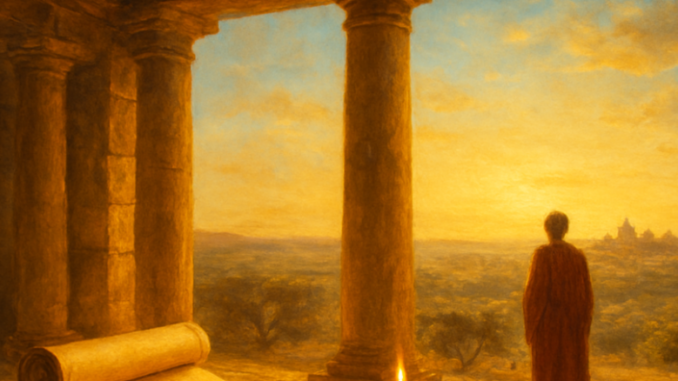
There are moments in life when you stand before a boundary you have never crossed. It might be a river, a doorway, or simply a decision that will change everything. The Book of Joshua in the Old Testament describes exactly such a moment: the people of Israel stand on the banks of the Jordan, ready to enter the Promised Land. But beneath this narrative of conquest and settlement lies a deeper layer of symbolism that still resonates more than three thousand years later. For Freemasons, this sixth book of the Hebrew Bible contains strikingly familiar themes about thresholds, courage, and the ongoing journey toward inner growth.
The River as a Symbol of Transition
The Jordan is no ordinary river in the story of Joshua. It serves as the dividing line between wilderness and fertile land, between wandering and arrival. Crossing it marks an irreversible change — there is no going back. The image of a river as a threshold appears across countless spiritual traditions. Water represents purification, but also the unknown — something fluid that has not yet taken solid form.
In Freemasonry, the threshold plays an equally significant role. Entering the lodge is not merely stepping through a doorway. The transition from outside to inside symbolizes leaving the profane world behind and entering a space governed by different principles: brotherhood, reflection, and symbolic labor. Just as the Israelites walked through the dry riverbed, the initiate leaves something behind in order to receive something new.
Twelve Stones from the Riverbed
One of the most compelling passages in the Book of Joshua describes how twelve men — representatives of the twelve tribes — each lifted a stone from the middle of the Jordan. These stones were set up as a memorial, a tangible reminder of the miraculous moment of crossing. The number twelve carries universal symbolism: think of the twelve months, the twelve signs of the zodiac, and the twelve apostles in later traditions.
The rough stone, or ashlar, is one of the central symbols in Freemasonry. It represents the individual in an unworked state — full of potential but not yet shaped by knowledge and experience. The twelve stones from the Jordan together form a monument of collective effort. They remind us that growth is not a solitary endeavor but a shared undertaking. Each stone contributes to the whole, just as every Brother or Sister contributes to the building of the symbolic temple.
Joshua as a Builder of New Beginnings
The figure of Joshua himself deserves special attention. As the successor to Moses, he represents a new generation of leadership. Where Moses received the Law and guided the people through the wilderness, it falls to Joshua to realize the vision. He is the executor, the builder, the one who must turn a promise into reality.
This role bears a strong resemblance to the Masonic ideal of the builder. Not the architect who designs the plan, but the craftsman who picks up his tools and gets to work. Joshua receives instructions and carries them out with care and dedication. His courage lies not in devising grand plans, but in working day after day toward their fulfillment. It is the quiet power of perseverance that takes center stage here.
“Be strong and courageous, for you shall cause this people to inherit the land.” This exhortation, repeated several times throughout the book, emphasizes that courage is not the absence of doubt but the willingness to move forward despite uncertainty. It is a message that resonated in the ancient world and still echoes in the ritual spaces where Freemasons gather today.
The Walls of Jericho: What Must Fall Before We Can Build
The fall of Jericho is perhaps the most famous passage in the Book of Joshua. Seven times the Israelites marched around the city, and then the walls came crashing down at the sound of ram’s horns. Beyond the literal reading, this story offers a powerful symbol: sometimes old walls must fall before new life becomes possible.
In the inner journey that Freemasonry describes, the same principle applies. The walls that need to come down are not physical ones, but the barriers of prejudice, fear, and self-deception that hinder our growth. The number seven, so prominently featured in the Jericho narrative, symbolizes completion and holiness across many traditions. The sevenfold march around the city suggests that transformation requires time and repetition. It is not a sudden flash of insight but a process of sustained effort.
Sound as a Force for Change
It is worth noting that the walls did not fall through the violence of weapons, but through sound. The ram’s horn — the shofar — brought the walls down. This detail invites contemplation on the power of the spoken word, of sound, of intention. In Freemasonry, the spoken word plays a central role in ritual. Words create reality, open doors, and seal promises. The fall of Jericho reminds us that even the most enduring walls sometimes yield to something that seems intangible.
An Invitation to Reflect
At first glance, the Book of Joshua is a story of conquest and settlement. But when we peel back the symbolic layer, we discover themes that are both universal and timeless: the courage to cross thresholds, the value of collective memory, the necessity of letting go of old structures, and the power of perseverance in building something new.
For those familiar with Freemasonry, these themes resonate like a well-known melody. The journey from Entered Apprentice to Fellow Craft to Master Mason is itself a journey of thresholds and breakthroughs. And just as the Israelites raised stones as a memorial, Freemasons create symbols and rituals that serve as reminders — of where they have come from and where they are headed.
The Book of Joshua invites us to pause and consider our own thresholds. What river do we still need to cross? What walls stand in the way of our growth? And what stones will we set up along the way — not as monuments to past glory, but as quiet markers of the transformation that continues within us, one step at a time?
Copyright text & image: devrijmetselaar.nl
Texts are based on the ideas and content of the author of devrijmetselaar.nl, reviewed, corrected, and supplemented with the assistance of OpenAI. Images are created based on the ideas of the author of devrijmetselaar.nl using OpenAI/DALL-E.
Frequently Asked Questions
What is the connection between the Book of Joshua and Freemasonry?
The Book of Joshua contains powerful symbols of thresholds, transformation, and spiritual growth that deeply resonate with Masonic teachings. Both traditions use the imagery of crossing boundaries and building to represent the journey toward inner enlightenment and self-improvement, making Joshua's story a meaningful guide for understanding the Masonic path.
What do the twelve stones from the Jordan River symbolize in Freemasonry?
The twelve stones represent collective effort and shared purpose, symbolizing that personal growth is not a solitary journey but a communal undertaking. In Freemasonry, these stones reflect the rough ashlar—each individual's potential—which becomes meaningful and purposeful when united with others in building the symbolic temple of brotherhood.
How does crossing the Jordan River relate to becoming a Freemason?
Crossing the Jordan symbolizes the threshold between the profane world and a space governed by higher principles, much like entering a Masonic lodge. Both experiences mark an irreversible transformation where one leaves behind the old and steps into a new way of being centered on reflection, brotherhood, and symbolic work.
What can Freemasons learn from Joshua's leadership?
Joshua embodies the Masonic ideal of the builder and craftsman who transforms vision into reality through dedicated work and instruction. His role as a leader who executes plans and guides others through meaningful change demonstrates the practical and spiritual responsibility that Masons embrace in their ongoing pursuit of self-improvement and service to their community.

Be the first to comment