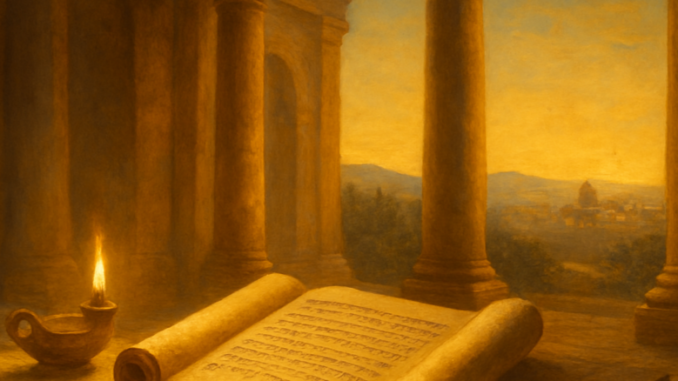
You probably know the feeling: you see something going wrong around you, but you hesitate to speak up. Who are you to raise your voice? You’re no expert, no leader, no authority. And yet, something keeps gnawing at you. That very tension lies at the heart of the Book of Amos — a text written over 2,700 years ago that still resonates with anyone who wrestles with the question: when should I speak, and when should I remain silent?
A Herdsman Becomes a Prophet
Amos was no priest, no scholar, and no man of rank. He describes himself as a herdsman and a dresser of sycamore figs from the small village of Tekoa. He had no formal training in sacred scripture and held no position in the temple. Yet he traveled to the northern kingdom of Israel to speak words that have echoed through the centuries. His message was uncomfortable: he called out those in power for their injustice, their greed, and their neglect of the most vulnerable members of society.
Why should this matter to you? Perhaps you recognize that familiar hesitation — the reluctance to speak up when you see something that isn’t right. The nagging doubt about whether it’s your place to offer criticism. Amos shows us that speaking truth doesn’t depend on your status or background, but on your willingness to listen to what truly matters.
The Plumb Line as a Symbol of Honesty
One of the most powerful images in the Book of Amos is that of a plumb line. As a building tool, it serves a straightforward purpose: to check whether a wall stands true. In Amos, the prophet uses it as a metaphor. Just as a plumb line reveals the crookedness of a structure without compromise, moral uprightness exposes the crookedness in human conduct. The plumb doesn’t lie, it doesn’t flatter, and it doesn’t adjust itself to suit anyone’s comfort.
For anyone familiar with the working tools of Freemasonry, this image resonates immediately. The plumb line is one of the key symbols that reminds us of sincerity and integrity in our actions. But here is the crucial point: we are not meant to measure the uprightness of others. We are called to examine our own inner construction first. Am I honest with myself? Do my words align with my deeds? The plumb line invites self-reflection without self-punishment — honest observation without condemnation.
Justice as Flowing Water
One of the most celebrated passages in Amos contains the call to “let justice roll on like a river, and righteousness like a never-failing stream.” This is not a static ideal but a living process. Water that flows purifies itself. Water that stands still becomes stagnant and murky.
“Let justice roll on like a river, and righteousness like a never-failing stream.”
This imagery speaks directly to a core idea in Freemasonry: moral growth is not a destination but a continuous journey. You don’t become a good person one day and simply check the box. Every day calls for renewed awareness, conscious choices, and the steady flow from intention into action. The inner work of building never stops.
The Courage to Be Unpopular
Amos was not welcomed with open arms. Amaziah, the priest of Bethel — the royal sanctuary — told him to leave and earn his bread elsewhere. The prophet was unwelcome with his message of self-examination and his critique of the established order. Yet he continued to speak.
This demands something real from us. Not the stubborn insistence on being right, but the courage to voice what you experience as true, even when it provokes resistance. In the lodge, Brethren learn to speak from sincerity, not from a desire for popularity. It’s not about winning the argument — it’s about being authentic. That can be uncomfortable, but it is always valuable.
What Can You Take From This?
The Book of Amos doesn’t offer a simple manual, but it does hold up a mirror. It invites you to ask yourself some searching questions:
Where in my life am I applying double standards? Do I have the courage to speak when silence would be easier? Is my sense of justice flowing freely, or has it become stagnant? Am I building something that stands true, or am I ignoring the crookedness?
Freemasonry doesn’t impose definitive answers to these questions, but it offers a space to explore them — in the stillness of the temple, in conversation with Brethren, and in the ongoing labor of self-improvement. Amos reminds us that this labor is not optional. The call for justice doesn’t come only from the outside world; it rises from within.
The Prophet Within
You don’t need a special title to speak truth. Amos was an ordinary man with a clear eye. What set him apart was not his position but his willingness to look, to see, and then to act. That same possibility lies within you — not to lecture others, but to test your own building work against the plumb line of honesty.
The ancient texts of the Old Testament continue to speak to us because they touch on universal human themes. The Book of Amos explores the tension between comfort and conscience, between status and integrity, between silence and speech. That tension never fully disappears, but you can learn to engage with it consciously. And that is precisely what the inner work of building demands.
Amos challenges you not to look away, not to remain silent when speaking is required, and not to rest comfortably in a structure that stands crooked. His message is timeless: justice is not an abstract ideal but a daily practice. Take the plumb line in your own hand, test your own work, and keep building what is upright and true. That is the invitation this ancient prophet still extends to each of us today.
Copyright text & image: devrijmetselaar.nl
Texts are based on the ideas and content of the author of devrijmetselaar.nl, reviewed, corrected, and supplemented with the assistance of OpenAI. Images are created based on the ideas of the author of devrijmetselaar.nl using OpenAI/DALL-E.
Frequently Asked Questions
What is the connection between the Book of Amos and Freemasonry?
The Book of Amos uses the plumb line—a fundamental building tool—as a metaphor for moral uprightness and integrity, which directly parallels Freemasonry's use of the plumb as one of its key working tools. Both traditions emphasize the importance of self-reflection, honesty, and continuous moral improvement rather than judging others. This shared symbolism reminds us that true integrity comes from examining our own inner construction and aligning our actions with our values.
Why should someone without authority or expertise speak up about injustice?
Amos teaches us that speaking truth doesn't depend on your status, credentials, or position—it depends on your willingness to listen to what truly matters and your courage to act on it. Freemasonry similarly values the principle that every member, regardless of background, has a voice and a responsibility to uphold justice and righteousness. When you see something wrong, your humanity and conscience are authority enough to speak.
What does the plumb line symbolize in Freemasonry?
The plumb line is a symbol of sincerity, integrity, and moral uprightness—it measures without compromise, flattery, or adjustment to suit anyone's comfort. In Freemasonry, it reminds us to examine our own inner construction and align our words with our deeds, rather than measuring the faults of others. This tool calls us to honest self-reflection and continuous moral growth throughout our lives.
How does the image of justice as a flowing river relate to Masonic ideals?
Justice as a never-failing stream represents a continuous, living process rather than a static goal—water that flows purifies itself, while water that stands still becomes stagnant. This imagery reflects Freemasonry's core principle that moral growth is an ongoing journey of renewed awareness and conscious choices, not a destination to be reached and forgotten. It reminds us that virtue and righteousness require daily commitment and intentional action.
Can someone with no formal training contribute meaningfully to their community?
Absolutely—Amos was a simple herdsman with no priestly training or scholarly credentials, yet his message of justice and compassion has resonated for over 2,700 years. Freemasonry similarly believes that every person, regardless of their background or education, can grow morally and contribute meaningfully to the betterment of society. What matters most is your willingness to listen, learn, and act with integrity and compassion.

Be the first to comment