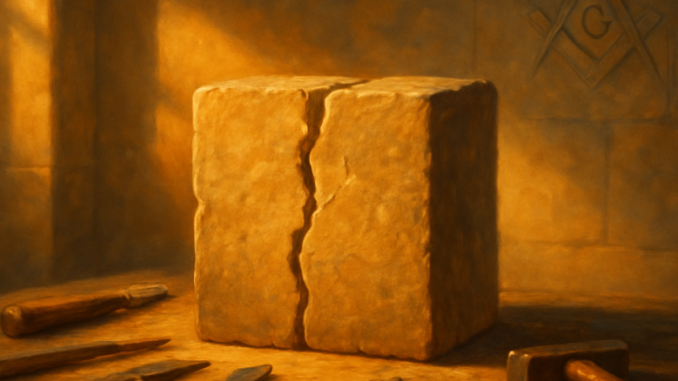
What if brotherhood is not a state of harmony but a state of sustained discomfort? What if the true test of connection lies not in the moments when everything runs smoothly, but precisely in the moments when tension becomes so palpable that walking away seems more attractive than staying? If that is the case, then everything we think we know about standing together in a lodge changes. The lodge is no longer a sanctuary — it becomes a crucible. And the division a brother feels with his lodge is not proof of failure, but perhaps the very beginning of genuine insight.
The Paradox of Commitment
There is a peculiar law that governs human communities: the more someone cares about a group, the more keenly they experience its shortcomings. Indifference, after all, knows no disappointment. Those who expect nothing are never hurt. But those who make themselves vulnerable, who invest time and energy in a collective ideal — they feel it when that ideal crumbles under the weight of habit, complacency, or misunderstanding. This is not weakness. It is the inevitable byproduct of sincere commitment.
In Freemasonry, this paradox takes on a distinctive form. The lodge presents itself as a workshop for self-improvement, a space where brothers help each other shape the rough ashlar into something purer. But what happens when the workshop itself feels rough? When the tools meant for building lie unused in a corner? When the ritual promise of brotherhood collides with the everyday reality of silence, indifference, or stagnation? The brother who experiences this confronts a philosophical riddle older than Freemasonry itself: how do you relate to a community that shares your values but does not always meet your expectations?
The Silence of Fifteen Brothers
Consider a seemingly ordinary situation. A brother cannot attend a meeting and lets the lodge know. The message is read by many. But no one responds with a gesture of help. No one picks up the gauntlet. The silence that follows is not hostile, not malicious — and that is precisely what makes it so telling. It is the silence of habituation. Of unconsciously leaning on the willingness of a small group while the collective remains in the background.
Philosophically, this touches on a fundamental question about community. The eighteenth-century thinker Immanuel Kant would recognize it as the difference between acting out of duty and acting out of inclination. Brotherhood as dutiful observance is fragile, because the moment the sense of duty fades, the behavior evaporates with it. Brotherhood as inner inclination — as the spontaneous willingness to lighten another’s burden without being asked — that is the living heart of what Freemasonry aims to cultivate. The question is not whether that heart exists, but whether it is dormant or truly awake.
The Difference Between Compromise and Conscious Choice
When tension arises between a brother and his lodge, the temptation is strong to think in terms of compromise. Give a little here, swallow a frustration there, and a superficial peace is restored. But a compromise, in the deepest sense of the word, is an agreement in which all parties surrender something without anyone truly choosing. It is the gray middle ground that inspires no one and satisfies no one.
There is a profound difference between a compromise and a conscious choice. A conscious choice demands clarity: what truly binds us, and what can we let go of without losing ourselves? This distinction is crucial for every brother who struggles with his place in the lodge. It is not about accepting everything, nor about rejecting everything. It is about discerning which tensions are fruitful and which merely wear you down. A conscious choice requires more courage than a compromise, because it compels honesty about what you truly value.
The true Mason does not build a temple of harmony. He builds a temple strong enough to bear the tension.
Stagnation: The Enemy of Tradition
Here a second philosophical question emerges. Freemasonry is rooted in tradition, and rightly so. Rituals, symbols, and customs form the framework within which the inner work takes place. But tradition is not the same as stagnation. Tradition is the living transmission of meaning from one generation to the next. Stagnation is clinging to forms whose original meaning has drained away. The difference is subtle but decisive. Tradition breathes. Stagnation suffocates.
When a lodge becomes more concerned with maintaining habits than with examining their meaning, it loses the very thing that gives it a reason to exist. The brother who identifies this and brings it up for discussion is, in essence, performing the most loyal work imaginable. He holds up the mirror — not out of hostility, but out of connection. The question is whether the lodge is willing to look into that mirror, or whether it would rather turn the mirror away and correct the messenger on form rather than substance.
Tension as Building Material
And so we arrive at the heart of this exploration. The division a brother experiences within his lodge is not a malfunction in the system. It is the system. The entire design of Freemasonry — with its rituals of trial, its symbols of imperfection, its emphasis on the rough ashlar — presupposes that growth is only possible through resistance. A hammer that never strikes stone shapes nothing. A workshop without tension is a museum.
This does not mean that every tension is beneficial, or that a brother must embrace every frustration as a teachable moment. Some tensions are signals that paths are diverging, that the fit between the individual and the community has changed. But it is worth pausing before reaching that conclusion — worth examining the tension itself as a tool before setting it aside. What is this friction trying to reveal? What rough edge within yourself does it expose? And what does it say about the lodge’s willingness — or reluctance — to do the inner work it professes to value?
Brotherhood, in its truest Masonic sense, was never meant to be comfortable. It was meant to be transformative. The lodge that avoids all tension avoids all growth. The brother who feels divided from his lodge may, paradoxically, be the one most deeply connected to its original purpose — for he still cares enough to feel the gap between what is and what could be. The question each of us must answer is not whether we can eliminate the discomfort, but whether we are willing to stay in it long enough to let it shape us. That is the real work of the Craft.
Copyright text & image: devrijmetselaar.nl
Texts are based on the ideas and content of the author of devrijmetselaar.nl, reviewed, corrected, and supplemented with the assistance of OpenAI. Images are created based on the ideas of the author of devrijmetselaar.nl using OpenAI/DALL-E.
Frequently Asked Questions
Is it normal to experience conflict or disappointment in a Masonic lodge?
Yes, absolutely. The article explains that experiencing tension in a lodge is not a sign of failure, but rather evidence of genuine commitment. When brothers care deeply about their lodge's ideals, they naturally feel disappointed when reality doesn't match those high expectations. This discomfort can actually be the beginning of meaningful growth and deeper understanding of brotherhood.
What does Freemasonry mean by the lodge being a 'crucible'?
A crucible is a vessel used to test materials under extreme heat, making it a powerful metaphor for the lodge as a place where brotherhood is tested and refined through real challenges. Rather than being merely a comfortable sanctuary, the lodge is presented as a transformative space where brothers help each other develop through both harmony and the productive discomfort of working through tensions together.
How should a brother respond when he feels the lodge isn't meeting his expectations?
The article suggests that rather than walking away or simply compromising, a brother should view this tension as an opportunity for philosophical reflection and genuine insight. This discomfort can inspire brothers to deepen their commitment to the lodge's true ideals and cultivate the spontaneous, inner inclination toward brotherhood that goes beyond mere duty.
What is the difference between duty-based and inclination-based brotherhood?
Duty-based brotherhood follows the rules and rituals out of obligation, but this commitment can fade when the sense of duty weakens. Inclination-based brotherhood, however, comes from a genuine inner desire to help fellow brothers without being asked, and this is described as the 'living heart' of what Freemasonry truly aims to cultivate in its members.



Be the first to comment