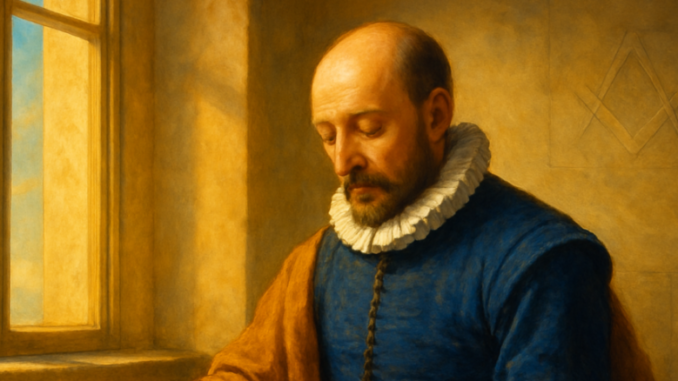
When the mind has no direction, Michel de Montaigne wrote in the sixteenth century, it thrashes about like a horse without a rider. This brief but powerful essay from his famous collection touches on a paradox that both the philosopher and the Freemason will recognize: rest without purpose brings not peace, but turmoil. What can two traditions — separated by centuries and vastly different in form — teach each other about the value of directed silence?
The Philosopher Speaks: A Mind Without Reins
In his essay “Of Idleness,” Montaigne describes how he withdrew to his country estate after a busy life, fully expecting his mind to settle into peaceful contemplation. The opposite happened. Without the discipline of daily occupation, his thoughts began to race like a runaway horse. Strange images, half-formed ideas, and unfinished reflections piled up like weeds in an untended garden. The philosopher concluded that the mind, much like the body, requires exercise to remain healthy.
Crucially, this was not an indictment of rest itself, but of aimless idleness. Montaigne drew a sharp distinction between doing nothing and being without purpose. The former can be restorative; the latter undermines the clarity of the soul. To tame his wild thoughts, he began writing them down. And so his famous Essays were born — exercises in self-knowledge, a way of giving the restless mind a channel through which to flow.
The Freemason Responds: Labor as the Path to Light
From the perspective of Freemasonry, Montaigne’s insight sounds remarkably familiar. The Craft has never glorified idleness. On the contrary, the search for Light — for truth and inner growth — demands constant labor. Not the labor of factories or markets, but the work upon the rough ashlar that every person carries within. That stone must be shaped, polished, and refined. Without such effort, a person remains trapped in darkness, no matter how much free time they may possess.
Masonic ritual serves precisely this purpose. It provides structure for the inner journey. Just as Montaigne used writing to organize his thoughts, the ritual offers the Freemason a framework within which reflection becomes fruitful. The symbols, actions, and words of the lodge are not empty formalities — they are tools that direct the mind toward what truly matters.
Where Both Traditions Converge
Montaigne and Freemasonry share a fundamental insight: human beings do not benefit from passive rest, but from active contemplation. Both traditions recognize that the mind grows confused without exercise, and that self-reflection is a discipline that must be learned and maintained. The philosopher pursued this through writing; the Freemason pursues it through working on the self within the enclosed space of the lodge.
A fallow mind produces not wisdom, but phantoms.
This shared starting point reveals a deeper truth. In both Renaissance philosophy and the Masonic tradition, the human being stands at the center as a creature who must shape itself. No one is born wise or virtuous. It takes effort, repetition, and honesty with oneself. The question is not whether one should rest, but how one rests in a way that nourishes the soul rather than starving it.
Idleness as a Mirror: What Can We Learn?
Montaigne’s essay holds up a mirror to each of us. How do we handle empty hours? Do we fill them with distraction, or do we dare to enter the silence with intention? A Freemason might add that brotherhood plays a vital role here as well. In the lodge, no one faces the inner struggle alone. The collective labor toward virtue and truth provides support where the individual mind threatens to lose its way.
Consider these parallels between the two traditions:
- Montaigne wrote his essays to bring order to his mind. The Freemason works the rough ashlar to achieve inner growth.
- Both traditions warn against aimless idleness as a subtle danger to the soul.
- Both view self-reflection as a skill that demands regular practice and discipline.
- Both seek meaning not in avoiding labor, but in finding labor that elevates the spirit.
The comparison between these two worlds demonstrates that ancient wisdom does not grow old. The Renaissance philosopher and the modern Freemason face the same challenge: how does one live a life of meaning? The answer lies not in avoiding work, but in finding work that uplifts the soul. Whether that means writing, or engaging in the ritual work of the lodge, matters little. What counts is the willingness to direct the mind, to train it, and to refine it.
A Timeless Lesson for Searching Souls
Montaigne’s essay on idleness is not a condemnation of rest — it is an invitation to conscious stillness. Freemasonry affirms this: the Light we seek is not found by sitting still and waiting, but by actively working on ourselves and on each other. The mind needs reins, a direction, a purpose. Without these, it runs wild, and we lose ourselves in shadows of our own making.
The dialogue between Montaigne and Freemasonry teaches us that idleness is not innocent rest — it is a danger to the searching mind. Those who wish to find the Light must be willing to work, to reflect, and to persevere. The philosopher did this with his pen; the Freemason does this in the lodge. Both paths lead to the same insight: only when the mind is given direction can it truly find peace.
Copyright text & image: devrijmetselaar.nl
Texts are based on the ideas and content of the author of devrijmetselaar.nl, reviewed, corrected, and supplemented with the assistance of OpenAI. Images are created based on the ideas of the author of devrijmetselaar.nl using OpenAI/DALL-E.
Frequently Asked Questions
What does Freemasonry teach about idleness and rest?
Freemasonry does not glorify idleness, but rather emphasizes that true rest comes through purposeful activity and self-improvement. The Craft teaches that the search for Light — truth and inner growth — requires constant labor on the self, much like shaping a rough stone into a polished ashlar. Without such directed effort and discipline, a person remains in darkness regardless of how much free time they possess.
How does Masonic ritual help direct the mind toward self-improvement?
Masonic ritual provides structure and framework for inner reflection, much like Montaigne used writing to organize his thoughts. The symbols, actions, and words of the lodge are not empty formalities but rather tools that guide the mind toward what truly matters, transforming potentially restless and chaotic thinking into fruitful contemplation and self-knowledge.
What is the 'rough ashlar' that Freemasons work upon?
The rough ashlar is a symbol of the self that every person carries within them. In Freemasonry, this stone represents one's potential for growth and refinement, and the work upon it refers to the ongoing process of spiritual and personal development through discipline, reflection, and labor within the Masonic tradition.
How does Freemasonry distinguish between doing nothing and being without purpose?
Like Montaigne, Freemasonry recognizes that passive idleness without direction creates mental turmoil and confusion, whereas purposeful rest combined with directed labor leads to clarity and wisdom. The Craft teaches that true peace comes not from doing nothing, but from actively engaging in meaningful self-work guided by the principles and structure of the lodge.



Be the first to comment