In an age where everything must happen faster, the slow grinding of the wheels of justice confronts us with an uncomfortable truth: some processes demand a kind of patience that runs directly counter to our expectations. As major court cases drag on for years, we are forced to ask what this means for our trust in societal institutions. Freemasonry, with its centuries-old emphasis on building slowly and deliberately, offers a surprisingly relevant perspective on this tension between haste and thoroughness.
The Measure of Time
When a court case is delayed for years, frustration is inevitable. Victims wait for acknowledgment, society demands a verdict, and our collective sense of justice feels eroded by endless postponement. Yet within this waiting lies something else entirely — the recognition that truth and justice cannot be forced by the clock.
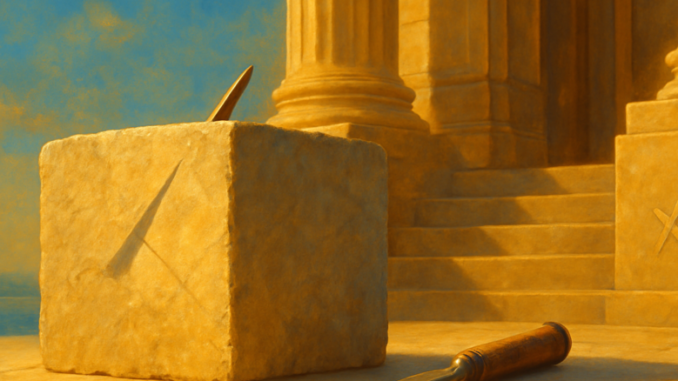
In Freemasonry, we speak of the rough ashlar that must be shaped into a perfect cube. This is not the work of days or weeks, but of years. The apprentice who chips away in haste destroys more than he creates. Seen through this lens, the slow pace of complex legal proceedings may not simply be a failure of efficiency — it may also reflect a kind of care and thoroughness that we have lost in other areas of life.
The Edifice of Trust
A society governed by the rule of law functions only through collective trust. Citizens agree to surrender the right to take justice into their own hands, in exchange for the promise that institutions will judge fairly. When that judgment is endlessly deferred, something in that trust begins to crack. The question that arises is not merely legal, but deeply ethical: how much patience can we ask of a society that yearns for justice?
The true Master Builder knows that a foundation laid too quickly endangers the entire structure.
This wisdom, deeply rooted in the building tradition from which Freemasonry draws its symbolism, casts a different light on judicial delays. A verdict resting on shaky evidence is like a cathedral built on sand. It may rise more quickly, but it will not stand when the storms come.
The Paradox of the Level
Among the most important symbols in Freemasonry is the level — the instrument representing equality and balance. In the context of justice, this symbol takes on a particular weight. The law must be equal for all, whether the parties involved are powerful or powerless, whether the case is straightforward or painfully complex.
Here a paradox reveals itself. On the one hand, equality demands that every case receives the attention it deserves, regardless of complexity or the prominence of those involved. On the other hand, this inevitably means that some cases require far more time than others. The level does not ask for speed — it asks for precision. It asks us to maintain balance, even when external pressure mounts.
Patience as a Forgotten Virtue
In a culture that glorifies instant gratification, patience has become a forgotten virtue. We order today and expect delivery tomorrow. We pose a question and demand an immediate answer. This mentality has seeped into every corner of our societal expectations, including our expectations of justice.
Freemasonry reminds us that the most important transformations take time. The Fellow Craft who grows into a Master undergoes a process that unfolds over years — not because of bureaucratic obstacles, but because inner growth simply cannot be accelerated. The same is true of truth in complex cases: it cannot be forced, only revealed.
Building a Just Society
What can we learn from this tension between urgency and thoroughness? Perhaps our frustration with slow justice should not be directed solely at the system, but also turned inward toward our own expectations. This does not mean we should accept inefficiency or allow delays to pass without consequence. It does mean we must learn to distinguish between slowness born of incompetence and slowness born of necessity.
Consider these guiding principles:
- Complex cases require thorough gathering and examination of evidence.
- Justice must serve truth, not speed.
- Trust in institutions demands transparency about processes and timelines.
- Patience is not passivity — it is active perseverance.
The Freemason sees himself as a builder of a better world, stone by stone, generation after generation. He knows that the edifice he contributes to will likely not be completed in his own lifetime. This long view — this capacity to work toward something that transcends one’s own existence — is precisely what our society needs when confronting complex challenges.
The Silence Before Judgment
In Masonic ritual, silence plays a central role. Before one speaks, there is contemplation. Before one judges, there is reflection. This practice stands in stark contrast to the modern impulse to react immediately, to condemn, to draw conclusions before the evidence has been fully weighed.
Perhaps the delayed court case, however frustrating it may be, is an unintentional invitation to that same silence. A reminder that some judgments must not be rendered lightly, and that some truths can only be found by those willing to wait.
The tension between our need for swift justice and the reality of slow legal processes touches on fundamental questions about how we live together. Freemasonry teaches that building takes time, that patience is not weakness but virtue, and that the foundation matters more than the speed at which the façade rises. In a world that spins ever faster, this may be the most radical message of all: that we must learn to wait for what is truly valuable, even when the waiting is painful.
Copyright text & image: devrijmetselaar.nl
Texts are based on the ideas and content of the author of devrijmetselaar.nl, reviewed, corrected, and supplemented with the assistance of OpenAI. Images are created based on the ideas of the author of devrijmetselaar.nl using OpenAI/DALL-E.
Frequently Asked Questions
What does Freemasonry teach about patience and why is it relevant today?
Freemasonry emphasizes building slowly and deliberately, using the symbol of the rough ashlar being shaped into a perfect cube over years of careful work. This ancient wisdom teaches that rushing important processes like justice can damage the outcome, much like an apprentice who chips away in haste destroys more than he creates. In our fast-paced world, this Masonic principle reminds us that true quality and integrity cannot be forced by the clock.
How does the Masonic symbol of the level relate to justice and fairness?
The level is one of Freemasonry's most important symbols, representing equality and balance in all things, including the law. Rather than demanding speed, the level asks for precision and fairness, ensuring that every case receives the attention it deserves regardless of complexity or the prominence of those involved. This principle teaches that true equality sometimes requires more time, not less, to maintain proper balance.
Why do Freemasons compare building a strong foundation to judicial processes?
Freemasonry uses building metaphors because the Craft draws its symbolism from the ancient building tradition, where a foundation laid too quickly endangers the entire structure. Similarly, a legal verdict based on shaky evidence is like a cathedral built on sand—it may rise quickly but will not stand when challenged. Freemasons understand that both buildings and justice systems must be constructed with care and thoroughness to endure.
How does Freemasonry view the relationship between trust and institutional patience?
Freemasonry teaches that a society governed by the rule of law functions only through collective trust, where citizens accept that institutions will judge fairly even if it takes time. The Masonic perspective recognizes that when judgment is endlessly deferred, trust begins to crack, but this is not an argument for rushing justice—rather, it is a call to ensure that the patience demanded is matched by genuine care and thoroughness. This balance between maintaining public trust and ensuring proper deliberation is central to Masonic values.

Be the first to comment