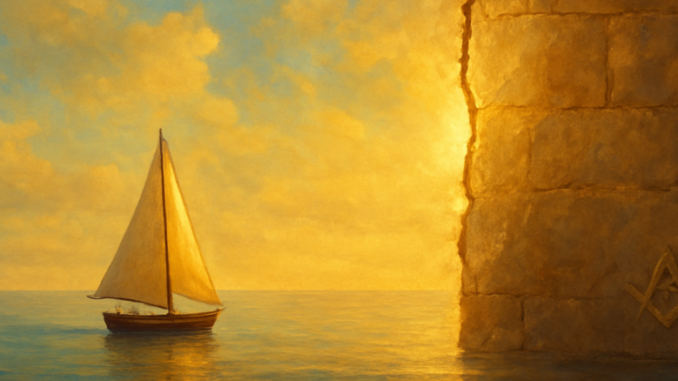
When the most fundamental bond a human being can know — that between a mother and her child — shatters in violence, an uncomfortable question demands our attention: what does human connection actually mean, and how do we relate to those who seem to fall outside every circle of brotherhood? A recent criminal case in The Hague, where a man was sentenced to compulsory psychiatric treatment after killing his mother and setting their home ablaze, confronts us with the very limits of our understanding of what it means to be connected to one another.
The Paradox of the Broken Bond
Here we encounter a paradox that Freemasonry has wrestled with for centuries: brotherhood presupposes reciprocity. But what happens when someone is unable to offer that reciprocity — not out of unwillingness, but out of incapacity, because a mind functions differently from what we consider normal? The Stoic philosopher Marcus Aurelius wrote in his Meditations that we must understand the actions of others from within their own inner state, not from within ours. This is not a license for destructive behavior, but a call toward deeper understanding.
Freemasonry upholds the ideal of universal brotherhood — the conviction that all human beings are fundamentally connected and that we carry obligations toward one another, regardless of origin or status. Yet this ideal is rarely tested against the most extreme cases. It is easy enough to feel brotherhood toward those we find agreeable. The real question is this: does brotherhood extend to those who have fallen the furthest?
Hiram Abiff and the Limits of Forgiveness
In Masonic tradition, the story of Hiram Abiff occupies a central place. The legendary architect of King Solomon’s Temple was murdered by three Fellow Crafts who tried to force him to reveal the secrets of a Master Mason. This story is not primarily about revenge or punishment. It is about how a community responds to betrayal from within. The three assailants were, after all, brothers — not outsiders.
What the legend teaches us is that brotherhood does not mean we approve of every deed. It means we continue to see the human being behind the act. This distinction is precisely what the legal concept of compulsory psychiatric treatment attempts to capture: an acknowledgment that some acts do not spring purely from free will, but from a disturbed mind that needs treatment rather than retribution alone.
The Lodge as a Training Ground for Difficult Connection
A Masonic lodge is not a gathering of like-minded people who simply affirm one another. At its best, it is a training ground where individuals of different backgrounds, opinions, and temperaments learn to engage with each other constructively. The rituals and symbols serve as a shared language that transcends superficial differences.
True brotherhood reveals itself not in embracing what is perfect, but in refusing to let go of what is broken.
This practice in connection prepares Brethren for the greater challenge: how do we relate to the world outside the lodge, including those we have not chosen and who confront us with the boundaries of our understanding? The eighteenth-century thinker Jean-Jacques Rousseau argued that the natural state of humanity is one of compassion and connection, but that society can distort these impulses. The question then becomes: can we restore that natural bond, even when others appear to have lost it entirely?
Compulsory Treatment as Societal Brotherhood
Imposing compulsory psychiatric treatment is, in essence, an act of societal brotherhood — however strange that may sound. It is the recognition that someone whose mind has driven him to terrible deeds cannot simply be severed from the human community. Instead, society takes responsibility both for protecting others and for the possibility of restoration.
This stands in stark contrast to a purely punitive approach, which places the offender permanently outside the circle. The philosopher Baruch Spinoza — himself an outsider who was excommunicated from his own community — wrote that we should neither celebrate nor lament human actions, but seek to understand them. Such understanding does not soften the suffering that has been caused. It is an attempt to fathom the human condition in all its complexity.
The Rough and the Perfect Ashlar
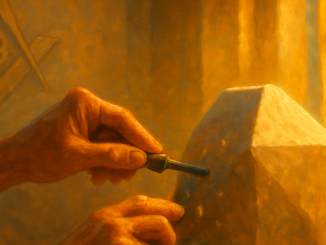
Freemasonry offers no ready-made answers to this dilemma. What it does offer is a tradition of reflection — of continually thinking through what it means to be human in relation to others. The well-known Masonic symbol of the rough ashlar and the perfect ashlar reminds us that every person is a work in progress: never finished, always capable of change.
Perhaps the question is not whether we can feel brotherhood for those who have done the unthinkable, but whether we are willing to make the effort to understand how a human being can be driven to such acts — and what that reveals about the vulnerability we all share.
The Open Question That Remains
And yet, the discomfort lingers. How far does our duty to connection truly reach? The mother in this case had no choice — she was bound by blood and love. Society, however, does have a choice. We can choose to keep those who have fallen the furthest within the circle of humanity, with all the costs and risks that entails. Or we can place them outside that circle and, in doing so, lose something of our own humanity.
The case in The Hague compels us to look beyond the condemnation of an act. It invites a philosophical exploration of what brotherhood truly means: not the easy bond with the pleasant and the familiar, but the difficult recognition that even the most broken human being is still a human being.
The question that stays with us may not be whether society is right to choose treatment over mere incarceration, but whether we as individuals are truly prepared to carry the weight of that brotherhood. Freemasonry teaches us that the work on the rough stone is never complete — and that the measure of our fraternity is found not in how we treat our closest Brethren, but in how we respond to those who challenge the very meaning of the bond we claim to share.
Copyright text & image: devrijmetselaar.nl
Texts are based on the ideas and content of the author of devrijmetselaar.nl, reviewed, corrected, and supplemented with the assistance of OpenAI. Images are created based on the ideas of the author of devrijmetselaar.nl using OpenAI/DALL-E.

Be the first to comment