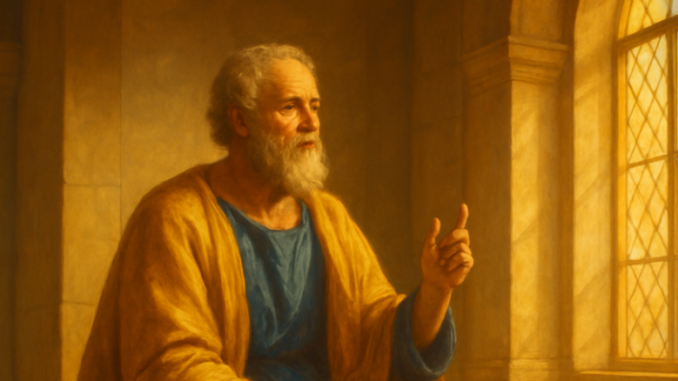
Imagine this: an old friend offers you a chance to escape your death sentence. The guards have been bribed, the plan is flawless, and everyone who loves you is begging you to flee. What do you do? This is precisely the situation Socrates faces in Plato’s dialogue Crito. His answer strikes at the very heart of what it means to be a person of integrity — and resonates deeply with values that Freemasons have cherished for centuries.
Why Does Socrates Refuse to Flee?
The dialogue opens in the early hours of morning, when Crito slips into Socrates’ prison cell with an urgent plea. The execution is drawing near, but there is still time to escape. Crito has arranged everything. He appeals to friendship, to Socrates’ responsibility toward his sons, to his own reputation. Yet Socrates refuses.
His reasoning is as simple as it is immovable: it does not matter what others think of you — only whether your actions are just. Socrates has lived his entire life in Athens and accepted the city’s laws. To flee now would violate those laws and, in doing so, undermine his own life’s work. The question is not whether the laws are perfect, but whether a person may break his word whenever it becomes inconvenient.
Is Obedience to Unjust Laws Not Cowardice?
This may be the most pressing question the Crito raises. After all, Socrates has been unjustly condemned. Would resistance not be braver than resignation? Here Plato unfolds a nuanced position that reaches far beyond blind obedience. Socrates acknowledges that laws can be unjust, but argues that the proper path is to change them through persuasion, not through lawlessness.
This distinction between personal conviction and social responsibility is fundamental. Socrates does not deny his own innocence, but he recognizes that he is part of something larger than himself. His individual fate does not outweigh the chaos that would ensue if everyone decided for themselves which laws to obey.
How Does This Relate to the Masonic Obligation?
Anyone with even a passing familiarity with Freemasonry will recognize in Socrates’ stance a deeply familiar principle. During initiation, a candidate takes obligations — promises of discretion, of brotherly fidelity, of moral self-improvement. These obligations are not taken under duress but freely, with full understanding of their meaning.
Duty in Freemasonry is not a blindfold but a compass: it points the way when personal interest and moral integrity collide.
Just as Socrates saw the laws not as chains but as the framework within which a just life becomes possible, the Freemason regards his obligations not as restrictions but as the pillars of his character. The obligation is not a burden — it is an anchor.
What Does Brotherhood Mean When Things Get Difficult?
Crito acts out of love when he begs Socrates to flee. Yet Socrates corrects him — not out of coldness, but from a deeper understanding of what true friendship demands. A friend who helps you do the wrong thing is no friend to your best self. Brotherhood sometimes means reminding the other of his own principles, even when it is painful to do so.
This insight echoes through the Masonic lodge. Brothers are encouraged to correct one another with gentleness but also with honesty. The goal is not to be liked, but to help each other grow toward moral excellence. This requires courage — both from the one who speaks and from the one who listens.
Is There Room for Personal Conscience?
A superficial reading of the Crito might suggest that Plato is preaching blind obedience. Nothing could be further from the truth. Socrates’ entire life was an exercise in critical thinking — in questioning assumptions, in listening to what he called his inner voice. His obedience to the laws did not arise from weakness but from deeply considered conviction.
Freemasonry navigates a similar tension. The fraternity asks for loyalty, but never at the expense of conscience. On the contrary: the ongoing self-reflection expected of every brother is designed to sharpen the conscience, not to suppress it. The search for truth is never finished, and every brother bears the responsibility to keep consulting his own inner compass.
What Can We Learn from All This?
The Crito confronts us with an uncomfortable truth: integrity is most valuable at the moment it costs the most. Socrates could have fled and lived out years in exile. Instead, he chose a death that affirmed his principles. This is not a call to martyrdom, but it is an invitation to reflect on our own boundaries.
What promises have we made — to ourselves or to others? Do we honor them when no one is watching? Do we dare to remind a brother of his own ideals? Are we open to receiving the same reminder from others?
The dialogue between Socrates and Crito is ultimately a dialogue each of us has with ourselves, every time comfort and principle collide. Freemasonry offers a space where that dialogue can take place, surrounded by brothers who know the same struggle.
Plato’s Crito is far more than a philosophical exercise about civic obedience. It is a meditation on what it means to remain true — to yourself, to your community, and to the values you have embraced. For Freemasons, this dialogue holds up a mirror: not to reassure us, but to challenge us. The question is not whether we will ever find ourselves in Socrates’ position, but whether we are already living according to the principles we would want to defend if we did.
Copyright text & image: devrijmetselaar.nl
Texts are based on the ideas and content of the author of devrijmetselaar.nl, reviewed, corrected, and supplemented with the assistance of OpenAI. Images are created based on the ideas of the author of devrijmetselaar.nl using OpenAI/DALL-E.
Frequently Asked Questions
Why does Socrates refuse to escape from prison even though he has been unjustly condemned?
Socrates refuses to escape because he believes it would violate the laws of Athens, which he has accepted and lived under his entire life. He argues that what matters is not what others think of you, but whether your actions are just. Breaking his word and fleeing would undermine his life's work and compromise his integrity, even though the laws condemning him are unjust.
Is Socrates' obedience to unjust laws an act of cowardice rather than courage?
No. Plato presents a nuanced position showing that Socrates acknowledges laws can be unjust, but the proper path to change them is through persuasion, not lawlessness. Socrates recognizes he is part of something larger than himself, and if everyone decided which laws to obey based on personal judgment, it would lead to chaos. His resignation is actually an act of principled courage rooted in social responsibility.
How does Socrates' concept of duty in the Crito relate to Masonic obligations?
Just as Socrates sees the laws as a compass guiding moral action rather than chains restricting freedom, Freemasons view their obligations as freely undertaken promises of discretion, brotherly fidelity, and moral self-improvement. Both emphasize that duty is not blind obedience but a principled commitment that guides behavior when personal interest and moral integrity collide.


Be the first to comment