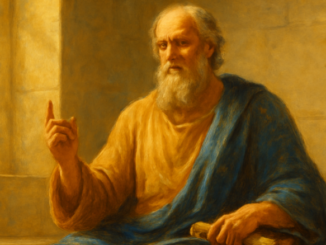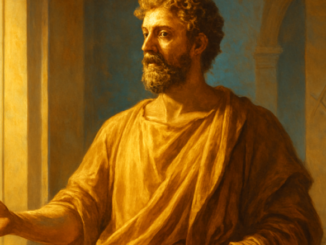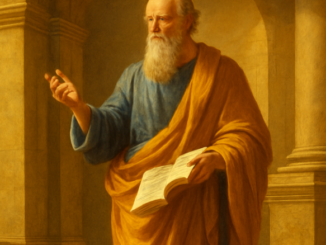
Ancient Greek philosophical dialogue symbolizing Masonic search for virtue
Plato – Freemasonry & Connection

Plato’s Meno and Freemasonry: Discovering Virtue by Asking

Picture yourself in lodge after an initiation ceremony. A brother turns to you and asks: what is virtue, really? You open your mouth to answer — and then realize you don’t quite know. This moment of not-knowing is exactly where Plato’s dialogue Meno begins, and where the Freemason’s most important work can take place. A Question That Changes Everything In the Meno, the Thessalian nobleman Meno poses a seemingly simple question to Socrates: can virtue be taught? Socrates responds with a counter-question that drives the entire dialogue: how can we teach something if we don’t even know what it is? This question isn’t meant to frustrate. It opens the door to deeper understanding. For the Freemason, this dynamic is deeply familiar. With every degree advancement, you encounter symbols and rituals whose meaning is never directly explained. You must search for yourself, ask questions, and discover that the question is often more important than the answer. Plato called this the method of elenchus — the systematic examination of what you think you know, until you discover what you truly know. Knowledge Already Within You One of the most celebrated passages in the Meno is the exchange between Socrates and a young […]
Rough ashlar stone in candlelight symbolizing Masonic self-reflection
Michel de Montaigne – Freemasonry & Connection

Montaigne on Fear: Lessons for Today’s Freemason

You’re about to make a major decision. Your stomach tightens, your thoughts race. Fear is a primal force that every human being knows intimately — whether you lived in sixteenth-century France or in the modern world today. Michel de Montaigne, the French thinker celebrated for his profoundly introspective essays, devoted an entire chapter to this very subject. His insights turn out to be remarkably relevant, especially for those committed to personal growth and brotherhood. So what can Freemasons learn from his reflections on fear? How Fear Works According to Montaigne In his essay “Of Fear,” Montaigne describes how anxiety influences our behavior in unpredictable ways. He recounts stories of soldiers who froze on the battlefield, of people who fled without knowing where they were going. Fear can paralyze us, but it can also drive us to reckless action. Montaigne observes that fear often causes more damage than the danger itself. It is not the threat that breaks us — it is our reaction to it. This insight applies directly to everyday life. How many opportunities do we let slip away out of fear of rejection? How many conversations do we avoid because we dread conflict? Montaigne invites us to face […]

Ancient stone bust of Marcus Aurelius symbolizing Stoic philosophy and inner peace
Marcus Aurelius – Meditations

Marcus Aurelius Book III: Philosophical Roots of Inner Peace

You wake up in the morning and the day is already overflowing with obligations, expectations, and unexpected twists. How do you maintain your inner calm amid all that chaos? This was the very question that occupied Marcus Aurelius when, as Roman Emperor, he wrote the personal notes we now know as the Meditations. In his third book, he turns his focus specifically to reason and the inner life. But where did these ideas come from? Which thinkers and philosophical traditions shaped his mind? By understanding the philosophical background, we can apply his insights more concretely in our own lives. The Stoic Tradition as Foundation Marcus Aurelius did not write in a vacuum. He stood on the shoulders of centuries of Stoic wisdom. This philosophical school, founded by Zeno of Citium around 300 BCE, had built a rich tradition by the second century. The core of Stoicism revolves around one supremely practical insight: we have no control over external events, but we do have control over our response to them. This is not an abstract philosophical principle — it is a daily exercise. In Book III, Marcus Aurelius applies this by continually pointing to the importance of reason as an inner […]

Open copy of Voltaire's Candide with Masonic symbols and garden imagery
Symbolism & Rituals

Voltaire’s Candide: Philosophical Roots of Suffering and Hope

When Voltaire published his satirical masterpiece Candide in 1759, he set off a philosophical earthquake. The work confronts the reader relentlessly with human suffering, yet refuses to abandon hope entirely. How can a thinker who depicts misery with such razor-sharp clarity still leave a path open toward meaning? The answers lie in a rich intellectual heritage stretching from the Stoic philosophers to the Enlightenment salons of Paris — and they connect in surprising ways to the ideals cherished by Freemasonry. Two Perspectives on Evil To understand Voltaire’s treatment of suffering, we need to set two fundamentally different worldviews side by side. On one hand stands the optimism of Gottfried Wilhelm Leibniz, the German philosopher who claimed that we live in the best of all possible worlds. According to Leibniz, God — as a perfect being — necessarily created the most harmonious universe. Every evil serves a higher purpose; every instance of suffering fits neatly into a grand cosmic plan. On the other hand stands Voltaire himself, who dissected this optimism with biting irony. After the devastating Lisbon earthquake of 1755, which killed tens of thousands of people, he could no longer accept the notion that all suffering has divine justification. […]

Ancient Roman scroll symbolizing Seneca's Stoic letters and Masonic wisdom
Lucius Annaeus Seneca – Letters to Lucilius

Seneca’s Fifth Letter: Roots of Wisdom and Brotherhood

In his fifth letter to Lucilius, the Roman philosopher Seneca tackles what seems like a straightforward question: how should a philosopher relate to the rest of humanity? Beneath this apparent simplicity lies a rich intellectual tradition stretching back to the early Stoics — and forward to later brotherhoods that place wisdom and human connection at their very center. This letter stands as a pivotal text bridging personal virtue and social responsibility, and its resonance with Freemasonry is striking. The Stoic Legacy: From Athens to Rome To fully appreciate Seneca’s Fifth Letter, we need to understand the philosophical currents that shaped his thinking. Stoicism, founded by Zeno of Citium around 300 BCE, provided the foundation for Seneca’s worldview. Teaching from the Stoa Poikile — the painted colonnade in Athens — Zeno argued that the human soul forms part of a greater cosmic whole. This idea that all people are connected through a universal reason, the logos, lies at the very heart of Letter V. Seneca inherited this tradition through Roman intermediaries. His teacher Attalus and the writings of Posidonius introduced him to a form of Stoicism that had merged with practical Roman wisdom. Where Greek Stoicism sometimes leaned toward abstract contemplation, […]

Ancient Greek philosophical dialogue connecting Plato's Meno to Freemasonry
Plato – Philosophical Background

Plato’s Meno: Philosophical Roots of Virtue and Knowledge

Can virtue be taught, or does every person already carry it within? This question, posed by Meno to Socrates in one of Plato’s most celebrated dialogues, touches on fundamental issues that still resonate today. The Meno offers not only a philosophical investigation into the nature of knowledge and morality but also opens a window into the intellectual world in which Plato wrote. For Freemasons, this dialogue strikes a particularly familiar chord: the quest for inner illumination, the role of symbols in unveiling hidden wisdom, and the conviction that true knowledge does not come from without but is awakened from within. The World of Plato: Athens and the Sophists To understand the Meno, we first need to step into the intellectual arena in which Plato operated. Fifth-century Athens was buzzing with philosophical activity. Sophists like Gorgias and Protagoras traveled the Greek world, teaching rhetoric, political skills, and what they called “virtue” to wealthy young men. Their approach was pragmatic: virtue, in their view, was a skill that could be learned, much like writing or arithmetic. Socrates, Plato’s teacher, took a radically different stance. Where the Sophists confidently claimed to sell wisdom, Socrates began every conversation by acknowledging his own ignorance. This […]

Open book with classical philosophical texts relating to Montaigne and fear
Michel de Montaigne – Philosophical Background

Montaigne on Fear: The Philosophical Roots of Essay 17

Michel de Montaigne did not write his essay ‘On Fear’ in an intellectual vacuum. Behind his seemingly personal observations about anxiety lies a rich philosophical tradition stretching back to Greek and Roman antiquity. By tracing these roots — Stoicism, Skepticism, and the moral psychology of Plutarch — we can better understand how sixteenth-century thinking about fear connects to the contemplative practice that also lies at the heart of Freemasonry. Stoicism as the Foundation Stoic philosophy is arguably the most important undercurrent in Montaigne’s thinking about fear. Seneca, whose letters Montaigne studied closely, regarded fear as a passion born from false judgments about reality. For the Stoics, fear arises when we treat external events as threats to our well-being, when true well-being resides in virtue alone. Epictetus put it sharply: it is not things themselves that disturb us, but our judgments about those things. Montaigne absorbs this Stoic insight but transforms it at the same time. Where Seneca aims for complete mastery over the passions, Montaigne is more modest. He acknowledges that fear is a human reality that cannot simply be reasoned away. This nuance makes his essay far more approachable than the sometimes severe Stoic treatises. He does not ask […]

Ancient Roman statue of Marcus Aurelius symbolizing Stoic wisdom and inner life
Marcus Aurelius – Content & Summary

Marcus Aurelius Book III: On Reason and the Inner Life

In the year 167 AD, somewhere along the northern frontier of the Roman Empire, Emperor Marcus Aurelius sat down to write his most private reflections. Book III of his Meditations opens with a confronting truth: our bodies decay, but our minds can remain sharp until the very last moment. These thoughts, penned amid the chaos of military campaigns, still offer a compass for anyone seeking inner peace and wisdom — including those of us who walk the path of Freemasonry. The Historical Context of Book III Marcus Aurelius never intended his Meditations to be published as a philosophical treatise. They were personal exercises in the art of living — spiritual journal entries written for an audience of one. Book III was most likely composed during his stay at Carnuntum, a Roman legionary fortress on the Danube, where he directed the Marcomannic Wars. Surrounded by disease, death, and the crushing weight of empire, he turned to the Stoic philosophy he had learned as a young man from his teacher Junius Rusticus. The Stoics, whose intellectual lineage stretches back to Zeno of Citium and was later refined by Epictetus and Seneca, taught that the only thing we truly possess is our own […]

Symbolic journey from darkness to light inspired by Voltaire's Candide
Symbolism & Rituals

Voltaire’s Candide IV: Suffering and Hope in the Best of Worlds

In 1759, a slim satirical novel burst onto the scene and upended the European intellectual world. Voltaire wrote Candide during an era scarred by earthquakes, wars, and religious persecution. The fourth chapter plunges its young hero into the depths of misery — yet also offers the first glimmer of hope. More than two and a half centuries later, this passage still speaks powerfully to anyone wrestling with an enduring question: how do we find meaning in the midst of incomprehensible suffering? The Historical Context of Candide Voltaire penned his masterpiece in the shadow of the devastating Lisbon earthquake of 1755, a catastrophe that killed tens of thousands. The disaster shattered the optimistic worldview championed by philosophers like Gottfried Wilhelm Leibniz, who argued that we live in “the best of all possible worlds” because an omniscient God would never create anything inferior. Voltaire, deeply shaken by the senseless suffering he witnessed all around him, resolved to unmask this optimism mercilessly through the power of his pen. Chapter Four of Candide marks a turning point in the story. After being expelled from the paradisiacal castle of Baron Thunder-ten-Tronckh, brutalized by soldiers, and left to wander aimlessly, our hero reaches his absolute nadir. […]

Ancient scroll representing Seneca's letters with Masonic square and compasses
Lucius Annaeus Seneca – Content & Summary

Seneca’s Fifth Letter: Philosophy, Humanity & Freemasonry

In 65 AD, the Roman philosopher Lucius Annaeus Seneca composed a series of letters to his friend Lucilius — a body of correspondence that would become one of the most influential philosophical works of antiquity. The fifth letter addresses a theme that still resonates powerfully today: how can we live a philosophical life without alienating ourselves from the society around us? Seneca warns against the pitfalls of both ostentatious display and excessive asceticism, pointing instead to a middle path that remains strikingly relevant — not least for those who walk the Masonic path of quiet self-improvement. The Historical Context of the Letter Seneca wrote his letters to Lucilius during the final years of his life, after withdrawing from the political arena of imperial Rome. Lucilius, who was serving as procurator of Sicily at the time, sought guidance from his older friend on how to lead a virtuous life. The fifth letter is essentially a response to Lucilius’s enthusiastic embrace of philosophy. Seneca, drawing on years of experience as an adviser at the court of Emperor Nero, knew the dangers of extremes all too well. In first-century Roman society, philosophy was not merely an intellectual pursuit — it was a way […]

Open book showing Montaigne's Essays with focus on the essay about fear
Michel de Montaigne – Content & Summary

Montaigne on Fear: Summary and Analysis of Essay 17

In 1580, a collection of essays appeared that would permanently reshape Western literature. Michel de Montaigne, the French nobleman and philosopher, wrote about everything that occupied his restless mind — from friendship to cannibalism. In the seventeenth essay of his first book, he turned his attention to a universal human experience: fear. This relatively short piece reveals just how profoundly Montaigne understood the human psyche, centuries before modern psychology would even begin to take shape. The Core Idea of the Essay Montaigne opens with a paradox that sets the tone for his entire argument: fear is the emotion he fears most. What seems like a clever play on words actually conceals a profound truth. Montaigne is not primarily concerned with the concrete dangers that threaten us, but with what fear does to the human mind. Fear robs us of our capacity for reason and strips us of our dignity. It transforms a soldier into a coward and a wise man into a fool. The central thesis of the essay is that fear is a more powerful and more disruptive emotion than any other passion. Even anger, grief, or desire leave the human mind somewhat intact. Fear, by contrast, takes complete […]

Ancient Greek dialogue scene representing Plato's Meno and the pursuit of virtue
Plato – Content & Summary

Plato’s Meno: Virtue and Knowledge as Foundations for Growth

In fifth-century Athens, a young aristocrat named Meno posed a question that philosophers have grappled with ever since: can virtue be taught, or is it an innate quality? Plato recorded this exchange in a dialogue that not only explores the foundations of ethics but also introduces a revolutionary theory of knowledge. The Meno remains one of the most accessible yet profoundly deep works in Western philosophy — a text that compels us to reflect on what we truly know and how we can become better people. For those on the Masonic path, where self-improvement and the pursuit of wisdom stand at the very heart of the Craft, this ancient dialogue holds remarkable resonance. The Central Question of the Dialogue The Meno opens with a direct and seemingly simple question from its title character to Socrates: is virtue something that can be taught, does it come through practice, or is it naturally present in human beings? True to his method, Socrates refuses to answer the question before first establishing what virtue actually is. This leads to an inquiry characteristic of Plato’s early dialogues — the dismantling of false certainties to create space for genuine understanding. Meno makes several attempts at a […]

Marcus Aurelius statue symbolizing Masonic presence and self-reflection
Marcus Aurelius – Freemasonry & Connection

Marcus Aurelius on the Here and Now: Freemasonry & Connection

You probably know the feeling: you’re sitting in a conversation, but your mind has already drifted to tomorrow. You’re walking through the city, but you’re mentally somewhere else entirely. The present moment sometimes feels like the hardest place to truly inhabit. Marcus Aurelius, the Roman emperor-philosopher, wrestled with exactly the same challenge more than eighteen centuries ago. In the second book of his Meditations, he wrote some of his most penetrating thoughts on presence and connection. For Freemasons, his words touch on something essential — the question of how to be truly present, both for yourself and for your Brothers. The Burden of Past and Future Marcus Aurelius never wrote his Meditations for publication. They were private notes — a conversation with himself. That’s precisely why they feel so raw and honest. In Book II, he confronts himself with the waste that occurs when the mind constantly slips away to what has been or what is yet to come. He reminds himself that the present is the only thing anyone truly possesses. The past is gone, the future uncertain. Only this moment offers space for action, for growth, for genuine connection. This wasn’t idle philosophizing. For Marcus Aurelius, it was […]

Golden city of El Dorado symbolizing Masonic ideals and Voltaire's philosophy
Symbolism & Rituals

Voltaire’s El Dorado: Utopia as a Mirror for Freemasonry

What would a perfect society look like? A place where greed holds no power, where people treat each other with genuine respect, and where wisdom matters more than wealth. Voltaire imagined exactly such a world in his masterpiece Candide, in the legendary kingdom of El Dorado. But was this golden land meant as a blueprint for humanity — or as a sharp mirror reflecting our deepest flaws? And what does an eighteenth-century literary utopia have to do with the ideals that Freemasons continue to cherish today? A Golden City That Doesn’t Exist In Candide, the naïve protagonist stumbles into El Dorado after a long string of misfortunes. It is a hidden kingdom where gold and gemstones litter the streets as though they were ordinary pebbles. The inhabitants laugh at Candide’s astonishment. What value does gold have when everyone already has enough? Voltaire doesn’t present this paradise as a serious proposal for how society should be organized. Instead, he uses it as a stark contrast to the world he saw around him — the cruelty, the wars, the religious intolerance of his era are inverted in El Dorado into their exact opposite. And yet, Candide leaves this paradise voluntarily. He wants […]

Symbolic representation of trust and brotherhood in Freemasonry
Lucius Annaeus Seneca – Freemasonry & Connection

Seneca on True Friendship and Brotherhood in Freemasonry

Have you ever shared a secret with someone you weren’t entirely sure you could trust? Or perhaps you’ve kept someone at arm’s length — someone who actually deserved your full openness? Nearly two thousand years ago, the Stoic philosopher Lucius Annaeus Seneca wrote a short but powerful letter to his friend Lucilius about precisely this dilemma. His reflections on true friendship cut to the heart of what it means to be genuinely connected to another person. And remarkably, they align seamlessly with one of the central values of Freemasonry: brotherhood. Trust Must Come Before Friendship — Not After Seneca opens his third letter with a warning that still resonates today. He argues that you should never trust someone first and only then consider whether they are worthy of that trust. Instead, you must carefully evaluate who you allow into your life — and then give your trust completely. Stopping halfway, Seneca insists, is worse than never beginning at all. This distinction between shallow acquaintances and deep friendships forms the backbone of his argument. For anyone who has ever visited a Masonic lodge, this will sound familiar. Freemasonry has no room for half-hearted bonds. When a candidate is initiated, he enters […]

Ancient Greek philosopher in contemplation symbolizing Freemasonry and Plato
Plato – Freemasonry & Connection

Plato’s Phaedo and Freemasonry: A Shared Quest for Light

Imagine sitting in a room with your closest friends, knowing this conversation will be your last. What would you want to talk about? For Socrates, in the final hours before his death, the answer was clear: the immortality of the soul and the meaning of a life well lived. In Plato’s dialogue Phaedo, we find not only a philosophical masterpiece on life and death, but also a wellspring of insights that resonate remarkably with the core principles of Freemasonry. The Setting of a Final Farewell The Phaedo unfolds in Socrates’ prison cell on the day of his execution. His students — Phaedo, Simmias, Cebes, and others — gather around their teacher for one last conversation. What follows is neither a lament nor a bitter goodbye, but a calm, profound exploration of what it means to live and die as a philosopher. Socrates faces his own death with a serenity that both astonishes and inspires his companions. This composure is not indifference or denial. It is the fruit of a life devoted to self-reflection and the pursuit of truth. Socrates spent his entire existence examining the human condition, asking difficult questions, and challenging false certainties. Now, at the end, he reaps […]

Symbolic bridge representing Masonic connection and Montaigne's philosophy
Michel de Montaigne – Freemasonry & Connection

Montaigne on Ambassadors: The Art of Connection in Masonry

When Michel de Montaigne wrote about diplomats and their conduct in the sixteenth century, he touched on something universal: the art of building connections. How do you convey a message without distorting it? How do you serve as an intermediary without letting your own interests take over? These questions, posed amid political intrigue and religious conflict, find a surprising echo in Freemasonry — a tradition equally concerned with how human beings can connect with one another and with higher values. The Ambassador as a Mirror of Humanity In his brief but incisive essay, Montaigne examines the behavior of ambassadors who interpret their instructions either too literally or too freely. Some cling rigidly to their orders, even when circumstances clearly call for adaptation. Others take so much liberty that they cease to serve their master and begin pursuing their own agenda. Montaigne seeks the middle path: an ambassador must exercise judgment, but always within the boundaries of his commission. This dilemma is timeless. Anyone who carries a message — whether as a diplomat, a friend, or a member of a community — faces the same challenge. How do you remain faithful to the essence of what you are communicating, while also […]

Ancient Roman oil lamp illuminating a writing tablet with Masonic symbols
Marcus Aurelius – Meditations

Marcus Aurelius and the Present Moment: Philosophical Roots

An oil lamp flickers softly as a Roman emperor, weary after a day of warfare on the northern frontiers, reaches for his writing tablet. It is deep into the night, somewhere around 170 AD. Marcus Aurelius begins to write — not for publication, but for himself. Sentences about impermanence, the present moment, the urgent need to live now. Where did these thoughts originate? What philosophical currents shaped this imperial mind that continues to inspire millions to this day? The Stoic Roots of the Present Moment In Book II of his Meditations, Marcus Aurelius turns with remarkable intensity to the theme of living in the here and now. This focus was no casual whim but the product of centuries of Stoic philosophical tradition. The Stoic school, founded by Zeno of Citium around 300 BC, developed a philosophy centered on mastering one’s own thinking. Marcus Aurelius inherited this tradition through a chain of teachers and writings stretching back to Greek antiquity. At the heart of Stoic thinking about time lies a fundamental insight: only the present moment is truly ours. The past is gone and unchangeable; the future is uncertain and beyond our control. Epictetus, the former slave whose teachings Marcus Aurelius […]

Symbolic golden city of El Dorado representing Voltaire's philosophical utopia
Symbolism & Rituals

Voltaire and El Dorado: Philosophical Roots of the Utopia

In 1759, Voltaire published his satirical masterpiece Candide, in which the naïve protagonist stumbles upon a seemingly perfect land: El Dorado. This golden realm, hidden deep in the mountains of South America, serves as a philosophical mirror held up to European society. But which thinkers and intellectual currents shaped Voltaire’s vision of this utopia? The roots stretch from Plato’s ideal state to the Renaissance humanists, touching upon questions that Freemasons have grappled with for centuries: how do we build a better world? The Utopian Tradition Before Voltaire The concept of an ideal society has a long history in Western thought. Plato, in his Republic, envisioned a community governed by philosopher-kings, where justice reigned as the supreme virtue. This vision remained influential for centuries, inspiring generations of thinkers to formulate their own societal ideals. In 1516, Thomas More published Utopia, describing a fictional island where private property did not exist and religious tolerance prevailed. The very title became synonymous with any imagined perfect land. Voltaire knew these works intimately. As a voracious reader and tireless correspondent with intellectuals across Europe, he had access to the entire utopian canon. Tommaso Campanella’s The City of the Sun and Francis Bacon’s New Atlantis were […]

Ancient philosophical scroll symbolizing Seneca's letters on friendship
Lucius Annaeus Seneca – Letters to Lucilius

Seneca on True Friendship: Philosophical Roots of Letter III

Can complete openness in friendship be naïve, or is withholding your true thoughts a betrayal of the bond you share? In his third letter to Lucilius, Lucius Annaeus Seneca poses a paradox that still resonates across the centuries: whoever distrusts a friend does not deserve to be trusted himself. Behind this seemingly simple statement lies a rich philosophical tradition connecting Stoic wisdom with deeper questions about human connection, virtue, and the art of living together. The Stoic Foundations of Friendship Seneca wrote his letters to Lucilius around 65 AD, at the height of his philosophical maturity. He drew upon a tradition stretching back to the early Stoa, founded by Zeno of Citium in third-century Athens. For the Stoics, friendship was no sentimental affair — it was a rational bond between virtuous souls. Chrysippus, one of the most important early Stoics, argued that only the wise are capable of true friendship, because only they possess the inner freedom to genuinely choose another person. This may sound elitist, but Seneca refines the idea. He acknowledges that wisdom is an ideal people strive toward, not a status they achieve. Friendship thus becomes a training ground for virtue — a space where individuals grow […]