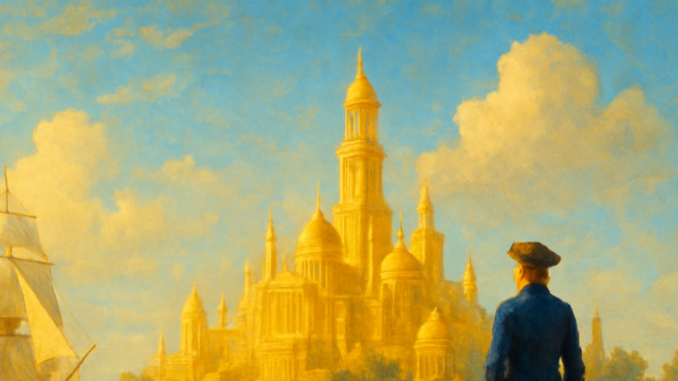
What would a perfect society look like? A place where greed holds no power, where people treat each other with genuine respect, and where wisdom matters more than wealth. Voltaire imagined exactly such a world in his masterpiece Candide, in the legendary kingdom of El Dorado. But was this golden land meant as a blueprint for humanity — or as a sharp mirror reflecting our deepest flaws? And what does an eighteenth-century literary utopia have to do with the ideals that Freemasons continue to cherish today?
A Golden City That Doesn’t Exist
In Candide, the naïve protagonist stumbles into El Dorado after a long string of misfortunes. It is a hidden kingdom where gold and gemstones litter the streets as though they were ordinary pebbles. The inhabitants laugh at Candide’s astonishment. What value does gold have when everyone already has enough? Voltaire doesn’t present this paradise as a serious proposal for how society should be organized. Instead, he uses it as a stark contrast to the world he saw around him — the cruelty, the wars, the religious intolerance of his era are inverted in El Dorado into their exact opposite.
And yet, Candide leaves this paradise voluntarily. He wants to return to the imperfect world, driven by love and perhaps a certain restlessness. This is no trivial detail. Voltaire is suggesting that human beings are not made for passive perfection. It is the search itself — with all its stumbling blocks — that gives meaning to existence.
Utopia as a Workshop for Character
This is where Voltaire’s thinking touches one of the central themes of Freemasonry: the rough ashlar. You are not born a perfected being. You enter the world as an unfinished stone that must be refined through effort, reflection, and the patient work of self-improvement. Seen through this lens, El Dorado is not a final destination but a vision that provides direction. It shows what might be possible if people could overcome their baser instincts. At the same time, the story acknowledges that such a victory is never permanent.
The utopia is not a destination — it is a compass reminding us of the direction in which we wish to grow.
In the lodge, the work is not about building a perfect world out there. It is about building yourself. The rituals, the symbols, the fraternal conversations — these are tools designed to bring you closer to your own El Dorado. Not through the naïve belief that perfection is attainable, but through the conscious choice to undertake the journey.
Connection Beyond Boundaries
What makes El Dorado truly remarkable in Voltaire’s description is the complete absence of conflict between people of different backgrounds. There are no priests persecuting dissenters, no kings waging wars over territory. Strangers are met with warm curiosity rather than suspicion. Voltaire, who himself faced censorship and persecution for his ideas, was clearly dreaming of a world in which diversity posed no threat.
This dream of connection across boundaries will feel deeply familiar to anyone who knows Freemasonry. In the lodge, people meet regardless of their religious beliefs or social backgrounds. The requirement is not uniformity of opinion, but a willingness to engage in respectful dialogue. Just as in El Dorado, differences are not erased — they are celebrated as a source of enrichment. It is precisely this diversity that makes the Masonic experience so powerful: the recognition that we can learn most from those who see the world differently than we do.
The Gardener and His Work
Candide does not end in El Dorado. It ends in a modest garden. The book’s famous closing line tells us that we must cultivate our garden. This is Voltaire’s answer to the question of how to live in an imperfect world. Not by escaping into dreams of paradise, not by despairing at reality, but by working concretely and patiently on what lies within your reach.
For Freemasons, this is a deeply familiar thought. The temple you build is not a structure of brick and mortar — it is the sum total of your actions, your relationships, your character. El Dorado reminds you that harmony is possible. The garden reminds you that daily work is necessary. Both are essential: the vision and the labor.
What Voltaire Still Teaches Us Today
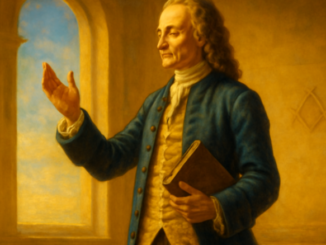
Voltaire was not a Freemason for most of his life, though he did join the lodge Les Neuf Sœurs in Paris in his later years. His initiation took place in 1778, shortly before his death, and on that occasion he wore the apron of Helvétius, another great Enlightenment thinker. This detail is telling: at the end of his life, Voltaire formally joined a brotherhood that pursued the very same ideals he had championed throughout his entire career.
El Dorado remains relevant because it poses the same questions that arise in the lodge. How do you relate to wealth and power? How do you treat people who think differently from you? What is the value of knowledge if it does not lead to wisdom? Voltaire’s answers are not always comforting, but they are honest. And honesty — both toward yourself and toward others — may well be the first step toward any meaningful form of connection.
Consider the key lessons that emerge from Voltaire’s vision and their Masonic parallels. El Dorado shows us that utopias are not meant to be reached — they are meant to give direction. Genuine connection arises from respecting diversity, not from enforcing uniformity. To cultivate the garden means to work daily on character and community. And at their core, Freemasonry and Voltaire’s philosophy share a fundamental belief in the possibility of human improvement.
Voltaire’s El Dorado invites you to reflect on your own utopia — not as an escape from reality, but as a compass for your actions. Freemasonry extends a similar invitation: work on yourself, connect with others, and understand that the journey matters more than the arrival. The golden city does not lie beyond the horizon. It lives in the quality of your daily choices. And perhaps that is precisely what Voltaire meant when he wrote that we must cultivate our garden.
Copyright text & image: devrijmetselaar.nl
Texts are based on the ideas and content of the author of devrijmetselaar.nl, reviewed, corrected, and supplemented with the assistance of OpenAI. Images are created based on the ideas of the author of devrijmetselaar.nl using OpenAI/DALL-E.
Frequently Asked Questions
What is El Dorado in Voltaire's Candide, and why does the protagonist leave this perfect paradise?
El Dorado is a hidden kingdom where gold and gemstones are so abundant they are worthless, and people treat each other with respect and wisdom. Candide voluntarily leaves this paradise driven by love and restlessness, suggesting that Voltaire believed human beings find meaning not in passive perfection, but in the search itself, with all its struggles and challenges.
How does Voltaire use El Dorado as social criticism rather than a serious blueprint for society?
Voltaire uses El Dorado as a stark contrast and mirror to reflect the flaws of eighteenth-century society. By presenting an inverted world where cruelty, wars, and religious intolerance are replaced by their opposites, he critiques the injustices of his era without proposing El Dorado as a literal model for how society should be organized.
What is the connection between El Dorado and the Masonic concept of the rough ashlar?
Both El Dorado and the rough ashlar concept emphasize that perfection is not a final destination but a direction for growth. Just as Masons refine themselves through effort and self-improvement, Voltaire's utopia serves as a compass showing the direction of personal development. The lodge work focuses on building oneself through rituals and fraternal engagement, not on achieving passive perfection.


Be the first to comment