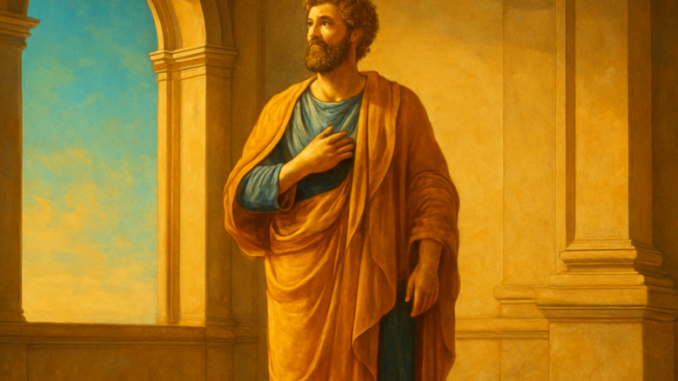
You wake up in the morning and the day is already overflowing with obligations, expectations, and unexpected twists. How do you maintain your inner calm amid all that chaos? This was the very question that occupied Marcus Aurelius when, as Roman Emperor, he wrote the personal notes we now know as the Meditations. In his third book, he turns his focus specifically to reason and the inner life. But where did these ideas come from? Which thinkers and philosophical traditions shaped his mind? By understanding the philosophical background, we can apply his insights more concretely in our own lives.
The Stoic Tradition as Foundation
Marcus Aurelius did not write in a vacuum. He stood on the shoulders of centuries of Stoic wisdom. This philosophical school, founded by Zeno of Citium around 300 BCE, had built a rich tradition by the second century. The core of Stoicism revolves around one supremely practical insight: we have no control over external events, but we do have control over our response to them. This is not an abstract philosophical principle — it is a daily exercise.
In Book III, Marcus Aurelius applies this by continually pointing to the importance of reason as an inner compass. When you are confronted in the morning with difficult colleagues or disappointing news, you face a choice: do you react impulsively, or do you take a moment to act from your rational faculty? The Stoics called this the hegemonikon — the ruling part of the soul. For Marcus Aurelius, cultivating this inner center was not a luxury but a necessity.
Epictetus: The Teacher Behind the Emperor
No philosopher exerted more influence on Marcus Aurelius than Epictetus. This former slave, who later became one of the most influential Stoic teachers, taught that freedom does not depend on your social position but on your inner attitude. His Enchiridion and Discourses formed the intellectual backbone of Marcus Aurelius’ thought. In Book III, the voice of Epictetus echoes clearly whenever Marcus Aurelius writes about the distinction between what lies within our power and what does not.
In practical terms, this means: you cannot determine whether you will fall ill today, but you can determine how you deal with illness. You cannot prevent someone from insulting you, but you can choose whether that insult holds any power over you. This is not passive resignation — it is active inner work.
Reason is the only instrument capable of examining and correcting itself, making inner freedom possible despite external constraints.
Seneca and the Art of Everyday Living
Alongside Epictetus, Seneca was a major influence. As a Roman statesman and philosopher, Seneca wrote practical letters about how to integrate wisdom into a busy life. His emphasis on self-reflection at the end of each day resonates strongly with Marcus Aurelius’ own method. Both understood that philosophy is not a theoretical exercise but a living art that demands daily practice.
Seneca’s Letters to Lucilius contain concrete advice you can still apply today. Take a moment every evening to reflect on your day: where did you react from emotion rather than reason? Where could you have acted more wisely? This self-reflection is not self-punishment — it is an instrument for growth. Marcus Aurelius did exactly the same, and his Meditations are the product of that daily discipline.
Heraclitus and the Flow of Change
An older influence that shimmers through Book III is Heraclitus. This pre-Socratic thinker is best known for his observation that everything flows — panta rhei. Nothing remains the same; change is the only constant. Marcus Aurelius regularly refers to this insight when he writes about the impermanence of fame, possessions, and even the body itself.
This is not gloomy pessimism but a liberating perspective. If everything changes, why cling to temporary things? Your energy is better spent on what endures: your character, your capacity for reason, your inner disposition. In practice, this means spending less time worrying about what you cannot hold on to and more time cultivating who you want to become.
Reason as a Building Block of Brotherhood
For those familiar with Freemasonry, this theme will sound familiar. The emphasis on inner work, self-reflection, and the cultivation of reason are central elements in Masonic thought. Just as Marcus Aurelius endeavored to work the rough stone of his character every day, the Freemason views his inner development as a lifelong project.
The Stoic tradition shares with Freemasonry the understanding that true brotherhood begins with individual responsibility. You can only be a good brother to others when you have first put your own inner house in order. This is not selfishness — it is a foundation. He who does not know and govern himself cannot truly serve others.
Practical Steps for Today
The philosophical background of Marcus Aurelius’ third book offers concrete tools for your daily life:
Begin each morning with the question: what lies within my power today, and what does not?
Pause before reacting emotionally. Ask yourself: is this my reason speaking, or my impulse?
End each day with a brief reflection: where was I faithful to my inner compass today?
Remind yourself in times of adversity: this too shall pass.
These exercises are not signs of weakness but of strength. They require discipline, honesty, and patience — precisely the qualities that both the Stoics and Freemasonry hold in the highest regard.
The philosophical background of Marcus Aurelius’ third book is not a dusty academic matter. It is a living tradition that invites us, today, in our own lives, to use reason as our compass. From Zeno to Epictetus, from Seneca to Heraclitus — these thinkers offered tools that still work. The question is not whether their wisdom is relevant, but whether we are willing to actually apply it. Inner peace is not something that happens to us. It is something we build — stone by stone, day by day.
Copyright text & image: devrijmetselaar.nl
Texts are based on the ideas and content of the author of devrijmetselaar.nl, reviewed, corrected, and supplemented with the assistance of OpenAI. Images are created based on the ideas of the author of devrijmetselaar.nl using OpenAI/DALL-E.
Frequently Asked Questions
What is the main philosophical principle that Marcus Aurelius applies in Book III of Meditations?
The main principle is that we have no control over external events, but we do have control over our response to them. Marcus Aurelius emphasizes the importance of using reason as an inner compass to choose rational action over impulsive reaction, particularly when facing difficult situations like challenging colleagues or disappointing news.
Who was Epictetus and why was he so influential on Marcus Aurelius?
Epictetus was a former slave who became one of the most influential Stoic teachers. His teachings, particularly the distinction between what lies within our power and what does not, formed the intellectual backbone of Marcus Aurelius' thought. Epictetus taught that freedom depends on inner attitude rather than social position, a concept that echoes throughout Marcus Aurelius' Book III.
How can I apply Marcus Aurelius' philosophy of inner peace to my daily life?
You can apply his philosophy by recognizing that while you cannot control external events—such as illness or insults—you can control how you respond to them. By cultivating your rational faculty (what the Stoics called the hegemonikon, or ruling part of the soul), you can practice active inner work to maintain inner calm amid chaos and obligations.


Be the first to comment