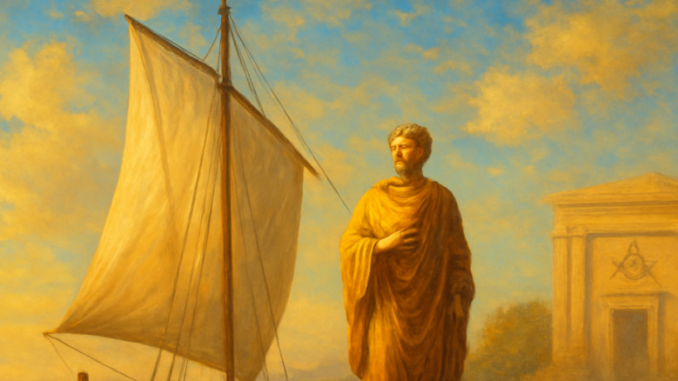
In the year 167 AD, somewhere along the northern frontier of the Roman Empire, Emperor Marcus Aurelius sat down to write his most private reflections. Book III of his Meditations opens with a confronting truth: our bodies decay, but our minds can remain sharp until the very last moment. These thoughts, penned amid the chaos of military campaigns, still offer a compass for anyone seeking inner peace and wisdom — including those of us who walk the path of Freemasonry.
The Historical Context of Book III
Marcus Aurelius never intended his Meditations to be published as a philosophical treatise. They were personal exercises in the art of living — spiritual journal entries written for an audience of one. Book III was most likely composed during his stay at Carnuntum, a Roman legionary fortress on the Danube, where he directed the Marcomannic Wars. Surrounded by disease, death, and the crushing weight of empire, he turned to the Stoic philosophy he had learned as a young man from his teacher Junius Rusticus.
The Stoics, whose intellectual lineage stretches back to Zeno of Citium and was later refined by Epictetus and Seneca, taught that the only thing we truly possess is our own mind. External circumstances — whether imperial power or personal loss — lie beyond our control. What we can govern is our response, our inner disposition. This insight forms the very heart of Book III.
The Central Theme: Mortality as Teacher
Book III opens with a remarkable meditation on aging and physical decay. Marcus Aurelius observes how even a gaping lion’s jaw or the crack in a ripe fig possesses its own kind of perfection. He reminds us that even Hippocrates, the great physician, died of the same diseases he tried to cure. Alexander the Great and his stable master were both seized by death alike. This is not pessimism — it is a call to clear-eyed sobriety.
Reason, Marcus Aurelius argues, is the only instrument we possess to both accept our mortality and fill our days with dignity.
By truly feeling the finite nature of life, he contends, we create space for what is essential. The confrontation with death is not meant to inspire fear but to liberate the mind from trivial concerns. Anyone who recognizes that each moment could be the last will not waste it on vanity or resentment.
The Inner Citadel: Protecting the Mind
A recurring theme in Book III is the concept of the mind as an inner citadel. Marcus Aurelius writes that we can withdraw into ourselves at any moment, as into a refuge that no one can enter without our permission. This idea of the mind as an impregnable fortress was not entirely new. Plato had already written about the soul needing to detach from bodily desires, and Aristotle emphasized reason as the highest human faculty.
Yet Marcus Aurelius gives this insight a distinctly practical turn. He asks: what actually prevents us from ordering our minds right now, in this very moment? Not circumstances, but our own thoughts form the obstacles. The chaos of the external world can only enter if we open the gate. This demands daily practice — a constant vigilance over our own patterns of thinking.
For anyone familiar with the Masonic tradition of guarding the inner temple, this metaphor will resonate deeply. The rough ashlar does not shape itself; it requires deliberate, sustained effort.
Connections to Brotherly Wisdom and Masonic Thought
The lessons of Book III resonate remarkably with the pursuit of self-knowledge that lies at the center of Freemasonry. When Marcus Aurelius speaks of working on one’s own mind — of separating the essential from the superfluous — he touches on universal themes of inner growth that every Mason will recognize. The idea that a person must shape himself as a sculptor works rough stone finds direct parallels in Masonic symbolism, where the rough ashlar is transformed into the perfect ashlar through discipline, reflection, and moral effort.
What is equally striking is how Marcus Aurelius emphasizes that this inner work does not lead to isolation but to a deeper sense of community. The person who masters his own mind can engage with others more justly and more lovingly. The reason he advocates is not cold calculation but a warm understanding of the human condition. He reminds us that we all share in the same logos — the same universal reason that connects all human beings. This is strikingly close to the Masonic understanding of the Brotherhood of Man, bound together not merely by ritual but by a shared commitment to moral truth.
Practical Wisdom for Daily Life
Book III contains concrete guidance that remains remarkably applicable nearly two millennia later. Marcus Aurelius advises beginning each morning with the thought that you will encounter difficult people — not to arm yourself with resentment, but to prepare yourself for patience. He warns against the accumulation of possessions and reputation as ends in themselves. These things are not inherently bad, but they become problematic when we make our happiness dependent on them.
His practical recommendations can be distilled into a few enduring principles: Begin each day with reflection on what truly matters. Regard setbacks as opportunities for character development. Remind yourself of the impermanence of all external things. Treat others with the same gentleness you would wish for yourself.
The power of these guidelines lies in their simplicity. Marcus Aurelius does not ask for extraordinary feats — only for daily attentiveness to ordinary life. In this sense, he stands in a long tradition of practical philosophy, from Socrates engaging passersby in conversation in the Athenian marketplace to Montaigne turning the everyday into a subject of deep contemplation in his essays.
From the Second Century to the Present Day
Nearly nineteen hundred years after the death of Marcus Aurelius, his Meditations are still read, discussed, and cherished. This speaks volumes about the universality of his insights. The questions that occupied him — how to live with uncertainty, how to maintain dignity under pressure, how to shape one’s own mind — are still very much our own. The historical distance does not make his words less relevant; if anything, it makes them more accessible. We can learn from him without needing to adapt to his specific context of Roman imperial life.
For Freemasons especially, Marcus Aurelius offers a powerful example of what it means to live a examined life. His Meditations are not dogma but an invitation — a model of the kind of ongoing self-inquiry that the Craft encourages in every Brother. The temple he builds is not made of stone but of thought, discipline, and moral intention.
Book III of the Meditations invites us into a form of self-examination that has no endpoint — only a continuing process. The reason Marcus Aurelius writes about is not a dry intellectual exercise but a living practice, one that shapes character, deepens compassion, and connects us to something larger than ourselves. Whether you approach these ancient reflections as a student of philosophy, a seeker of wisdom, or a Freemason committed to the never-ending work on your own rough stone, the message remains the same: the most important work you will ever do is the work you do within.
Copyright text & image: devrijmetselaar.nl
Texts are based on the ideas and content of the author of devrijmetselaar.nl, reviewed, corrected, and supplemented with the assistance of OpenAI. Images are created based on the ideas of the author of devrijmetselaar.nl using OpenAI/DALL-E.
Frequently Asked Questions
What is the connection between Marcus Aurelius's Book III and Freemasonry?
The article suggests that Marcus Aurelius's reflections on reason, inner peace, and wisdom in Book III offer guidance for those who walk the path of Freemasonry. Both share an emphasis on inner development, self-reflection, and the cultivation of virtue through personal discipline and philosophical understanding.
Why did Marcus Aurelius write Book III of his Meditations?
Marcus Aurelius wrote Book III as private reflections and personal spiritual journal entries, not for public publication. He composed these thoughts while stationed at Carnuntum, a Roman fortress on the Danube, during the Marcomannic Wars. The writings served as personal exercises in the art of living, influenced by the Stoic philosophy he had learned from his teacher Junius Rusticus.
What is the main message about mortality in Book III?
Book III teaches that recognizing our finite nature and mortality is not meant to inspire fear, but rather to liberate the mind from trivial concerns. By understanding that each moment could be our last, we are called to fill our days with dignity and focus on what is truly essential, rather than wasting time on vanity or resentment. This clear-eyed acceptance of death is presented as a path to wisdom.



Be the first to comment