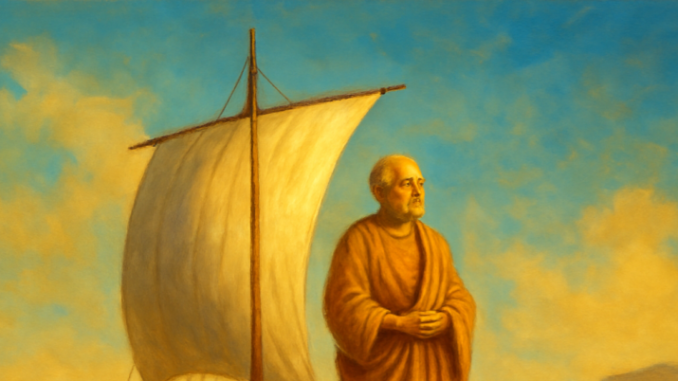
In his fifth letter to Lucilius, the Roman philosopher Seneca tackles what seems like a straightforward question: how should a philosopher relate to the rest of humanity? Beneath this apparent simplicity lies a rich intellectual tradition stretching back to the early Stoics — and forward to later brotherhoods that place wisdom and human connection at their very center. This letter stands as a pivotal text bridging personal virtue and social responsibility, and its resonance with Freemasonry is striking.
The Stoic Legacy: From Athens to Rome
To fully appreciate Seneca’s Fifth Letter, we need to understand the philosophical currents that shaped his thinking. Stoicism, founded by Zeno of Citium around 300 BCE, provided the foundation for Seneca’s worldview. Teaching from the Stoa Poikile — the painted colonnade in Athens — Zeno argued that the human soul forms part of a greater cosmic whole. This idea that all people are connected through a universal reason, the logos, lies at the very heart of Letter V.
Seneca inherited this tradition through Roman intermediaries. His teacher Attalus and the writings of Posidonius introduced him to a form of Stoicism that had merged with practical Roman wisdom. Where Greek Stoicism sometimes leaned toward abstract contemplation, its Roman counterpart was firmly rooted in daily life. We see this practical emphasis clearly in Letter V, where Seneca warns against philosophical showmanship that alienates the philosopher from fellow citizens.
The Tension Between Seclusion and Community
One of the central tensions in Letter V concerns how the wise person should relate to the crowd. Seneca navigates carefully between two extremes. On one side stands the Cynic tradition of Diogenes of Sinope, who provocatively rejected social conventions. On the other lies the Epicurean retreat into the secluded garden, where philosophers kept exclusively to their own circle. Seneca chooses neither extreme.
True philosophy distinguishes itself not through outward display, but through an inner transformation that draws a person closer to their fellow human beings.
This position reveals the influence of Panaetius of Rhodes, who had adapted Stoicism for the Roman aristocracy a generation before Seneca. Panaetius emphasized that the wise person lives not outside society but within it, and that philosophy must never serve as an excuse for social indifference. It is for this reason that Seneca cautions Lucilius against a way of life that repels rather than attracts.
Parallels with Freemasonry
Reading the Fifth Letter through the lens of Freemasonry reveals remarkable parallels. The tension Seneca describes between inner development and social engagement mirrors a fundamental question within fraternal organizations devoted to personal growth. The lodge is a sheltered space for reflection, but complete withdrawal from the world is never the goal.
Where Seneca warns against philosophical posturing, Freemasonry likewise cautions against outward show without inner substance. Wearing ritual regalia or memorizing ancient texts means little without the accompanying character development. In both traditions, genuine wisdom manifests in how one lives — not in how one presents oneself to others.
This shared emphasis is no coincidence. Both traditions recognize that the real work happens internally, and that external markers of belonging are merely symbols pointing toward deeper truths. A Freemason who knows every word of the ritual but fails to practice brotherly love in daily life has missed the point entirely — just as Seneca’s philosopher who dresses in rags to appear wise has confused the signpost for the destination.
The Role of Friendship in Philosophical Formation
The letter format itself deserves attention. Seneca does not write to an abstract audience but to Lucilius, a friend whom he mentors intellectually and spiritually. This connects to the Aristotelian tradition in which friendship — philia — is considered essential to the good life. Aristotle distinguished three forms of friendship, the highest of which is grounded in mutual virtue.
Seneca’s correspondence with Lucilius embodies this highest form. The letters are not monologues but invitations to reciprocal reflection. Here too we see a foreshadowing of later fraternal traditions, in which members do not seek to convert one another but instead search together for truth and self-improvement. The master learns from the apprentice, and the apprentice from the master — a dynamic that will feel immediately familiar to any Freemason.
Historical Context: Philosophy Under Nero
Letter V was written during a politically charged period. Seneca had served as advisor to Emperor Nero and eventually withdrew when the political situation became untenable. His letters to Lucilius date from this later phase of life, when Seneca devoted himself to philosophical writing with a keen awareness that his time was finite.
This context explains the urgency of his message. Seneca speaks not from academic detachment but from lived experience. He had seen firsthand at court how power corrupts and how easily people lose their inner compass. His warning in Letter V against seeking conspicuousness carries extra weight in this light. The philosopher must distinguish himself through character, not through behavior that attracts the attention of potentially dangerous rulers.
For Freemasons, this historical backdrop adds another layer of meaning. Throughout history, fraternal organizations have had to navigate their relationship with political power carefully. The imperative to work quietly, to let one’s actions speak louder than one’s claims, resonates across centuries and traditions.
Two Perspectives on the Same Truth
When we place the Stoic philosopher beside the Freemason, we see two worlds that overlap in surprising ways. The Stoic strives toward ataraxia — equanimity achieved through understanding what is truly valuable. The Freemason works on the rough ashlar, shaping and polishing his own character. Both traditions acknowledge that this work cannot happen in isolation.
The common ground is substantial. Both Stoicism and Freemasonry emphasize universal brotherhood. Both traditions warn against hollow rituals devoid of inner meaning. In both, the relationship between the individual and the community stands at the center. And in both, friendship and mentorship form the pedagogical heart of the endeavor.
The difference may lie in the methods. Where Seneca works through philosophical argumentation and personal correspondence, Freemasonry employs ritual and symbolism to convey comparable truths. Yet the core message remains recognizable across the centuries: be in the world, but do not let its superficial values define you. Pursue wisdom not as a badge of distinction, but as a quiet force that shapes how you treat every person you encounter.
Seneca’s Fifth Letter, written nearly two thousand years ago, continues to speak to anyone engaged in the lifelong work of self-improvement within a community of like-minded seekers. Its insistence that true philosophy — and by extension, true Masonic practice — is measured not by outward display but by inner transformation and genuine human connection remains as relevant today as it was in ancient Rome. The rough stone is shaped not in solitude, but in the company of brothers who hold each other accountable to the highest standards of character and compassion.
Copyright text & image: devrijmetselaar.nl
Texts are based on the ideas and content of the author of devrijmetselaar.nl, reviewed, corrected, and supplemented with the assistance of OpenAI. Images are created based on the ideas of the author of devrijmetselaar.nl using OpenAI/DALL-E.
Frequently Asked Questions
What is the main theme of Seneca's Fifth Letter to Lucilius?
Seneca's Fifth Letter addresses how a philosopher should relate to the rest of humanity. It bridges personal virtue and social responsibility, presenting a middle path between social withdrawal and excessive worldly engagement. The letter emphasizes that true philosophy involves inner transformation that draws people closer to their fellow human beings rather than separating them through outward display or seclusion.
How does Seneca balance the tension between seclusion and community in his philosophy?
Seneca avoids two extremes: the Cynic rejection of social conventions and the Epicurean retreat into exclusive philosophical circles. Instead, influenced by Panaetius of Rhodes, Seneca argues that the wise person should live within society, not outside it. He emphasizes that philosophy must never serve as an excuse for social indifference, and that the philosopher should engage with fellow citizens rather than repel them through arrogance or detachment.
What is the connection between Stoic philosophy and Freemasonry mentioned in this article?
The article suggests that Seneca's Fifth Letter has striking resonance with Freemasonry through its emphasis on wisdom and human connection. Both traditions share the Stoic legacy of viewing all people as connected through universal reason (the logos) and place importance on balancing personal virtue with social responsibility. This common ground reflects how later brotherhoods, like Freemasonry, built upon philosophical foundations that prioritize both individual development and meaningful human fellowship.




Be the first to comment