A seventeen-year-old motorcyclist lost his life in a tragic accident over the weekend. It’s the kind of news that stops you mid-scroll — a life barely begun, suddenly ended. Beyond the grief it brings to families and communities, it confronts us with an uncomfortable question: how do we shape who we are, knowing that our time here is finite and fragile? Freemasonry offers a framework for thinking about this — not as abstract philosophy, but as a daily practice of intentional living.
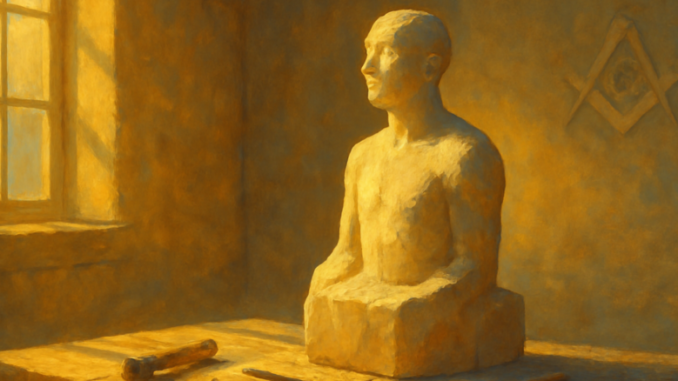
The Rough Ashlar and the Unfinished Sculptor
In Freemasonry, the rough ashlar represents the individual at the beginning of their life’s journey. This unworked stone must be shaped, refined, and polished until it can take its proper place in a greater structure. It’s a powerful symbol, but it also raises a haunting question: what happens when the sculptor cannot finish his work? What if life ends before the stone finds its final form?
A seventeen-year-old stands at the very beginning of that shaping process. Personality is still developing, brimming with potential and possibility. The sudden end of such a young life reminds us that we cannot afford to postpone the work on ourselves. Every moment of conscious self-development counts — not because we know how much time we have, but precisely because we don’t.
What Does Shaping Character Actually Look Like?
Character formation sounds abstract, but in practice it’s remarkably concrete. It comes down to daily choices. How do you respond when someone wrongs you? What do you do with your free hours? Which conversations do you seek out, and with whom? The Roman emperor and Stoic philosopher Marcus Aurelius wrote in his Meditations that we should sculpt our souls as though we could die at any moment — not out of fear, but out of urgency to live according to our values.
In the lodge, this idea is made practical through rituals that invite Brethren into honest self-reflection. You are never told who you should be, but you are consistently encouraged to look honestly at who you are. That’s the crucial difference between being shaped by external force and shaping yourself from within. Freemasonry offers tools, not a blueprint.
Character formation is not a destination — it is a daily exercise in conscious living.
Three Practical Steps for Building Character
How can you begin shaping your character more intentionally, starting today? Here are three actionable practices you can apply immediately:
1. Evening reflection: Take five minutes each evening to review your day. Ask yourself: where did I act in alignment with the person I want to become, and where did I fall short? This isn’t self-punishment — it’s honest inventory. Many Masonic traditions encourage exactly this kind of nightly self-examination.
2. Choose one virtue per month: Focus deliberately on a single quality — patience, honesty, courage, compassion. Seek out daily situations where you can practice it. The French essayist Michel de Montaigne took a similar approach in his writing, placing one human quality under the microscope at a time. By narrowing your focus, you deepen your practice.
3. Find a mirror: Seek out someone who will give you honest feedback. In Freemasonry, Brethren serve as mirrors for one another. Without truthful reflection from others, self-knowledge remains shallow. A trusted friend, mentor, or fellow lodge member can reveal blind spots you’d never discover alone.
The Paradox of the Unfinished Stone
There is a paradox embedded in the work of self-improvement. On one hand, we know the work is never truly finished. Even the wisest among us dies a student. On the other hand, it is precisely this incompleteness that gives meaning to every step we do take. A seventeen-year-old may have had only a fraction of the time granted to others, but every friendship he forged, every act of courage or kindness, every new thing he learned — all of it contributes to the mosaic of a life lived.
The Stoic philosopher Seneca wrote that what matters is not how many years we live, but how fully we fill them. A short life can be rich; a long life can remain hollow. This is not offered as consolation for the bereaved — nothing can fill that silence. But it is a call to action for those of us still drawing breath: fill your days with deliberate choices.
What You Can Do Today
After reading this article, you can close this screen and go on with your day. Or you can do one thing differently. Choose a single moment today to act deliberately as the person you aspire to become. Perhaps it’s a difficult conversation you’ve been avoiding. Perhaps it’s an apology you’ve owed someone for too long. Perhaps it’s simply pausing to ask yourself: am I living in a way I’d want to be remembered for?
Freemasonry teaches that we are builders of an invisible temple — one made not of stone, but of character, relationships, and deeds. Every day is an opportunity to lay a new stone. The tragic news of a young life cut short reminds us that we don’t know how many stones we still get to place. Let that knowledge not paralyze you, but propel you forward.
A young life that ends too soon leaves a silence that words cannot fill. What we can do is feel the urgency to live our own lives with intention. Shaping character is not a luxury for those with time to spare — it is the core activity of a meaningful existence. Start today. Start now. Because tomorrow is a promise no one can guarantee.
Copyright text & image: devrijmetselaar.nl
Texts are based on the ideas and content of the author of devrijmetselaar.nl, reviewed, corrected, and supplemented with the assistance of OpenAI. Images are created based on the ideas of the author of devrijmetselaar.nl using OpenAI/DALL-E.

Be the first to comment