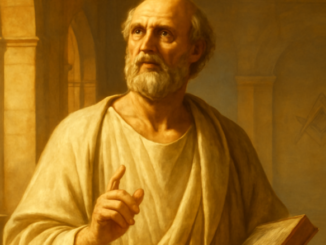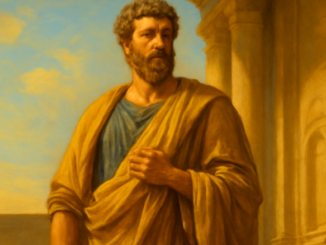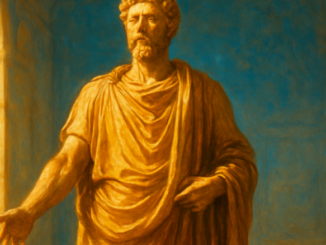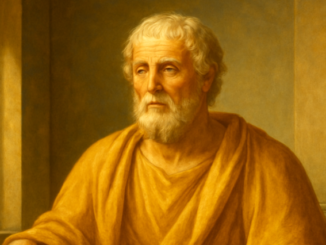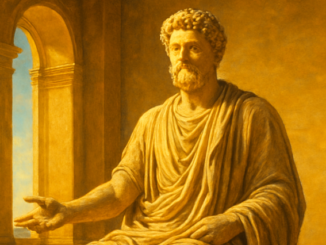
Statue of Marcus Aurelius representing Stoic brotherhood and philosophy
Marcus Aurelius – Content & Summary

Marcus Aurelius Book VI: On Brotherhood and Humanity

In the year 170 AD, amid grueling military campaigns along the Danube frontier, the Roman Emperor Marcus Aurelius sat down in the solitude of his army tent and wrote some of the most penetrating reflections ever composed on what it means to be connected to our fellow human beings. Book VI of his Meditations, nearly two thousand years later, still speaks powerfully to anyone who contemplates brotherhood, community, and the art of living together. The Historical Context of Book VI Marcus Aurelius ruled as emperor from 161 to 180 AD, a reign marked by wars, plagues, and political turmoil. Yet this philosopher-king found time to examine his inner life with remarkable honesty. Book VI was most likely composed during the Marcomannic Wars, when the emperor was confronted daily with the rawest dimensions of human existence — violence, betrayal, and death. It was precisely under these harsh conditions that he developed his deepest insights into human connection. The Stoic philosophy in which Marcus Aurelius had been educated by teachers such as Junius Rusticus and Apollonius of Chalcedon formed the bedrock of his thinking. The Stoics taught that all human beings are part of a single cosmic community, bound together by the […]

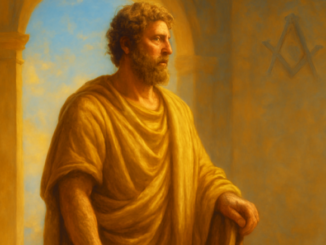
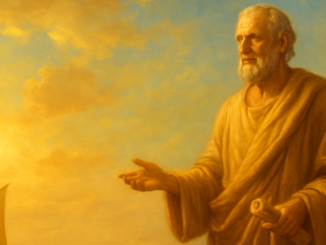
Ancient Stoic philosopher reflecting in contemplation within a symbolic lodge
Lucius Annaeus Seneca – Letters to Lucilius

Seneca on Simplicity and Fidelity: The Philosophical Roots

Can anyone truly practice philosophy when their life contradicts their words? Lucius Annaeus Seneca poses this question with striking sharpness in his twentieth letter to Lucilius. It is a question that has echoed through the centuries and still reverberates today in the silence of the Masonic lodge, where the tension between professing and practicing lies at the very heart of the work. Let us explore the philosophical sources Seneca drew upon when he composed this remarkable letter. The Paradox of the Talking Philosopher Seneca opens his letter with a challenge that is as simple as it is unsettling: let your actions match your words. The demand sounds self-evident, and that is precisely what makes it so treacherous. The Stoic tradition from which Seneca emerged had always wrestled with the gap between theory and practice. Zeno of Citium, the founder of the Stoa around 300 BCE, was already criticized by opponents who argued that his strict doctrines were impossible to live by. Seneca acknowledges this tension openly. He was himself a wealthy man at the court of Emperor Nero — a position that was difficult to reconcile with his preaching of sobriety. Yet this is not hypocrisy in the simple sense […]

A closed bridge shrouded in mist symbolizing Masonic self-reflection
Spiritual Traditions

The Closed Bridge as a Mirror for the Soul: A Masonic View

Imagine you’re driving down the highway, heading to a meeting, an appointment, or someone you love. Then a sign appears: the bridge ahead is closed. At least 48 hours. As a precaution. Your plans crumble, frustration rises. But what if this forced stop is more than an inconvenience? What if every blocked road in life is an invitation to turn inward? The Paradox of Precaution as Wisdom The word “precaution” carries a curious duality. On one hand, it implies fear of what lies ahead. On the other, it speaks of prudence — the ability to see beyond immediate utility. The decision to close a bridge is not a sign of weakness but of deeper insight: some structures deserve inspection before they collapse. This principle already echoed through the writings of Marcus Aurelius, who wrote in his Meditations about the importance of self-examination before the soul develops cracks. The Stoic emperors understood that prevention is not cowardice — it is wisdom. The same wisdom runs through Freemasonry, where ritual silence precedes every piece of work. Before the gavel falls, there is reflection. Stillness as a Spiritual Necessity Modern culture has an uneasy relationship with standing still. We are perpetually on the […]

Ancient Stoic scroll with Masonic square and compasses symbolizing simplicity
Lucius Annaeus Seneca – Content & Summary

Seneca’s Letter XX: Simplicity and Loyalty to Philosophy

What does it truly mean to live by your convictions? And why is simplicity not a deficiency but a profound source of strength? In his twentieth letter to Lucilius, the Stoic philosopher Seneca examines these questions with the sharpness and warmth that have made his philosophical letters timeless. This ancient text invites a conversation about authenticity, inner freedom, and the courage to live simply in a world overflowing with distraction — themes that resonate deeply with the principles and symbols of Freemasonry. What Does Seneca Ask of Us in Letter XX? Seneca opens Letter XX with an urgent question: are we truly living according to the principles we profess? He insists that philosophy must never remain a merely theoretical pursuit. It must become visible in our everyday choices. The heart of his message is that words and deeds must align. Anyone who claims to love wisdom yet loses himself in luxury and outward display is deceiving both himself and others. The Stoic thinker emphasizes that genuine progress in philosophy can be measured by the degree to which a person embraces simplicity — not as a form of deprivation, but as a conscious choice. Simplicity frees the mind from unnecessary worries […]

Bust of Marcus Aurelius symbolizing Stoic virtue and philosophical wisdom
Marcus Aurelius – Meditations

Marcus Aurelius and the Stoic Roots of Virtue as Supreme Good

When Marcus Aurelius writes in the sixth book of his Meditations that only virtue possesses real value, he is not speaking as a solitary thinker philosophizing in his tent. He is articulating a tradition that began more than four centuries before him in the colonnades of Athens, was shaped by exiles and slaves, and ultimately reached the throne of the Roman Empire. The claim that virtue is the sole good forms the beating heart of Stoicism — but what does it actually mean? And which thinkers forged this conviction before an emperor committed it to his private journal? The Paradox of the Stoic Good Here lies a philosophical paradox that deserves careful examination. Stoicism asserts that virtue — and only virtue — is good. Wealth is not good. Health is not good. Even life itself is not good. How can such an extreme position be reasonable? The answer lies in the Stoic definition of the good: something is truly valuable only if it always, under all circumstances, leads to well-being. Wealth can breed greed, health can foster arrogance, and a long life can descend into idleness. But a virtuous character, the Stoics argued, can never be misused. You can have […]

Bronze key on a stone table symbolizing Seneca's philosophy and Masonic freedom
Lucius Annaeus Seneca – Freemasonry & Connection

Seneca on True Freedom: Breaking the Invisible Chains

There is a key lying on the table. Cast in bronze, worn smooth by countless hands. You could pick it up, walk outside, and open any door you encounter. Yet you remain seated — not because the door is locked, but because you are not sure you truly want to be free. Lucius Annaeus Seneca wrote about precisely this paradox in his eighteenth letter to Lucilius: the human being who remains captive even though the cage stands wide open. The Key Nobody Picks Up In Letter XVIII, Seneca addresses his friend Lucilius with a question that has remained equally urgent across the centuries: what truly makes a person free? The answer Seneca offers is as simple as it is unsettling. Freedom does not begin with breaking external chains — it begins with recognizing the shackles we have placed upon ourselves. The slave who fears his master is less enslaved than the free citizen who refuses to face his own fears. Seneca describes how we bind ourselves to possessions, to the approval of others, to habits that once offered comfort but have since become prisons. The philosopher invites us to periodically live as though we own nothing, thereby loosening the grip […]

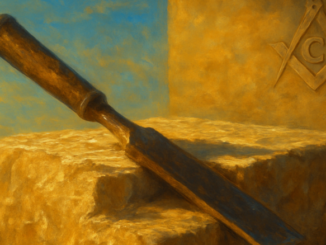
Rough ashlar stone with gavel symbolizing Stoic obstacles in Freemasonry
Marcus Aurelius – Freemasonry & Connection

Marcus Aurelius on Obstacles: Stoic Wisdom for Freemasons

In 172 AD, Emperor Marcus Aurelius sat along the Danube frontier, surrounded by war and personal loss, and wrote some of the most penetrating observations ever recorded about the human capacity to transform adversity. His fifth book of the Meditations contains a core insight that still resonates in Masonic lodges around the world nearly two thousand years later: the obstacle becomes the way. This philosophical legacy connects the ancient Stoic tradition with the ongoing pursuit of moral perfection that lies at the heart of Freemasonry. The Historical Context of Book V Marcus Aurelius never intended his Meditations for publication. They were private notes — a journal of self-examination written during one of the most turbulent periods of his reign. Book V emerged during the Marcomannic Wars, a grueling campaign against Germanic tribes that kept the emperor far from Rome, surrounded by death and hardship. And yet, amid all of it, he turned his gaze inward. He asked himself a deceptively simple question: how do I remain a good man when the world around me descends into chaos? This was no rhetorical exercise. Marcus Aurelius buried children, lost trusted advisors, and watched soldiers fall around him. His own health was failing. […]

Ancient Roman scroll symbolizing Seneca's philosophy of true freedom
Lucius Annaeus Seneca – Content & Summary

Seneca Letter XVIII: True Freedom and Inner Independence

What does it truly mean to be free? In his eighteenth letter to Lucilius, the Roman philosopher Lucius Annaeus Seneca unfolds a paradox that remains strikingly relevant today: most people who consider themselves free are, in reality, slaves to their desires, fears, and possessions. True freedom, Seneca argues, lies not in the absence of physical chains but in the liberation of the mind. This letter stands as a cornerstone of Stoic ethics and offers a timeless reflection on what it means to be master of yourself — a theme that resonates deeply with anyone engaged in the inner work of self-improvement and moral development. The Central Argument: Slavery of the Mind Seneca opens his letter with a sharp observation: many people who are legally free live in a state of inner captivity. They are governed by cravings for wealth, fame, and pleasure. The Stoic philosopher turns the conventional understanding of freedom on its head. It is not external circumstances that determine whether a person is free, but the inner condition of the soul. A slave who masters his passions is freer than an emperor who surrenders to his appetites. This idea connects to the broader Stoic teaching that Seneca develops […]

Compass and square symbolizing philosophy and Freemasonry guidance
Lucius Annaeus Seneca – Freemasonry & Connection

Seneca’s Letter XVI: Philosophy as a Compass for Connection

Imagine waking up in the morning with the day stretching out before you like an unfamiliar road. You have decisions to make, people to meet, perhaps conflicts to resolve. What helps you choose the right direction? For Lucius Annaeus Seneca, the answer was clear: philosophy. In his sixteenth letter to Lucilius, he describes how philosophy is not merely an intellectual pursuit but a practical guide for daily life. This idea resonates deeply with Freemasonry, where brethren likewise seek an inner compass that connects them to themselves and to others. Philosophy as a Daily Companion Seneca writes to his friend Lucilius that philosophy is not a luxury reserved for quiet moments — it is a necessity for every single day. He compares it to a helmsman guiding his ship through rough waters. Without knowledge of the stars and currents, you are at the mercy of the waves. The same holds true for life: without philosophical reflection, you are swept along by impulses, emotions, and external pressures. This idea can be applied directly to your own life. Instead of reaching for your phone first thing in the morning, begin with a moment of silence. Ask yourself: what do I truly want to […]

Open copy of Marcus Aurelius Meditations beside Masonic rough ashlar stone
Marcus Aurelius – Content & Summary

Marcus Aurelius Book V: Overcoming Obstacles as an Art

Imagine waking up and facing the day ahead like a mountain you must climb. Everything inside you resists. Your mind searches for excuses, and the warm blankets feel like a safe harbour. It is precisely in moments like these that the Roman Emperor Marcus Aurelius addressed himself with words that still resonate nearly two thousand years later. In the fifth book of his Meditations, he explores how we need not see obstacles as enemies — but as the path itself. The Context of Book V Marcus Aurelius never wrote his Meditations for publication. They were personal exercises in the art of living — private reflections set down during some of the most turbulent years of the Roman Empire. Book V was most likely composed during military campaigns along the Empire’s northern frontiers, amid war, plague, and personal loss. These circumstances make the text all the more powerful: this is not a philosopher speaking from an ivory tower, but a man confronting the harshest realities of existence on a daily basis. The book opens with a passage that almost everyone can relate to. Marcus describes the moment of waking, when the temptation to stay in bed is at its strongest. He […]

Ancient compass symbolizing Stoic philosophy and Masonic inner direction
Lucius Annaeus Seneca – Letters to Lucilius

Seneca and Stoic Philosophy: Ancient Roots of Masonic Wisdom

A compass always points north, no matter where you stand or how lost you feel. For Lucius Annaeus Seneca, philosophy served exactly this purpose — not as a collection of abstract theories, but as a reliable guide that gives the soul direction in times of uncertainty. In his sixteenth letter to Lucilius, he unfolds this idea with an urgency that still resonates today. But what intellectual traditions shaped Seneca’s conviction that philosophy is indispensable for a life well lived? And what can Freemasons recognize in this ancient quest for an inner compass? The Stoic Foundation of Seneca’s Thought Seneca wrote from the heart of Roman Stoicism, a philosophical school founded around 300 BCE by Zeno of Citium in the painted colonnade of Athens. Stoicism taught that a person can only be truly free when they master their inner disposition, regardless of external circumstances. This core idea permeates Letter XVI entirely. In essence, Seneca reaffirms what Zeno, Cleanthes, and Chrysippus had articulated centuries earlier: happiness does not lie in what happens to us, but in how we respond to it. Yet Seneca was no slavish follower. He adapted the rigorous Greek Stoa for Roman life, where political power, wealth, and social […]

An open door at night symbolizing spiritual passage and Masonic transition
Spiritual Traditions

The Door That Opens: Rescue as a Spiritual Act

A school principal in Nepal opened the doors of his school in the middle of the night as floodwaters began to rise. Nearly nine hundred students found safety on the upper floors. It was a simple act — a door swinging open — yet within that movement lies something far deeper than practical emergency response. What does it mean to open a door in a moment of crisis? And what does this gesture reveal about spirituality in the most concrete sense of the word? The Door as a Symbol of Transition A door is never merely a physical object. In virtually every spiritual tradition, a door marks a transition — a threshold between two worlds. Think of the temple gates in ancient mystery schools, or the threshold the initiate crosses to enter a new life. Plato, in his Allegory of the Cave, described how the philosopher leaves the cave and steps toward the light. That exit is a door — an opening into a different level of reality. In Freemasonry, the door plays a strikingly similar role. The candidate seeking admission to the lodge knocks upon a closed door and waits until entry is granted. It is a ritual moment […]

Rough ashlar stone with hammer and chisel symbolizing Masonic character building
Marcus Aurelius – Freemasonry & Connection

Marcus Aurelius on Duty: The Stone as a Symbol of Character

Every morning, before the first light slips through the window, every human being faces the same inner struggle. The warmth of the bed pulls at us while the day and its obligations wait. In Book V of his Meditations, Marcus Aurelius describes exactly this moment — the instant when character is forged. For Freemasons, this struggle resonates with a deeply rooted symbol: the working of the rough stone. Both traditions understand that the fulfillment of duty is not a burden but the very hammer with which we shape ourselves into something enduring. Waking Up as a Moral Turning Point Marcus Aurelius opens Book V with a scene every reader recognizes. He addresses himself at the break of day: rise, for you were made for the work that befits a human being. The emperor does not philosophize from an ivory tower but from the mud of military campaigns and the weight of administrative burdens. His words carry the gravity of lived experience. In his writing, this daily act of waking becomes a metaphor for a greater awakening. Not only must the body rise, but the mind must orient itself toward its true calling. In Freemasonry, we find a kindred idea: the […]

Ancient Stoic philosophy scroll with Masonic square and compasses symbol
Lucius Annaeus Seneca – Content & Summary

Seneca Letter XVI: Philosophy as a Guide for Living

What does it truly mean to practice philosophy? Is it enough to read books and collect wise quotations, or does the love of wisdom demand something far more fundamental? In his sixteenth letter to Lucilius, Lucius Annaeus Seneca explores these questions with the directness and warmth that define his celebrated correspondence. This letter reveals why philosophy cannot remain an intellectual hobby — it must become a compass for daily action. What Is the Central Question of This Letter? Seneca opens with an observation that still resonates nearly two thousand years later: many people claim to be philosophers, yet their lives tell a different story. They can quote Plato and recite the doctrines of the Stoics, but the moment fate tests them, they fall prey to the same fears and desires as everyone else. The central question Seneca poses is therefore not “what do you know?” but “how do you live?” This distinction between knowledge and practice forms the heart of Letter XVI. Seneca argues that philosophy only acquires real value when it shapes character and directs action. A philosopher who fails to embody his own principles is like a physician who cannot heal himself. Philosophy, as Seneca puts it, must […]

Rough ashlar being shaped into a perfect cube symbolizing character through adversity
Personal Development & Leadership

Failure as a Teacher: What Adversity Reveals About Character

When a world-class athlete once again misses the podium at a major championship, an inevitable question arises: what does this tell us about their character? Is failure a sign of weakness — or does it reveal something far deeper about inner strength? In Freemasonry, there is an ancient teaching that the rough ashlar only reveals its true form through persistent work. Today, we explore what repeated adversity can teach us about personality and growth — not through the lens of sports commentary, but through a more profound question about human development. Why Does Adversity Strike Us So Deeply? There is something deeply fascinating about watching someone who belongs to the absolute elite in one arena fail repeatedly in another. It raises questions that reach far beyond sport. Why does a person keep returning to a discipline where success remains elusive? What drives someone to expose themselves to public failure again and again? The Greek philosopher Aristotle wrote extensively about what he called thumos — the driving force of ambition and spirited pride within the human soul. This is not blind ego but a deep longing to achieve something of genuine value. When that longing is repeatedly frustrated, a crucial choice […]

Statue of Marcus Aurelius symbolizing Stoic duty and Masonic character
Marcus Aurelius – Meditations

Marcus Aurelius Book V: The Philosophical Roots of Duty

Why would a Roman emperor force himself out of bed before sunrise, even when every fiber of his body resisted? This question confronts us when reading Book V of the Meditations of Marcus Aurelius. The answer lies not in imperial discipline alone, but in ancient philosophical traditions that laid the groundwork for his thinking about duty and strength of character — traditions that continue to resonate deeply within Freemasonry. The Core of Stoic Duty Stoic philosophy, founded by Zeno of Citium around 300 BCE, forms the bedrock upon which Marcus Aurelius built his reflections. The Stoics taught that every human being fulfills a specific role within the cosmic order. Duty, in this view, is not an external constraint imposed from above — it is the natural consequence of understanding your place in the greater whole. When Marcus Aurelius speaks in Book V about rising from bed as a duty, he is invoking this deeper principle: you were born to act in accordance with your nature as a rational, social being. The early Stoics, including Chrysippus and Cleanthes, developed the concept of kathêkon, often translated as “appropriate action” or “duty.” This idea differs from modern notions of obligation because it is […]

Masonic level and temple symbolizing balance between body and spirit
Lucius Annaeus Seneca – Freemasonry & Connection

Seneca’s Letter XIV: The Body as a Workshop for the Spirit

A candle flickers in the early morning light. A Freemason stands before his mirror — not out of vanity, but out of habit. He studies his face, feels the weariness of a short night, and wonders: how much attention does this body actually deserve? Nearly two thousand years ago, Lucius Annaeus Seneca posed precisely this question to his friend Lucilius. The answer he gave touches, with surprising directness, on something brothers in the lodge have always sought: the right balance between the material and the spiritual. The Paradox of Bodily Care In his fourteenth letter, Seneca confronts us with an apparent contradiction. On the one hand, we must not neglect the body, for it carries the spirit. On the other, we must not become enslaved to it, for then the servant becomes the master. Seneca writes with his characteristic sobriety: we should treat the body as an instrument, not as an idol. It deserves maintenance, not worship. This idea was far less self-evident in the Roman world than it might seem today. Gladiatorial games, bathhouse culture, and culinary excess defined the streetscape. Seneca did not oppose bodily pleasure in itself, but rather its tyranny. When the body dictates what the […]

Ancient rock standing firm against ocean waves symbolizing Stoic resilience
Marcus Aurelius – Content & Summary

Marcus Aurelius Book V: Duty and Strength of Character

The fifth book of Marcus Aurelius’ Meditations opens with a remarkably intimate scene: the Roman emperor urging himself to get out of bed. This seemingly mundane moment carries a far deeper message. It is not about waking early — it is about the willingness to fulfill your duty, even when every fiber of your being resists. In Book V, Marcus Aurelius examines what it means to show true character when life pushes back, and how a sense of duty shapes us into who we are truly capable of becoming. The Morning as a Symbolic Starting Point Marcus Aurelius begins Book V with an inner dialogue that most of us will recognize instantly. He describes how the warmth of the bed beckons, how the mind invents reasons to stay lying down just a little longer. Yet he reminds himself that he was not born for comfort — he was born to act. The morning becomes a symbol for every new beginning, every choice where ease and duty stand in opposition. The moment of waking represents the awakening of consciousness to its responsibility. This image of the morning struggle touches on a universal human experience. It is not only the physical act […]

Stoic philosopher's hammer and rough ashlar stone on a Masonic workbench
Lucius Annaeus Seneca – Letters to Lucilius

Seneca on Body Care: Philosophical Roots of Letter XIV

A hammer rests on a workbench. To most, it is simply a tool. To a Freemason, it represents something far greater — the capacity to work upon oneself, to shape the rough ashlar into something refined. Lucius Annaeus Seneca would have recognized this image immediately. In his fourteenth letter to Lucilius, he addresses a theme that is as concrete as it is symbolically rich: the care of the body. Behind this seemingly practical advice lies a deep philosophical tradition stretching from the early Stoics to the Masonic conviction that every person is both temple and builder. The Stoic Foundation of Body Care Seneca’s views on the body are rooted in the teachings of the early Stoa, founded by Zeno of Citium around 300 BCE. The Stoics divided all things into three categories: the good, the bad, and the indifferent. Health, wealth, and physical well-being fell into the category of adiaphora — indifferent things. This did not mean, however, that the body could simply be neglected. Chrysippus, one of the most influential early Stoics, argued that certain indifferent things could be classified as “preferred indifferents” — things that do not constitute virtue in themselves but are instrumentally valuable for living a […]

Open book with classical philosophy texts symbolizing Montaigne's essays
Michel de Montaigne – Philosophical Background

Montaigne on Profit and Loss: Tracing the Philosophical Roots

When Michel de Montaigne argues in his twenty-first essay that one man’s profit is another man’s loss, he draws upon a rich philosophical tradition stretching back centuries. This short but influential essay reflects not only the economic turmoil of sixteenth-century France but also the voices of Seneca, Plutarch, and Stoic philosophy. How did Montaigne relate to these thinkers, and what can we still learn today from their dialogue about greed, temperance, and human relationships? The World of the Renaissance Humanist To understand Montaigne’s essay, we must immerse ourselves in the intellectual climate of the French Renaissance. Scholars were rediscovering classical texts from Greek and Roman antiquity on a massive scale. Montaigne, born in 1533, grew up with Latin as his first language. His father ensured he could read the classics as naturally as other children read fairy tales. This upbringing made him a true humanist — someone who regarded the wisdom of the Ancients not as dead knowledge but as a living guide for daily life. Renaissance humanism was defined by a return to the source: the original Greek and Latin texts, stripped of medieval interpretations. Erasmus had paved the way with his rediscovery of the New Testament in Greek. […]