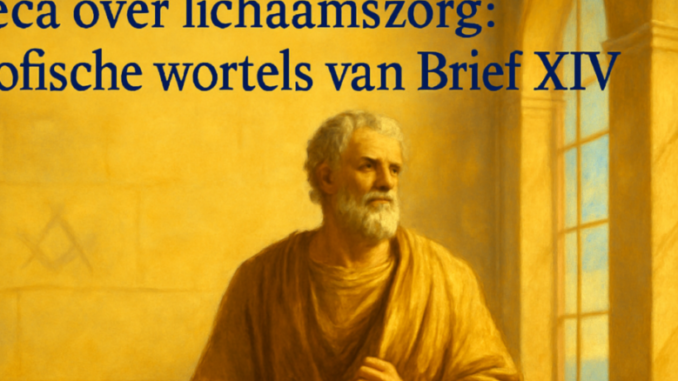
A hammer rests on a workbench. To most, it is simply a tool. To a Freemason, it represents something far greater — the capacity to work upon oneself, to shape the rough ashlar into something refined. Lucius Annaeus Seneca would have recognized this image immediately. In his fourteenth letter to Lucilius, he addresses a theme that is as concrete as it is symbolically rich: the care of the body. Behind this seemingly practical advice lies a deep philosophical tradition stretching from the early Stoics to the Masonic conviction that every person is both temple and builder.
The Stoic Foundation of Body Care
Seneca’s views on the body are rooted in the teachings of the early Stoa, founded by Zeno of Citium around 300 BCE. The Stoics divided all things into three categories: the good, the bad, and the indifferent. Health, wealth, and physical well-being fell into the category of adiaphora — indifferent things. This did not mean, however, that the body could simply be neglected. Chrysippus, one of the most influential early Stoics, argued that certain indifferent things could be classified as “preferred indifferents” — things that do not constitute virtue in themselves but are instrumentally valuable for living a virtuous life.
Seneca adopts this nuance and sharpens it in Letter XIV. The body is not an end in itself, but neither is it an enemy to be suppressed. It is a tool, a vehicle through which the soul performs its work. This vision resonates deeply with the Masonic tradition, in which the body is seen as the rough stone that must be shaped — not destroyed or ignored.
The Influence of Epicurus on Seneca’s Thought
Remarkably, Seneca frequently quotes Epicurus in his letters — the founder of a rival philosophical school. While Epicureanism is often misunderstood as a doctrine of indulgent pleasure, Epicurus actually advocated for moderation and the avoidance of pain. Seneca recognized in this position a kinship with his own Stoic ideals. In Letter XIV, this influence emerges when Seneca warns against both excessive asceticism and excessive indulgence. The body deserves attention, but not obsession.
The body is not the temple itself, but the building material with which we may complete our inner temple.
This cross-pollination between Stoicism and Epicureanism illustrates Seneca’s pragmatic temperament. He was no dogmatist, but a thinker who acknowledged wisdom wherever he found it. This eclectic quality makes his work particularly accessible to Freemasons, who likewise seek truth across diverse traditions without binding themselves to any single doctrine.
Plato’s Shadow: Body and Soul in Tension
The relationship between body and soul was a central theme in ancient philosophy, and Plato’s dualism cast a long shadow over later thinkers. In dialogues such as the Phaedo, Plato described the body as a prison of the soul — a view that could easily lead to rigorous asceticism. Seneca rejects this extreme position without explicitly criticizing Plato. He acknowledges the tension between bodily needs and spiritual aspirations but seeks a middle path.
The Stoics, and Seneca in particular, saw body and soul as more intimately connected than Plato’s dualism suggested. The soul uses the body the way a painter uses a brush. A worn-out brush hinders the work; a well-maintained instrument enhances it. This symbolic understanding of the body as an instrument finds its echo in the Masonic idea that every tool — from the compasses to the square — carries a deeper meaning.
Musonius Rufus and the Practice of the Body
Seneca was not alone in his attention to physical discipline. His contemporary Musonius Rufus, often called the “Roman Socrates,” also emphasized the importance of physical training as part of philosophical education. Musonius argued that philosophy was not merely an intellectual exercise but a way of life that engaged the whole person. His influence on later Stoics such as Epictetus is well documented, and it is likely that Seneca and Musonius moved in the same intellectual circles.
The emphasis on bodily discipline as moral practice connects these Roman thinkers to the ritual dimension of Freemasonry. Progressing through the degrees, performing symbolic actions, being physically present in the lodge — these are not peripheral matters but essential elements of inner transformation. The body participates in the work of the soul.
The Temple as Body, the Body as Temple
In Masonic symbolism, the Temple of Solomon occupies a central place. It is not merely a historical structure but a symbol of the inner person who must be built and refined. Seneca’s Letter XIV fits seamlessly into this symbolic framework. When he writes about caring for the body, he is really speaking about maintaining the temple in which the spirit dwells.
To neglect the body would mean allowing the temple to fall into ruin. To idolize the body would mean valuing the outer walls above the sanctuary within. Seneca seeks balance, and this balance is precisely what the Freemason strives for when he works upon himself. The square symbolizes right proportion — the equilibrium between opposing forces.
Historical Context and Personal Experience
Seneca wrote his letters to Lucilius during the final years of his life, after withdrawing from political life at the court of Emperor Nero. His own health was fragile; he suffered from asthmatic complaints and digestive problems. Letter XIV speaks from this personal vulnerability. It is not an abstract treatise but the matured wisdom of someone who knew and accepted the limits of his own body.
This authenticity gives the letter a power that transcends the centuries. Every Freemason who has stood in the lodge while contending with physical limitation knows this tension — the spirit eager to ascend while the body reminds us of our mortality. Seneca does not offer an escape from this tension. Instead, he offers what the best philosophical and Masonic traditions have always offered: a way to hold opposites together with dignity and purpose.
Seneca’s Letter XIV remains a remarkable document — one that bridges ancient Stoic philosophy and the living tradition of Freemasonry. Its central lesson is deceptively simple: care for the body without worshipping it, attend to the spirit without despising its earthly vessel. For the Mason who works daily at the rough stone, this balance is not a luxury but a necessity. The hammer on the workbench is never just a hammer. It is a reminder that every act of shaping — whether of stone or of self — begins with the recognition that our tools, including our bodies, deserve both respect and right use.
Copyright text & image: devrijmetselaar.nl
Texts are based on the ideas and content of the author of devrijmetselaar.nl, reviewed, corrected, and supplemented with the assistance of OpenAI. Images are created based on the ideas of the author of devrijmetselaar.nl using OpenAI/DALL-E.
Frequently Asked Questions
What did Seneca believe about the relationship between body care and virtue?
Seneca viewed the body not as an end in itself but as a tool or vehicle through which the soul performs its work. Drawing from Stoic philosophy, he classified physical well-being as a 'preferred indifferent' — something that doesn't constitute virtue itself but is instrumentally valuable for living a virtuous life. The body deserves care and attention, but should not be the focus of obsession.
How does Seneca's philosophy on body care connect to Freemasonry?
Seneca's view of the body as a tool to be shaped resonates deeply with Masonic tradition, which sees the body as 'rough stone' that must be refined and shaped. Both philosophies recognize the individual as both temple and builder — using the body as an instrument for self-improvement and spiritual development, much like a Freemason uses the hammer to work upon the rough ashlar.
Why did Seneca reference Epicurus, a rival philosopher, in Letter XIV?
Although Epicureanism is often misunderstood as promoting indulgence, Epicurus actually advocated for moderation and avoiding pain. Seneca recognized a kinship between this position and his own Stoic ideals. In Letter XIV, this influence appears in Seneca's warning against both excessive asceticism and excessive indulgence, demonstrating his pragmatic and eclectic approach to finding wisdom from various philosophical traditions.


Be the first to comment