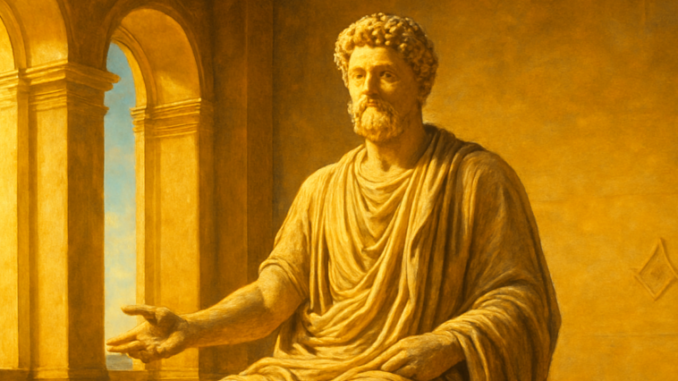
Every morning, before the first light slips through the window, every human being faces the same inner struggle. The warmth of the bed pulls at us while the day and its obligations wait. In Book V of his Meditations, Marcus Aurelius describes exactly this moment — the instant when character is forged. For Freemasons, this struggle resonates with a deeply rooted symbol: the working of the rough stone. Both traditions understand that the fulfillment of duty is not a burden but the very hammer with which we shape ourselves into something enduring.
Waking Up as a Moral Turning Point
Marcus Aurelius opens Book V with a scene every reader recognizes. He addresses himself at the break of day: rise, for you were made for the work that befits a human being. The emperor does not philosophize from an ivory tower but from the mud of military campaigns and the weight of administrative burdens. His words carry the gravity of lived experience.
In his writing, this daily act of waking becomes a metaphor for a greater awakening. Not only must the body rise, but the mind must orient itself toward its true calling. In Freemasonry, we find a kindred idea: the candidate enters the lodge from darkness and seeks the light. That light is not an external gift bestowed upon him — it is an inner readiness to see what one previously refused to look upon.
The Rough Stone and the Daily Hammer Blows
In Masonic symbolism, the rough ashlar represents the individual in an unworked state — angular, irregular, not yet shaped by conscious self-improvement. The perfect ashlar, by contrast, represents the ideal of moral refinement. Between the two lies a process that is never truly complete: the continual shaping of oneself through self-reflection, discipline, and devotion to higher values.
Marcus Aurelius would have understood this imagery immediately. In Book V, he emphasizes that strength of character is not acquired once and for all but must be reaffirmed daily. Every morning we would rather stay in bed, every task we postpone, every confrontation we avoid — these are the moments when the rough stone remains unworked. Conversely, every choice to embrace duty over comfort is another blow of the hammer.
Strength of character is not a gift received but a form given to oneself through daily devotion to duty.
Duty as a Binding Principle
For Marcus Aurelius, duty is never an isolated concept. Human beings are social creatures, part of a greater whole he calls the cosmopolis — the world-community of all rational beings. Our obligations flow from this interconnectedness. When we neglect our responsibilities, we harm not only ourselves but the entire fabric of relationships in which we exist.
Freemasons will recognize in this the principle of brotherhood. The lodge is not a collection of isolated individuals but a community in which every brother bears responsibility for the whole. The ritual work serves as a constant reminder: one does not build for oneself alone but contributes to a symbolic temple that serves all. That temple rises only when each member understands and fulfills his duty.
The Inner Citadel and the Building of the Temple
Marcus Aurelius writes of the inner citadel — that impregnable fortress within ourselves where external circumstances hold no power. This is not a flight from the world but a solid foundation from which to engage with it. The emperor reminds himself that he need not seek tranquility in remote retreats but in the ordering of his own mind.
In Freemasonry, we encounter a comparable image: the inner temple. The physical lodge room is merely an outward sign of a spiritual reality. The real labor takes place not upon stone walls but upon the architecture of the soul. Both traditions emphasize that this building work requires concentration, silence, and a return to essential values.
Contemplation as a Working Tool
Both Stoic meditation and Masonic ritual function as tools of self-transformation. The Meditations of Marcus Aurelius were never intended for publication; they were a daily exercise in self-examination. In a similar way, the lodge ritual offers a structured space for reflection. The symbols speak not only to the intellect but to a deeper level of understanding.
This parallel is instructive. In both traditions, the practice itself is the point. It is not enough to understand a principle intellectually — it must be internalized through repetition, through the discipline of returning to it again and again. The Stoic writes his reflections each evening; the Mason revisits the ritual with each meeting. Both practices aim at the same goal: the gradual, deliberate refinement of the self.
Virtue as a Living Practice
Marcus Aurelius repeatedly warns against merely theorizing about virtue. Philosophy that is not lived is idle talk. The value of insight reveals itself only in daily application — in how we respond to setbacks, how we treat our fellow human beings, and how we meet the obligations life places upon us.
Freemasonry shares this emphasis on practice over theory. The symbols and rituals are not ends in themselves but instruments that encourage the brother to take concrete steps toward improvement. It is not about possessing knowledge but about applying it in everyday life. The square and compasses remind us of proportion and justice, but these instruments lose their meaning if they are not translated into tangible action.
Consider the core themes that unite these two traditions:
- Self-reflection as a daily discipline
- Duty as an expression of our bond with others
- Character formation as a lifelong process
- Virtue as lived practice, not abstract ideal
When we read Book V of the Meditations with an eye to these affinities, a rich dialogue opens between two traditions that, though separated by centuries, ask the same fundamental questions. What does it mean to be a good person? How do we shape our character? And what obligations do we owe to the community of which we are a part?
The rough stone lies before us, every morning anew. Marcus Aurelius invites us to rise and take up the hammer — not because it is easy, but because the work that befits us consists precisely in that shaping. Freemasonry offers a symbolic language to express this same truth: that we are both the stone and the sculptor, and that every act of duty, however small, brings us closer to the form we are meant to become. The temple we build is not made of marble or mortar. It is made of the choices we make each day when the alarm sounds and the world calls us to our work.
Copyright text & image: devrijmetselaar.nl
Texts are based on the ideas and content of the author of devrijmetselaar.nl, reviewed, corrected, and supplemented with the assistance of OpenAI. Images are created based on the ideas of the author of devrijmetselaar.nl using OpenAI/DALL-E.
Frequently Asked Questions
What is the connection between Marcus Aurelius's philosophy and Freemasonry?
Both traditions share a fundamental understanding that character is forged through daily struggle and duty rather than being a fixed gift. Marcus Aurelius's concept of awakening to one's moral calling parallels the Masonic candidate's journey from darkness into light. Both emphasize that strength of character must be continuously reaffirmed through self-discipline and devotion to higher values.
What does the rough ashlar symbolize in Freemasonry?
The rough ashlar represents the individual in an unworked, undeveloped state — angular and irregular. It symbolizes the human condition before conscious self-improvement. The process of shaping it into a perfect ashlar represents the lifelong journey of moral refinement through self-reflection, discipline, and dedication to duty.
How does Marcus Aurelius view the act of waking up each morning?
Marcus Aurelius sees waking up as a moral turning point and metaphor for greater spiritual awakening. In Book V of Meditations, he addresses himself at dawn to rise and fulfill the work that befits a human being. Each morning presents a choice between comfort and duty, and choosing duty is how we continually shape ourselves into something enduring.

Be the first to comment