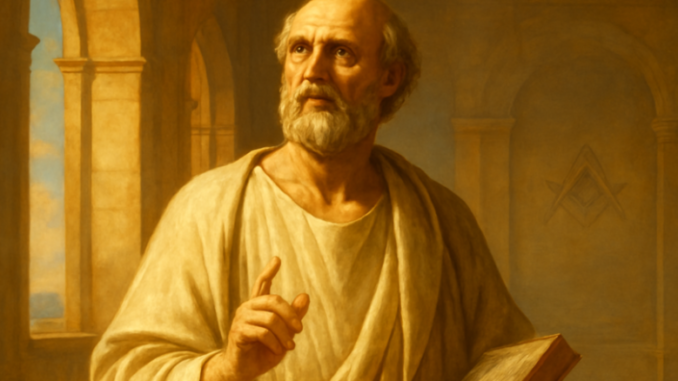
What does it truly mean to live by your convictions? And why is simplicity not a deficiency but a profound source of strength? In his twentieth letter to Lucilius, the Stoic philosopher Seneca examines these questions with the sharpness and warmth that have made his philosophical letters timeless. This ancient text invites a conversation about authenticity, inner freedom, and the courage to live simply in a world overflowing with distraction — themes that resonate deeply with the principles and symbols of Freemasonry.
What Does Seneca Ask of Us in Letter XX?
Seneca opens Letter XX with an urgent question: are we truly living according to the principles we profess? He insists that philosophy must never remain a merely theoretical pursuit. It must become visible in our everyday choices. The heart of his message is that words and deeds must align. Anyone who claims to love wisdom yet loses himself in luxury and outward display is deceiving both himself and others.
The Stoic thinker emphasizes that genuine progress in philosophy can be measured by the degree to which a person embraces simplicity — not as a form of deprivation, but as a conscious choice. Simplicity frees the mind from unnecessary worries and creates space for what truly matters: moral growth and inner peace.
Why Does Seneca Value Simplicity So Highly?
Seneca explains that whoever possesses much also has much to lose. The person who clings to wealth, status, and material goods becomes a slave to his possessions. Simplicity, by contrast, grants freedom. Those who are content with little fear nothing and need not flatter anyone to maintain their position.
True wealth lies not in accumulating possessions, but in diminishing desire.
This insight touches on a universal human theme. In every era and culture, people struggle with the tension between having and being. Seneca encourages his student to regularly practice periods of voluntary austerity. By occasionally living with the bare minimum, one discovers what is truly necessary — and luxury loses its grip on the soul.
How Does Loyalty to Philosophy Relate to Daily Action?
A central point in Letter XX is the demand for consistency. Seneca warns against the danger of philosophical theater — people who speak wise words while their lives tell an entirely different story. He calls on Lucilius to examine himself critically. Do your actions match your words? Would you feel ashamed if others could see how you truly live?
This self-examining attitude has deep parallels with the practice of Freemasonry. In the Craft, the same essential question is always present: is there harmony between a person’s inner life and outward behavior? The rough ashlar that the Freemason works upon symbolizes precisely this process — the patient shaping of character until words and deeds form a unity.
What Examples Does Seneca Use to Illustrate His Point?
Throughout his letters, Seneca regularly refers to historical figures as exemplars of virtue. In Letter XX, he evokes the image of philosophers who put their teachings into practice regardless of circumstances. He mentions Socrates, who remained faithful to his principles until death, and Diogenes, who found in radical simplicity a form of freedom that kings could not rival.
These examples are not presented as unattainable ideals but as sources of inspiration. Seneca acknowledges that perfection is not within human reach. What matters is the direction in which one is moving. Living a little closer to your own values each day is already a victory.
What Can Freemasons Learn from Letter XX?
The themes of Letter XX resonate powerfully with the symbolic language of Freemasonry. The square and compasses remind the Brother to measure and regulate his conduct. Just as Seneca calls for simplicity, these working tools invite us to cut away the superfluous and retain only what is essential.
The rough ashlar represents the unrefined individual who is shaped through self-reflection. The apron recalls the dignity of honest and simple labor. The light in the Lodge symbolizes the truth that one seeks by living with consistency and integrity.
Seneca’s emphasis on the unity of words and deeds lies at the very heart of what Freemasonry strives for: not merely proclaiming lofty ideals, but embodying them in daily life. The Lodge is not a place for empty rhetoric — it is a workshop where characters are forged.
Is Simplicity Still Relevant in Our Time?
One might ask whether Seneca’s message is hopelessly outdated. After all, we live in an age of abundance where status is often measured by visible consumption. Yet it is precisely for this reason that the call for simplicity is more relevant than ever. More and more people are searching for meaning beyond the material. Minimalism and intentional living are not passing trends but expressions of a deeper longing for authenticity.
Seneca’s philosophy does not offer ready-made answers, but it does provide a compass. By regularly pausing to ask what is truly necessary, we create space for the good life — not a life without pleasure, but a life in which pleasure does not become the master.
Letter XX is an invitation to radical honesty with yourself. Simplicity and loyalty to philosophy are not goals in themselves but means to build a life that can withstand the test of truth. For Freemasons and seekers of wisdom alike, this ancient text remains a mirror — not one to admire your reflection in, but one to look into honestly and to identify what can be improved. Just as the rough ashlar slowly takes shape under patient hands, so too does the person who unites his words with his deeds grow into something greater than he was before.
Copyright text & image: devrijmetselaar.nl
Texts are based on the ideas and content of the author of devrijmetselaar.nl, reviewed, corrected, and supplemented with the assistance of OpenAI. Images are created based on the ideas of the author of devrijmetselaar.nl using OpenAI/DALL-E.
Frequently Asked Questions
What is the main message of Seneca's Letter XX?
Seneca's Letter XX emphasizes that philosophy must not remain theoretical but must be visible in everyday choices, with words and deeds aligned. He argues that genuine progress in philosophy is measured by embracing simplicity as a conscious choice, not deprivation, which frees the mind from unnecessary worries and creates space for moral growth and inner peace.
Why does Seneca believe simplicity is a source of strength rather than weakness?
Seneca argues that those who possess much also have much to lose and become slaves to their possessions. Simplicity, by contrast, grants freedom because those content with little fear nothing and need not flatter anyone. True wealth lies in diminishing desire rather than accumulating possessions, and by practicing voluntary austerity, one discovers what is truly necessary and luxury loses its grip on the soul.
What does Seneca mean by loyalty to philosophy in daily action?
Loyalty to philosophy means maintaining consistency between one's words and actions. Seneca warns against philosophical theater—speaking wise words while living differently. He calls for critical self-examination: Do your actions match your professed principles? Would you feel ashamed if others saw how you truly live? This alignment between belief and behavior is essential to authentic philosophical practice.



Be the first to comment