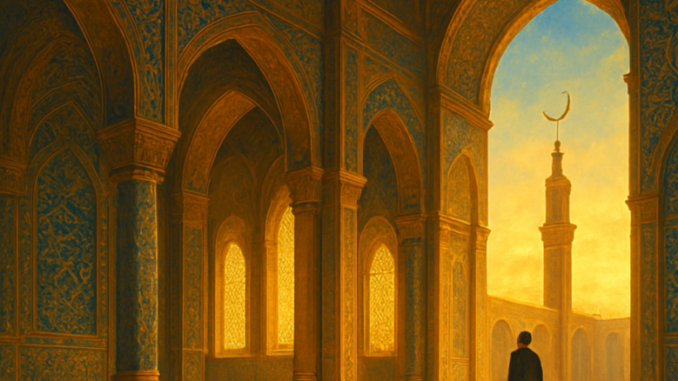
What can a creature just a few centimeters long teach us about the deepest questions of human existence? The sixteenth Surah of the Quran bears the name An-Nahl — The Bee — and in doing so, it opens a surprising window onto spirituality, community, and the hidden order of creation. For those willing to look beyond the literal text, a meditative landscape unfolds, one that shares remarkable common ground with the spiritual quest at the heart of Freemasonry.
A Paradox of Smallness and Greatness
Our exploration begins with an apparent contradiction. The bee is a tiny creature, yet in a sacred text it is elevated to the status of a divine sign. The Quran speaks of how the Creator inspired the bee to build her dwellings in mountains, in trees, and in the structures that people raise for her. From within her body comes a drink of varying colors in which there is healing for humankind. The verse concludes that in this there is surely a sign for those who reflect.
This passage is an invitation to contemplation. It is not really about biology or honey production — it points to a deeper truth: that wisdom can lie hidden in the seemingly insignificant. The Freemason recognizes this principle immediately. In the lodge, work is carried out with simple tools — the compass, the square, and the level. None of these instruments is extraordinary in itself, yet through their symbolic application they unlock profound insights about self-knowledge and moral growth.
The Hive as a Mirror of Brotherhood
The beehive functions as a perfectly organized community. Every bee has her role, and the whole transcends the sum of its parts. There is no central leader issuing commands; order arises from a shared commitment to the welfare of the hive. This image resonates deeply with the Masonic ideal of brotherhood. The lodge is not a hierarchy in which one member stands above another, but a workshop in which every individual contributes to a greater edifice.
Goethe, himself initiated into Freemasonry, wrote about the necessity of cooperation in order to truly build something of lasting value. The bee illustrates this principle with elegant simplicity. She does not labor for personal gain but for the community. The honey she produces feeds the larvae, sustains the queen, and provides a winter reserve. Nothing of her work is wasted.
For Freemasons, this should strike a familiar chord. The lodge exists not to serve any single member but to create a space where collective effort — ritual, study, charity — produces something greater than any Brother could achieve alone. The hive, like the lodge, thrives on mutual dedication.
Labor as Spiritual Practice
In An-Nahl, work is not presented as punishment or as a necessary evil. Instead, it is depicted as a form of divine inspiration. The bee builds because she is called to do so. Her labor is at once practical and sacred. This perspective stands in stark contrast to the modern view, in which work is often reduced to an economic transaction — time traded for money, effort exchanged for reward.
The bee shows us that labor need not stand in opposition to spirituality. Rather, it can be its very expression.
For the Freemason, working on the rough ashlar is a lifelong task. It is about refining one’s own character, chipping away at imperfections. This inner labor demands patience, repetition, and devotion. Just as the bee makes thousands of flights to produce a single drop of honey, moral growth requires sustained, lifelong commitment. There are no shortcuts on this journey, and the work itself — not merely its outcome — is where meaning resides.
A Necessary Counterpoint: The Shadow Side of Order
Yet a measure of caution is warranted. The beehive can also be read as an image of blind obedience, of individuality dissolving entirely into the collective. Not every community is healthy; not every order is just. The question arises: where is the line between harmonious cooperation and the surrender of one’s own judgment?
Here, Freemasonry offers an important counterbalance. Unlike the bee, who acts from instinct, the Freemason is called to conscious reflection. Ritual is not an automatism but an invitation to think deeply. The working tools are symbols that demand personal interpretation. Spinoza argued that true freedom lies in understanding the causes of our actions. The Freemason strives for that same awareness — to act not from unexamined habit, but from understanding and choice.
This critical self-awareness is what distinguishes a living tradition from mere conformity. The lodge asks its members to think, to question, and to grow — never simply to obey.
Synthesis: The Search for the Sweet
What connects the reader of the Quran with the seeking Freemason? Both traditions recognize that the visible world points toward something that transcends it. Honey is not just nourishment — it is also healing. Stone is not just building material — it is also a symbol of the human soul. In both cases, the practitioner is invited to look deeper, to discover a hidden meaning beneath the surface of things.
An-Nahl reminds us that spiritual wisdom is not reserved for exalted realms. It manifests in the everyday, in the small, in the repetition of seemingly simple actions. The Freemason who handles his working tools and the Muslim who reflects upon the verses share a common disposition: an openness to the mystery that hides within the ordinary.
A Question That Lingers
What would happen if we approached our daily activities with the same attentiveness the bee brings to building her comb? Would our work then transform from obligation into fulfillment? The Bee of the Quran leaves this question open, as all great spiritual texts do. It offers no ready-made answer, only an invitation. It is up to the reader to accept that invitation and to find the sweetness in their own search.
The sixteenth Surah of the Quran opens a contemplative space in which the bee serves as teacher. Her example speaks to anyone willing to recognize the great within the small. For the Freemason, this text holds up a mirror: the hive as an image of brotherhood, honey as the fruit of patient labor, building as a spiritual vocation. What remains is not a conclusion but a question, not an answer but a direction. And perhaps that is precisely what both the Quran and the lodge wish to teach us — that the journey itself is the destination.
Across traditions and centuries, the humble bee has served as a symbol of something far greater than herself. Whether encountered in the pages of the Quran or reflected in the rituals of the lodge, her message is consistent: wisdom hides in plain sight, labor can be sacred, and true community is built through shared purpose rather than imposed authority. For the Freemason willing to look with fresh eyes at ancient symbols, An-Nahl offers both a mirror and a map — an invitation to find the divine in the ordinary and the extraordinary in the small.
Copyright text & image: devrijmetselaar.nl
Texts are based on the ideas and content of the author of devrijmetselaar.nl, reviewed, corrected, and supplemented with the assistance of OpenAI. Images are created based on the ideas of the author of devrijmetselaar.nl using OpenAI/DALL-E.
Frequently Asked Questions
What is the spiritual significance of the bee in the Quran, and how does it relate to Freemasonry?
The sixteenth Surah of the Quran, called An-Nahl (The Bee), elevates the bee to the status of a divine sign despite its small size. The passage teaches that wisdom can be found in seemingly insignificant things, a principle that resonates with Freemasonry. Just as Freemasons use simple tools like the compass and square to unlock profound spiritual insights, the bee demonstrates that depth and meaning are not determined by size or apparent importance, but by one's willingness to reflect and contemplate.
How does the beehive's organization compare to the structure of a Masonic lodge?
Both the beehive and the Masonic lodge are organized communities where order arises from shared commitment rather than hierarchical command. Every bee has a role in the hive's collective welfare, with no single leader issuing orders. Similarly, a lodge is not a hierarchy where one member stands above another, but a workshop where every individual contributes to a greater purpose. Both systems illustrate that true accomplishment comes through cooperation and mutual dedication to something larger than oneself.
What does the bee's selfless labor teach us about the Masonic ideal of brotherhood?
The bee works not for personal gain but entirely for the community's welfare, producing honey that feeds larvae, sustains the queen, and provides winter reserves. This principle of selfless contribution mirrors the Masonic ideal of brotherhood, where members work together for collective spiritual and moral growth rather than individual benefit. The bee exemplifies how cooperation and shared commitment create lasting value, a fundamental principle that Freemasons, including initiated figures like Goethe, have long recognized as essential to building something of enduring worth.



Be the first to comment