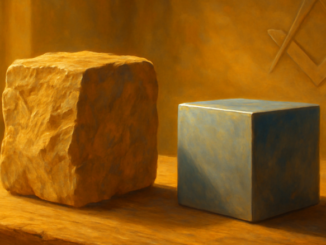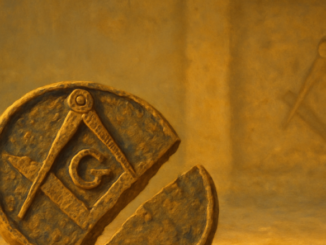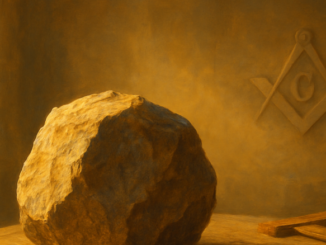
Rough ashlar stone resting in stillness, symbolizing Masonic spiritual practice
Spiritual Traditions

Stillness as Spiritual Practice: Masonic Lessons from Impasse

When political negotiations grind to a halt and progress seems like a distant mirage, the instinctive reaction is frustration. We want movement, results, forward momentum. But for those who have learned to look beneath the surface, an apparent impasse can reveal an ancient secret that builders and philosophers have cherished for centuries: stillness as a gateway to genuine transformation. The Stone That Does Not Move Picture a rough ashlar. It sits there, unworked, seemingly useless. Days pass, perhaps weeks, and nothing appears to happen. The untrained eye sees only stagnation — an obstacle, raw material that stubbornly refuses to become what it should be. Yet every stonemason knows that this period of rest is far from empty. The stone is being studied, measured, and carefully considered. The craftsman contemplates where the chisel must fall, which forms lie hidden within the rough material. The same dynamic plays out on the political stage whenever negotiations seem to stall. Commentators see no grand gestures, no breakthroughs, and declare the process broken. But is the absence of visible action truly the same as the absence of meaning? Freemasonry teaches us that the answer is far more complex than it first appears. Patience as a […]
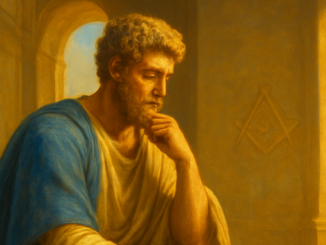
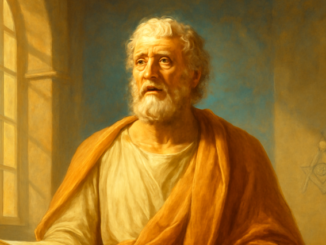
Ancient Roman bust symbolizing Marcus Aurelius and Masonic inner retreat
Marcus Aurelius – Freemasonry & Connection

Marcus Aurelius and Freemasonry: The Art of Inner Retreat

There is a remarkable kinship between the Stoic wisdom of a Roman emperor and the ritual practice of an ancient fraternity. When Marcus Aurelius writes about retreating into oneself in Book IV of his Meditations, he touches upon a theme that also runs deep within Freemasonry. How do these two traditions — separated by nearly two thousand years — relate to one another? And what can they still teach us today about the art of finding inner peace in a restless world? The Stoic Perspective: The Citadel of the Mind Marcus Aurelius never intended his Meditations for publication. They were personal notes, often written at the front lines during military campaigns. In Book IV, he unfolds a core idea that underpins his entire philosophy: a person can, at any moment and regardless of circumstances, retreat into their own inner world. He compares the mind to a citadel — an impregnable fortress that can only be surrendered from within. The outside world, with all its chaos and demands, has no real power over our inner state unless we voluntarily hand that power over. For the Roman emperor, this was no idle philosophical exercise. He ruled a vast empire and faced wars, […]

Ancient rough stone being shaped by chisel symbolizing Stoic moral improvement
Lucius Annaeus Seneca – Content & Summary

Seneca Letter 11: On Blushing, Shame, and Moral Nobility

There comes a moment when the cheeks flush without permission. A wave of heat rises through the face, as uncontrollable as the tide. In his eleventh letter to Lucilius, the Stoic philosopher Seneca examines this remarkable phenomenon — the blush of shame. But beneath this physical reaction lies a far deeper inquiry: one about the nature of virtue, the inner voice that guides our conduct, and the presence of a wise witness within our minds. What does this blushing reveal about who we truly are? The Involuntary Blush as a Mirror of the Soul Seneca opens his letter with an observation that is both simple and profound: even the most seasoned orators can blush when they stand before a crowd. Even those accustomed to public performance sometimes feel that irresistible warmth rising to their faces. This is not a weakness, the Stoic philosopher insists, but a quality of nature that even the wisest person cannot entirely suppress. The body has its own language — a language that does not always obey the commands of reason. The blush reveals something essential about our humanity: that we are not purely rational beings, but also creatures of flesh with reactions rooted deep within […]

Marcus Aurelius bust symbolizing Stoic philosophy and Masonic virtue
Marcus Aurelius – Freemasonry & Connection

Marcus Aurelius on the Good: Living According to Nature

What did Marcus Aurelius actually mean when he wrote about living in accordance with nature? And why does this ancient idea resonate so deeply with what Freemasons strive for? In the third book of his Meditations, the Roman emperor unfolds a vision of the good that remains strikingly relevant today. These are thoughts worth exploring together — as seekers of truth have always done. What Did Marcus Aurelius Mean by ‘Nature’? This is perhaps the first question that arises when reading Book III. Marcus Aurelius speaks constantly about living according to nature, but he does not mean the romantic ideal of untouched forests and flowing rivers. For the Stoics, nature carried a far deeper meaning: the rational order that permeates the universe, the logos that connects all things. The emperor saw each person as part of a greater whole. When we act in harmony with our rational nature, we act rightly — almost by definition. This may sound abstract, but its practical implication is remarkably clear: to live virtuously means to recognize and fulfill your role in the larger fabric of existence. Is this not precisely what a Freemason pursues when working on his rough ashlar? The Connection Between Stoic […]

Ancient Greek philosophers debating virtue in a classical setting
Plato – Content & Summary

Plato’s Protagoras: Can Virtue Be Taught?

Before dawn, young Hippocrates pounds on the door of Socrates, his eyes blazing with excitement. The famous sophist Protagoras has arrived in Athens, and Hippocrates is desperate to become his student. But Socrates asks a question that changes everything: what exactly do you expect to learn? This moment launches one of Plato’s most vivid dialogues — a work that wrestles with a question as urgent today as it was in ancient Athens: is virtue something that can be taught, or is it an innate quality that some simply possess and others do not? The Encounter Between Socrates and Protagoras In the luxurious home of the wealthy Callias, Socrates meets the renowned sophist Protagoras, surrounded by admiring students and other celebrated thinkers such as Hippias and Prodicus. Protagoras is no ordinary teacher — he charges substantial fees for his instruction and claims he can train young men to become better citizens. Socrates, ever the critical questioner, issues a challenge: if virtue can truly be taught, why do great statesmen consistently fail to make their own sons as virtuous as themselves? This is no mere academic exercise. It strikes at the heart of what it means to be a good person and […]

Overturned coach on a mountain road symbolizing Masonic brotherhood in crisis
Personal Development & Leadership

When the Coach Overturns: Brotherhood in Times of Disaster

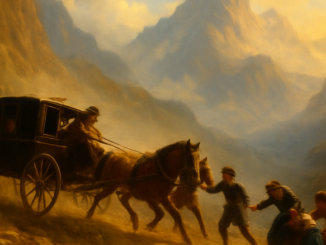
The mountain air is still crisp when the coach begins its descent. Thirteen travelers — strangers to one another — share the same wooden bench, the same sweeping views of Alpine peaks. Then everything tips. In a split second, strangers become companions in fate, bystanders become rescuers, and somewhere in the chaos, something unfolds that Freemasons recognize instinctively: the true nature of brotherhood. A Mountain Road as a Metaphor for Life The tragic accident in the Swiss Alps — one dead, twelve injured — shocks us. But beneath the headlines lies a deeper layer of meaning. Anyone who has walked a mountain trail knows the path is rarely predictable. Rocks shift, weather turns, and what seemed stable can give way in the blink of an eye. This is not merely a physical reality; it is a spiritual truth that Freemasons have acknowledged for centuries. In Freemasonry, we speak of life as a journey from rough to polished. The rough ashlar we symbolically receive at our initiation must be shaped through experience, reflection, and trial. No one chooses to face those trials in the form of an overturned coach on an Alpine pass. Yet it is precisely in such moments that […]

Rough ashlar stone symbolizing self-knowledge and growth in Freemasonry
Philosophy & Ethics

Autism and Self-Knowledge: Ethical Lessons from Freemasonry

When someone discovers later in life that they are fundamentally different from what the world expected, a remarkable moment of self-knowledge emerges. The recent openness of a well-known public figure about receiving an autism diagnosis offers a surprising mirror for a theme that sits at the very heart of Freemasonry: knowing yourself as the foundation for ethical action. Two worlds, two perspectives on the same question — how does honesty about who you are lead to better conduct? The Outsider’s Perspective: Vulnerability as Weakness Modern society holds a curious paradox when it comes to openness. On one hand, authenticity is celebrated as the highest virtue. On the other, vulnerability is often seen as a liability — an Achilles’ heel best kept hidden. When someone publicly declares they are glad about a diagnosis that many perceive as a limitation, it collides with widespread incomprehension. The outsider thinks in terms of normal and deviant, strong and weak, successful despite or because of. This perspective has deep historical roots. As far back as Aristotle, we find the idea that virtue manifests in the middle ground — in moderation and self-control. Any deviation from the norm, in whatever form, was considered a disruption of […]

Open Bible showing the Epistle to Titus with Masonic square and compasses
Christianity

The Epistle to Titus: Building a Community of Integrity

Evening settles over the lodge. An elder brother opens a yellowed book and reads aloud from a letter written nearly two millennia ago to a young leader on the island of Crete. The words ring surprisingly modern — about appointing trustworthy overseers, about purity of heart, about deeds that speak louder than words. The brethren listen intently, for what the Apostle Paul wrote to his companion Titus touches the very core of what Freemasons strive to achieve: the building of a community of people defined by integrity. A Letter to a Young Leader The Epistle to Titus is one of the shortest texts in the New Testament — just three chapters long. Paul likely wrote these words around the year 65 AD to his trusted associate Titus, whom he had left behind on Crete to organize fledgling Christian communities. In antiquity, the island was notorious for its rough population and moral laxity. Titus faced a daunting task: bringing structure where chaos reigned, appointing leaders where distrust prevailed, and building a community that would actually live by its professed values. The heart of Paul’s counsel revolves around a single central theme: the gap between what people claim to believe and how […]

Bicycle workshop symbolizing resilience and Masonic character in uncertain times
Personal Development & Leadership

Character in Times of Crisis: Masonic Lessons from Uncertainty

Somewhere in the Netherlands, a bicycle mechanic stands quietly in his workshop, absorbing the news. For thirty years, he repaired Batavus bicycles — he knew every bolt and nut by heart. Now, uncertainty looms over the parent company, and he finds himself asking: what remains when the ground shifts beneath your feet? This isn’t just a question for employees and customers. It’s a question Freemasonry has been posing for centuries: who are you, truly, when everything around you changes? When Certainties Evaporate Recent news about the uncertain future of the parent company behind the iconic Dutch bicycle brands Batavus and Sparta has sent shockwaves through thousands of lives. Workers fear for their jobs. Customers worry about warranties and spare parts. An entire network of suppliers and dealers holds its breath. In moments like these, a fundamental truth reveals itself: economic structures we assumed to be permanent turn out to be as fleeting as the seasons. For those initiated into Freemasonry, this situation raises a deeper question — one that goes beyond financial outcomes or legal restructuring. It’s a question about human character. How do you conduct yourself when the foundation shakes? Which part of you remains standing when external certainties […]

Firefighting helicopters over Athens illustrating Masonic themes of sacrifice and service
Spiritual Traditions

When Rescuers Fall: Spiritual Lessons from Athens

On a summer day above Athens, two firefighting helicopters collided while battling wildfires. A Danish and a Greek pilot lost their lives trying to save others. This tragic event touches something fundamental — the question of what it truly means to place yourself in service of a greater whole. For Freemasons, this moment of sacrifice raises spiritual questions deeply rooted in the tradition of the Craft. The Paradox of Sacrifice Firefighters, rescue workers, and pilots who battle wildfires live a daily reality most of us will never experience. They choose to run toward danger while everyone else runs away. That choice is not abstract. It is a concrete, physical act that demands courage, training, and something harder to name — an inner conviction that protecting others matters more than protecting yourself. In Freemasonry, we speak of shaping the rough ashlar. That shaping does not happen in isolation. It happens in relation to others, in the understanding that personal development gains meaning when it serves the community. The two pilots above Athens, each from a different country, worked together toward the same goal. Their nationality was irrelevant. What mattered was their shared commitment. What Service Really Means in Practice Spirituality in […]

Masonic rough ashlar symbolizing talent, responsibility, and ethical duty
Philosophy & Ethics

What Being the Favorite Teaches Us About Ethics in Masonry

When someone is labeled the favorite, something curious happens: the expectation of victory transforms winning from a possibility into an obligation. Professional cyclist Lorena Wiebes, who recently claimed another dominant stage victory at the Tour, carries that burden with apparent ease. But what does it truly mean to be required to perform simply because others expect it of you? And doesn’t this touch on a deeper ethical question that lies at the very heart of Freemasonry — the relationship between talent, responsibility, and moral duty? The Paradox of Merit and Expectation There is a philosophical tension here that seems harmless on the surface but raises fundamental questions upon closer examination. A cyclist who has become the best through years of dedication and innate talent is criticized when she doesn’t win. The logic seems perverse: precisely because she excels, what was once remarkable becomes obligatory. Aristotle might have spoken here about the relationship between aretè — the virtue of excellence — and the social context in which that virtue acquires meaning. Freemasonry knows a remarkably similar dynamic. Once a man is initiated as a Brother, he accepts an invisible but very real contract — not just with his lodge, but with […]

Open book of Montaigne's Essays with Masonic rough ashlar and square symbolism
Michel de Montaigne – Content & Summary

Montaigne on Good and Evil: The Power of Our Judgment

What if pain is not an objective evil, but merely what we make of it? In his fourteenth essay from the first book of the Essays, Michel de Montaigne examines a bold proposition: our perception of good and evil does not depend on things themselves, but on the judgments we form about them. Rooted in the Stoic philosophy of thinkers like Epictetus and Marcus Aurelius, this insight strikes at the very heart of human freedom. If we can truly become masters of our own judgments, a path opens toward inner peace — even in the midst of turmoil. The Core Idea of the Essay Montaigne opens this essay with a reference to a classical dictum he attributes to Epictetus: it is not things that disturb us, but our judgments about those things. This thought forms the backbone of the entire argument. Montaigne explores how the very same event can be experienced in completely different ways by different people. What is unbearable suffering for one person turns out to be a challenge — or even a source of pride — for another. The question then arises: where does evil truly reside? In the event itself, or in the lens through which […]

Rough ashlar and working tools symbolizing Masonic self-improvement and compassion
Michel de Montaigne – Freemasonry & Connection

Montaigne on Cruelty: How Compassion Makes You a Better Man

You’re stuck in traffic when someone cuts you off, and irritation flares instantly. At work, a colleague dismisses your idea, and your thoughts drift toward resentment. These are small moments, but they reveal something larger: how quickly we harden ourselves against others. Michel de Montaigne addressed this very mechanism in the sixteenth century in his essay “Of Cruelty.” His conclusion? Cruelty is not a sign of strength — it is a sign of weakness. And compassion is not softness — it is the highest form of human civilization. For Freemasons, who dedicate themselves to moral refinement and brotherhood, Montaigne holds up a practical mirror: how gentle are we, really, in our daily conduct? What Montaigne Teaches Us About Cruelty In his essay, Michel de Montaigne examines why human beings are cruel — not only to one another, but also to animals. He observes that cruelty often grows from habit and indifference. Once a person becomes accustomed to inflicting pain, he argues, the capacity for empathy gradually erodes. This is not some abstract philosophical puzzle. It speaks directly to how we treat colleagues, family members, strangers on the street, and even ourselves. Montaigne notes that hunters who kill animals without hesitation […]

A rough ashlar stone illuminated by a single spark of light in a Masonic lodge
Philosophy & Ethics

The Question as Starting Point: What If Everything Began Today?

Imagine the world was created today. Imagine that all our memories, our history books, our fossil records and ancient manuscripts are nothing more than illusions — conjured into existence in this single moment of creation. It’s a thought that pulls the ground from beneath your feet, a question that destabilizes everything you think you know. And yet, this very disruptive question is one of the most powerful tools available to a thinking person. The Question Mark as a Tool In everyday life, we use question marks casually. We ask for directions, the time, the weather forecast. But there is another kind of question — one that doesn’t seek information but transformation. The philosopher René Descartes once subjected everything he believed to systematic doubt, until he arrived at his famous conclusion: “I think, therefore I am.” He wondered whether an evil demon might be deceiving him entirely about the nature of reality. It is no coincidence that precisely these kinds of radical questions laid the foundations of modern philosophy. In Freemasonry, the question plays a distinctive and central role. The seeker who knocks at the door of the lodge arrives not with answers but with a question in the heart. The […]

Aircraft mechanic tools symbolising Masonic craftsmanship and character building
Personal Development & Leadership

KLM Under Scrutiny: What Craftsmanship Reveals About Character

Imagine stepping onto an aircraft, trusting that every bolt, every cable, every engine has been meticulously inspected by someone who has mastered their craft to its very core. That trust is no small thing. The recent news that KLM’s engineering and maintenance division has been placed under heightened regulatory oversight since May touches on something fundamental: the question of who we are when no one is watching — and how our daily work shapes the person we become. When Oversight Becomes a Mirror Heightened oversight sounds like a punishment, but there is another way to look at it. It is a moment of confrontation with a simple yet profound question: are we doing what we promised? Are we living up to the standards we set for ourselves? For an aircraft mechanic, this is literally a matter of life and death. For the rest of us, the stakes may be subtler — but they are no less real. In Freemasonry, we call this working on the rough ashlar. Every Brother enters the lodge as unfinished material, full of rough edges and imperfections. The goal is not to achieve perfection but to work consciously and deliberately on oneself. That work doesn’t happen […]

A symbolic path leading back to familiar ground representing Masonic loyalty
Philosophy & Ethics

Return and Loyalty: What a Football Transfer Teaches About Ethics

A seasoned 37-year-old footballer returns to the country where his career began. Some call it sentiment; others see a calculated move. But behind every homecoming lies a deeper question: what does it mean to return to your origins? And what does that choice reveal about someone’s character? When Dutch club NEC announced the return of a Serbian midfielder to Nijmegen, it offered a surprising mirror for an age-old ethical question — one that stands at the very heart of Freemasonry. The Outside View: Romance or Calculation? For the average football fan, a transfer like this stirs mixed feelings. Is this a veteran looking to perform one last trick on familiar turf? Or a seasoned professional eager to prove his worth in a league he knows inside out? The cynic sees a marriage of convenience: the club gains name recognition; the player gets game time. The romantic sees a man returning to his roots — to the place where it all started. These two readings coexist without either being entirely right or wrong. The outside world tends to judge quickly. We search for motives, hidden agendas, the self-interest lurking behind every decision. That impulse is profoundly human, but it often says […]

Square and compasses with the letter G — key symbols in Freemasonry
Symbolism & Rituals

Symbols in Freemasonry: Their Meaning and Background

Freemasonry is one of the oldest and most fascinating fraternities in the world, and its symbolism lies at the very heart of everything it stands for. The symbols in Freemasonry are not random decorations — they are carefully chosen images that embody deep moral, philosophical, and spiritual lessons. From the square and compasses to the All-Seeing Eye and the rough ashlar, each symbol invites the Freemason to engage in self-reflection, personal growth, and the pursuit of a better world. In this article, we explore the most important Masonic symbols, their historical origins, and what they mean within the Craft. The Historical Background of Masonic Symbols To truly understand the symbols in Freemasonry, it is essential to look back at the roots of the fraternity. Modern speculative Freemasonry as we know it was formally established on June 24, 1717, when four lodges in London united to form the first Grand Lodge of England. However, the symbolic traditions they inherited reach much further back — to the operative stonemasons and cathedral builders of the Middle Ages. These medieval craftsmen — the so-called operative masons — used tools like the compasses, the square, and the level in their daily work. When the fraternity […]

Montaigne essay on constancy and its connection to Masonic self-knowledge
Michel de Montaigne – Content & Summary

Montaigne on Constancy: What Essay 12 Teaches Us About Courage

Imagine standing at the threshold of a difficult decision. You feel the tension in your body, the doubt racing through your mind. How do you remain steadfast when circumstances seem to conspire against you? Michel de Montaigne wrestled with precisely this question when he wrote his twelfth essay. In ‘On Constancy,’ he examines what it truly means to be resolute — and why we should not be too quick to congratulate ourselves when we merely appear courageous. The Core Idea of the Essay In this brief but powerful essay, Montaigne poses a surprising question: is constancy really what we think it is? He argues that true constancy does not simply mean standing in the face of danger. What matters is how you respond inwardly to threat. You might appear brave as you stride toward a drawn sword, but if you are trembling with fear on the inside and only pressing forward out of shame, can that really be called courage? Montaigne draws a sharp distinction between outward behaviour and inner disposition. He observes that many people we regard as courageous actually act out of impulse, pride, or even ignorance of the danger they face. The true test of constancy lies […]

Sunlight streaming into a Masonic lodge during a moment of silent reflection
Spiritual Traditions

Violence and Spirituality: What a Bank Robbery Teaches Us

Morning sunlight streams through the tall windows of a lodge building in the north of the Netherlands. A group of Freemasons sit together in silence, their thoughts occupied by the day’s news: a deadly armed robbery at a German bank, a life brutally ended, a suspect apprehended. In the stillness, a question arises — one far older than any lodge: how do we relate to the darkness within humanity, and where do we find the light? The Shadow in the Headlines When violent news reaches us, most of us feel a mixture of horror, grief, and perhaps a certain distance. It happened there, not here. It happened to that person, not to me. Yet every encounter with human violence invites us into a deeper inquiry — not to pass judgment on the perpetrator or the victim, but to reflect on the human condition in which both light and darkness dwell. This tension lies at the very heart of Freemasonry. The search for enlightenment does not begin by denying the shadow but by acknowledging it. The rough ashlar with which every Entered Apprentice begins his journey represents the unrefined human being — complete with flaws, impulses, and the potential for both […]

Rough ashlar stone on a builder's workbench symbolizing Masonic self-knowledge
Personal Development & Leadership

Departure as Self-Knowledge: What Breaking a Contract Reveals

In the seventeenth century, breaking an oath was considered one of the gravest transgressions a person could commit. Guild brothers swore loyalty to their craft, knights to their lord, and apprentices to their master. Today, we read about a footballer having his contract terminated and departing with immediate effect. Reactions range from understanding to outrage. But those who look deeper will recognize an ancient question lurking beneath the surface: what does a rupture reveal about the character of the one who breaks away? The Historical Weight of the Broken Word In the medieval guilds, a contract was far more than a business arrangement. It was a sacred promise, sealed through a ritual in which the apprentice placed his hand upon the tools of his trade or a holy object. Historians of the craft guilds describe how a departing member didn’t just lose his profession — he lost his name and reputation. The collective had invested in his formation, and a premature departure was seen as theft of that shared capital. Yet even those strict times recognized exceptions. When a journeyman discovered that his calling lay elsewhere, when a master proved unjust, or when circumstances changed fundamentally, there existed rituals of […]