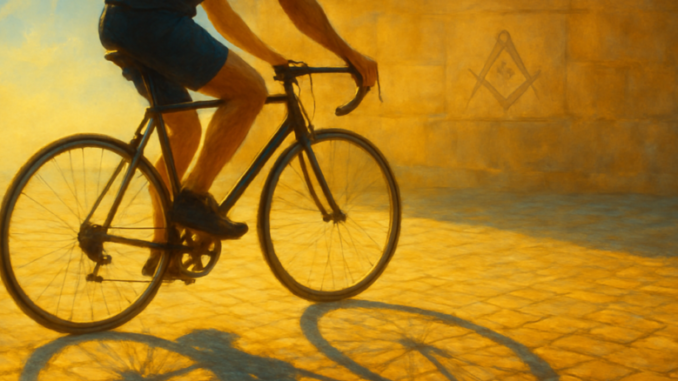
When someone is labeled the favorite, something curious happens: the expectation of victory transforms winning from a possibility into an obligation. Professional cyclist Lorena Wiebes, who recently claimed another dominant stage victory at the Tour, carries that burden with apparent ease. But what does it truly mean to be required to perform simply because others expect it of you? And doesn’t this touch on a deeper ethical question that lies at the very heart of Freemasonry — the relationship between talent, responsibility, and moral duty?
The Paradox of Merit and Expectation
There is a philosophical tension here that seems harmless on the surface but raises fundamental questions upon closer examination. A cyclist who has become the best through years of dedication and innate talent is criticized when she doesn’t win. The logic seems perverse: precisely because she excels, what was once remarkable becomes obligatory. Aristotle might have spoken here about the relationship between aretè — the virtue of excellence — and the social context in which that virtue acquires meaning.
Freemasonry knows a remarkably similar dynamic. Once a man is initiated as a Brother, he accepts an invisible but very real contract — not just with his lodge, but with an ideal of self-improvement that has no endpoint. It is as though the promise of growth automatically creates the expectation of growth. And with that expectation, an ethical dimension emerges: are you responsible for what you can do, or only for what you actually do?
Immanuel Kant and the Duty of Capability
Immanuel Kant, the great Prussian philosopher whose work continues to dominate ethical thinking to this day, would approach this question through his categorical imperative: act only according to a maxim that you could will to become a universal law. Applied to the burden of being the favorite: if everyone with talent decided that performing was optional, talent itself would lose all meaning. Capability creates duty — that would be Kant’s likely conclusion.
Those who receive much bear the responsibility not to leave that gift unused. This applies to talent, to knowledge, and to the opportunity of Brotherhood.
But something doesn’t sit right. Isn’t this duty also a form of enslavement to the expectations of others? The Freemason seeks precisely freedom — freedom of spirit, freedom of thought, freedom to determine his own path. How does that freedom relate to the ethical weight of being expected to excel?
The Counterweight: The Wisdom of Marcus Aurelius
The Stoic emperor Marcus Aurelius offers a surprising counterbalance. In his Meditations, he writes repeatedly about the necessity of detaching from outcomes. Do what is right, strive for excellence, but leave the judgment of the result to the gods — or to fate, or to what we might now call the fortune of the finish line. Wiebes can push her legs, execute her tactics, maximize her focus. But the wind, the crash of a rival, the unexpected mechanical failure — all of that lies beyond her control.
This Stoic attitude resonates deeply with a core principle in Freemasonry: work on yourself, not on your reputation. The rough ashlar is not polished to impress others but to come closer to an inner ideal. The outside world may harbor expectations, but the true measuring stone lies within. This shifts the ethical question entirely: it is not whether you win, but whether you can account for your preparation and effort before your own conscience.
Responsibility Without Chains: A Synthesis
Perhaps the answer lies in a synthesis that would neither fully satisfy Kant nor Marcus Aurelius, but that proves practically workable. Yes, talent creates responsibility. Those who have the gift to inspire others, to lead, or simply to ride faster than anyone else carry a certain moral weight. But that weight is not unlimited. It is bounded by intention and integrity.
Did you give everything you had with the means available to you? Were you honest with yourself and others about your abilities? Did you respect the process, regardless of the outcome? If the answer to these questions is yes, then the ethical duty has been fulfilled — regardless of whether you crossed the finish line first. The Freemason who reflects on his labor at the end of a piece of work does not ask whether he built the most beautiful temple. He asks whether he contributed his best stone.
The Question That Remains
And yet, something continues to gnaw. Had Wiebes lost today, the analysis would not have centered on her effort or her integrity. It would have been about disappointment, about a missed opportunity, about a favorite who failed. The world measures by outcomes, not by intentions. And so the tension persists between the inner ethics of the Brotherhood and the outer ethics of society.
Perhaps this is precisely why Freemasonry so deliberately creates an enclosed space. A lodge is a place where the outcome doesn’t count, where the rank and status of daily life fall away, where only the sincerity of one’s striving remains. There, the favorite can stop being the favorite for a moment. There, everyone is equal in their imperfection and in their desire for improvement.
The question that remains is not easily answered: if we truly believe that inner integrity matters more than outward achievement, why do we still attach so much value to the result? And if we acknowledge that this tendency is deeply human and perhaps unavoidable, how do we prevent it from clouding our judgment of ourselves and others? These are questions with no finish line — and it is precisely in that open-endedness that their true value lies.
Copyright text & image: devrijmetselaar.nl
Texts are based on the ideas and content of the author of devrijmetselaar.nl, reviewed, corrected, and supplemented with the assistance of OpenAI. Images are created based on the ideas of the author of devrijmetselaar.nl using OpenAI/DALL-E.
Frequently Asked Questions
What does Freemasonry teach about using our talents and abilities?
Freemasonry teaches that when a man is initiated as a Brother, he accepts a meaningful commitment to self-improvement and personal excellence that extends throughout his life. The fraternity recognizes that with talent and capability comes an ethical responsibility to develop these gifts, not for external validation, but as part of the noble journey of becoming a better man. This principle transforms individual achievement into a moral and spiritual practice rooted in the ideals of the craft.
How does Freemasonry balance the pursuit of excellence with personal freedom?
Freemasonry seeks to reconcile the ethical duty to excel with the fundamental freedom that is central to the fraternity's values. While Masons are encouraged to strive for excellence and fulfill their potential, the craft also teaches detachment from outcomes and the acceptance of what lies beyond our control. This balance allows Masons to pursue mastery with integrity while maintaining inner peace and spiritual freedom.
Does Freemasonry expect perfection from its members?
No—Freemasonry recognizes that perfection is an ideal, not an expectation. The fraternity emphasizes the journey of continuous self-improvement rather than flawless performance. What matters is the sincere effort to grow, learn, and develop one's character, understanding that the path of the Mason is lifelong and that setbacks are part of the process of becoming a better man.
What is the relationship between personal responsibility and Masonic ethics?
In Freemasonry, personal responsibility is grounded in the principle that those with capability and knowledge have an ethical duty to use these gifts constructively. However, this duty is balanced with wisdom and acceptance—Masons are taught to do what is right and strive for excellence while understanding that outcomes depend on factors beyond their control. This philosophy creates a mature ethical framework based on integrity, effort, and humility.


Be the first to comment