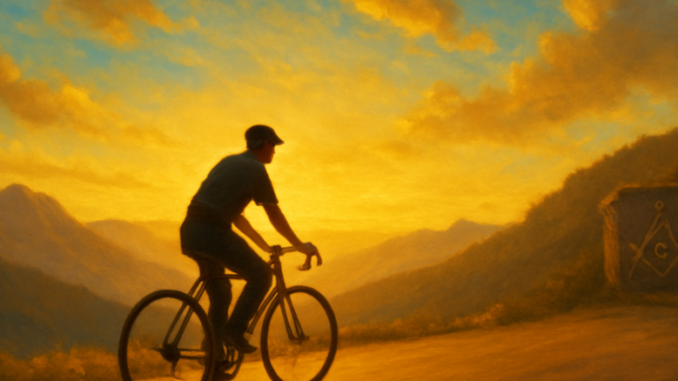
You may have seen the story in passing: Slovakia sent a team masseur to compete at the UCI Road World Championships — not to win, not to execute some grand tactical plan, but simply to be there. At first glance, it seems like little more than a footnote in sporting history. But pause for a moment, and you’ll discover a surprisingly profound lesson about spirituality, Freemasonry, and the transformative value of presence itself.
When Showing Up Matters More Than Winning
The Slovak cycling team harbored no illusions. Their representative at the World Championships wasn’t a professional rider with years of elite training — he was someone who normally works behind the scenes. Yet he got on the bike. Why? Because sometimes, being present is the only victory that counts. In a culture obsessed with performance, medals, and records, this is an almost revolutionary act.
You probably know the feeling: that moment when you show up somewhere knowing full well you won’t excel. A meeting where you have little to contribute, a gathering where others are far ahead of you, a conversation in which you mostly listen. And yet, the very act of showing up is often more valuable than you realize. It’s a statement of commitment — a willingness to be part of something larger than yourself.
The Spiritual Dimension of Presence
Across nearly every spiritual tradition, presence is regarded as a foundational practice. The Stoics — Marcus Aurelius in particular — emphasized the importance of being fully in the moment. In his Meditations, he writes about the art of performing every action as though it were your last. Not out of fear, but out of complete devotion to the present.
This idea resonates deeply within Freemasonry. Entering the lodge is, in itself, a meaningful act. You don’t need to be the most articulate Brother, the most experienced, or the wisest. Your presence alone contributes to the whole. Every stone in a building has its place — including the unassuming stones that don’t form elegant arches but quietly support the foundation.
Showing up is the first step of every spiritual journey. Without presence, no transformation is possible.
What the Ancient Masters Teach Us
Aristotle spoke of hexis — the state of being that arises through repetition. You become what you do. By showing up again and again, by being present in your own life, you slowly shape your character. This is not a passive process. It takes courage to appear when the outcome is uncertain, when failure seems more likely than success.
The Slovak masseur climbing onto his bike at the World Championships is practicing an ancient wisdom, perhaps without even realizing it. His action says: I am here. I am part of this story, even if my name will never appear in the headlines. We find the same attitude in the Zen tradition, where the act of sitting is itself the enlightenment — not some result that comes after it.
Presence in Freemasonry
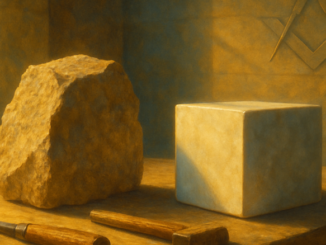
In Freemasonry, we speak of the rough ashlar — the unworked stone that must be shaped and refined. But before you can begin that work, you must first place the stone on the workbench. You must show up. You must be present. The rituals and symbols only gain meaning when there are Brethren who experience them, who bring their full attention to the moment.
This is why regular attendance in the lodge is so valued. It’s not about delivering impressive speeches or demonstrating intellectual prowess. It’s about the willingness to participate in a shared quest. Every Brother who walks through the door enriches the space with his unique perspective, his own life experience, and his quiet presence.
The Courage to Begin Imperfectly
Perhaps you recognize the tendency to wait until you feel ready. Until you know enough, can do enough, are enough. But spiritual growth doesn’t work that way. Johann Wolfgang von Goethe, himself a Freemason, wrote that one must begin in order to become — not the other way around. You don’t first become wise and then act. You act, and in that action, wisdom grows.
The Slovak World Championship participant embodies this truth. He didn’t wait until Slovakia had produced a cycling champion. He got on the bike now, with the skills he had, knowing full well his participation might be dismissed as a mere formality. But formalities carry their own power. They keep traditions alive, they demonstrate commitment, and they say: we are here too.
What This Means for Your Own Path
Where in your life are you still waiting to show up? What spaces do you avoid entering because you feel you’re not enough? The lesson of the masseur at the World Championships — and the deep spiritual tradition it mirrors — is clear: begin. Be present. The transformation will follow.
Presence is not passivity — it is an active choice. Showing up creates possibilities that absence never offers. Imperfect participation is infinitely more valuable than perfect absence. Every journey begins with the first step, not with its completion.
In Freemasonry, it is often said that the journey matters more than the destination. But there is something even more fundamental: the willingness to begin that journey at all. To rise, to lace up your shoes, and to go. Or in this case, to get on your bike — even when you know you’ll finish last.
The story of the Slovak masseur at the Road World Championships is far more than a sporting curiosity. It is a mirror that invites us to reflect on our own willingness to show up, to be present, and to participate in life without any guarantee of success. Within that willingness lies a deep spiritual truth that Freemasons have cherished for centuries: the journey toward self-knowledge and Brotherhood does not begin with knowledge or skill, but simply with the courage to be there.
Copyright text & image: devrijmetselaar.nl
Texts are based on the ideas and content of the author of devrijmetselaar.nl, reviewed, corrected, and supplemented with the assistance of OpenAI. Images are created based on the ideas of the author of devrijmetselaar.nl using OpenAI/DALL-E.


Be the first to comment