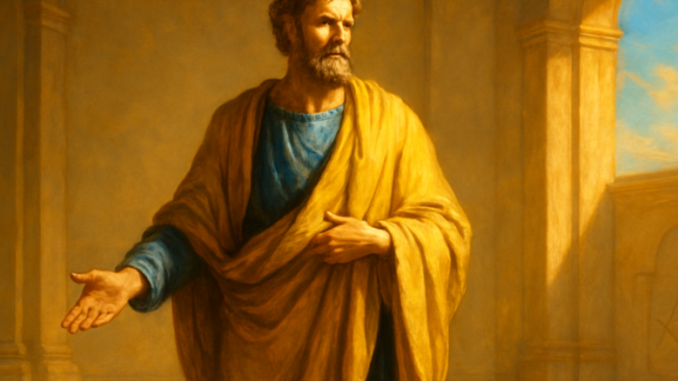
What does it truly mean to be mortal? And how can our mortality liberate us rather than confine us? In Book IX of his Meditations, Marcus Aurelius wrestles with these fundamental questions. As Roman Emperor, he wrote these private reflections not for publication but as an inner compass amid war, disease, and political turmoil. Book IX stands out as a particularly penetrating section in which the Stoic philosopher-emperor approaches death not as an enemy, but as a teacher — a perspective that resonates deeply with the Masonic tradition.
The Core Idea: What Remains When Everything Passes?
The central question running through Book IX is deceptively simple: if everything is transient, what remains of value? Marcus Aurelius answers by arguing that the very recognition of our finitude compels us to make essential choices. He does not see death as a dark endpoint but as a natural transformation within the cosmic order. The emperor reminds himself that countless rulers, philosophers, and ordinary citizens preceded him in death — and that this fact should not paralyze him but spur him toward virtuous action.
This perspective aligns closely with the broader Stoic tradition in which Seneca and Epictetus also wrote. For all of them, death is a neutral event — neither good nor bad in itself. What matters is how we shape our lives in the light of its inevitability.
A Different Kind of Immortality
Unlike many religious traditions, Marcus Aurelius does not seek comfort in personal survival after death. His concept of immortality is of a different order entirely. He speaks of merging with the universal logos — the all-encompassing rationality that pervades the universe. When we die, the elements that compose us return to the whole. This is not a loss but a homecoming.
Death is not an ending but a transformation: what once had form returns to the formless source from which all things arise.
This idea resonates profoundly with Masonic thinking about the cycle of death and rebirth. In the rituals of Freemasonry, symbolic death plays a central role — not as something to fear, but as a necessary passage toward higher consciousness. Just as the rough ashlar must be worked to become a perfect cube, so the old self must die to make room for inner growth.
The Emperor’s Examples: From Conqueror to Dust
Marcus Aurelius frequently invokes historical figures to drive his point home. He mentions Alexander the Great and his stable master, both of whom ended in exactly the same way — dissolved into the same basic elements. It does not matter whether you were a conqueror or a servant; death makes no distinction based on rank or fame. He also references the philosophers who lived before him and who, despite all their wisdom, died just the same. This is not cynicism — it is clarity.
These examples serve a practical purpose. They remind us that attachment to status, possessions, or even intellectual achievement is ultimately futile when we forget that all of it is temporary. The real question then becomes: how do you live today, knowing that tomorrow is uncertain?
Timeless Lessons for the Modern Seeker
The lessons of Book IX are surprisingly relevant today. In an age when we are inundated with distractions and superficialities, Marcus Aurelius offers a powerful counterweight. He invites us not to suppress the thought of death but to embrace it as a motivator. When you realize your time is finite, you become far more selective about where you direct your attention. Gossip, jealousy, and petty conflicts lose their grip.
Several key principles emerge from the text. Death is a natural process, not a punishment or injustice. Immortality lies not in personal survival but in returning to the greater whole. Status and possessions are temporary; virtue and character are what endure. And awareness of mortality frees us from small-mindedness.
The Masonic Connection: Memento Mori and the Master’s Ritual
Freemasonry has a rich tradition of reflecting on death. The symbol of the skull and crossbones is not intended to be macabre — it functions as a memento mori, a reminder of mortality that urges us toward an honest and upright life. In the Master Mason degree, the candidate undergoes a symbolic death and resurrection, directly analogous to the transformation Marcus Aurelius describes.
This parallel is no coincidence. Both Stoic philosophy and the Masonic tradition draw from the same wellspring of ancient wisdom. Plato’s teachings on the immortal soul, the Mysteries of Eleusis, and the legend of Hiram Abiff — they all circle around the same theme: that death is a gateway, not a wall.
Marcus Aurelius would likely have recognized something familiar in the Masonic lodge. Not because of the rituals themselves, but because of the underlying intention: to shape better human beings by confronting them with the fundamental questions of existence. Who am I? What do I leave behind? How do I live in accordance with my highest values?
Book IX of the Meditations is far from a gloomy treatise on the end of life. It is a liberating invitation to be fully present in the here and now. Marcus Aurelius teaches us that death only casts its shadow when we refuse to face it. By acknowledging our mortality, we gain vitality and purpose. This lesson, written by an emperor nearly two thousand years ago, remains as relevant as ever for anyone seeking meaning, inner peace, and the kind of self-knowledge that both Stoicism and Freemasonry hold as the highest pursuit.
Copyright text & image: devrijmetselaar.nl
Texts are based on the ideas and content of the author of devrijmetselaar.nl, reviewed, corrected, and supplemented with the assistance of OpenAI. Images are created based on the ideas of the author of devrijmetselaar.nl using OpenAI/DALL-E.

Be the first to comment